In the villages and mining communities of Ituri province in eastern Democratic Republic of Congo, the arrival of a rare Ebola strain has brought back a familiar public health threat under unfamiliar conditions: a virus spreading in places where distance, insecurity and limited medical access can determine who receives care in time.
The outbreak began drawing attention in May 2026 after health authorities identified Bundibugyo virus disease, a species of Ebola, in laboratory samples from Ituri. Unlike some other Ebola outbreaks, this strain has no licensed vaccine or specific approved treatment, leaving health workers to rely on early detection, infection prevention, supportive care and community cooperation.
For communities scattered across Ituri, the response has unfolded in an environment shaped by years of conflict, displacement and population movement. Health officials and the World Health Organization have warned that insecurity, difficult transport routes and highly mobile populations have complicated efforts to trace contacts and contain transmission.
The outbreak’s centre has been in Ituri, where early cases were reported in health zones including Mongbwalu, Rwampara and Bunia. By mid-June, WHO reported that the province accounted for the overwhelming majority of confirmed cases in the country, with transmission recorded across multiple health zones.
In Mongbwalu, a gold-mining area in Ituri, the movement of workers, traders and families has created a challenge for health teams trying to identify people who may have been exposed. The town and surrounding communities sit within a region where economic activity depends on constant movement, making traditional outbreak-control measures harder to apply. WHO has identified population mobility and trade links as factors increasing the difficulty of controlling the outbreak.
For families living through the outbreak, Ebola has brought back memories of previous epidemics in eastern Congo while creating new fears because the current strain has fewer medical tools available. The Bundibugyo virus was first identified in Uganda in 2007 and has caused previous outbreaks with significant fatality rates, according to WHO. In the current outbreak, authorities have emphasized that supportive medical care remains essential even without a licensed vaccine or specific therapy for this strain.
Health workers have faced risks alongside the communities they serve. WHO reported infections among health and care workers during the early stages of the outbreak, highlighting the vulnerability of medical staff during Ebola responses.
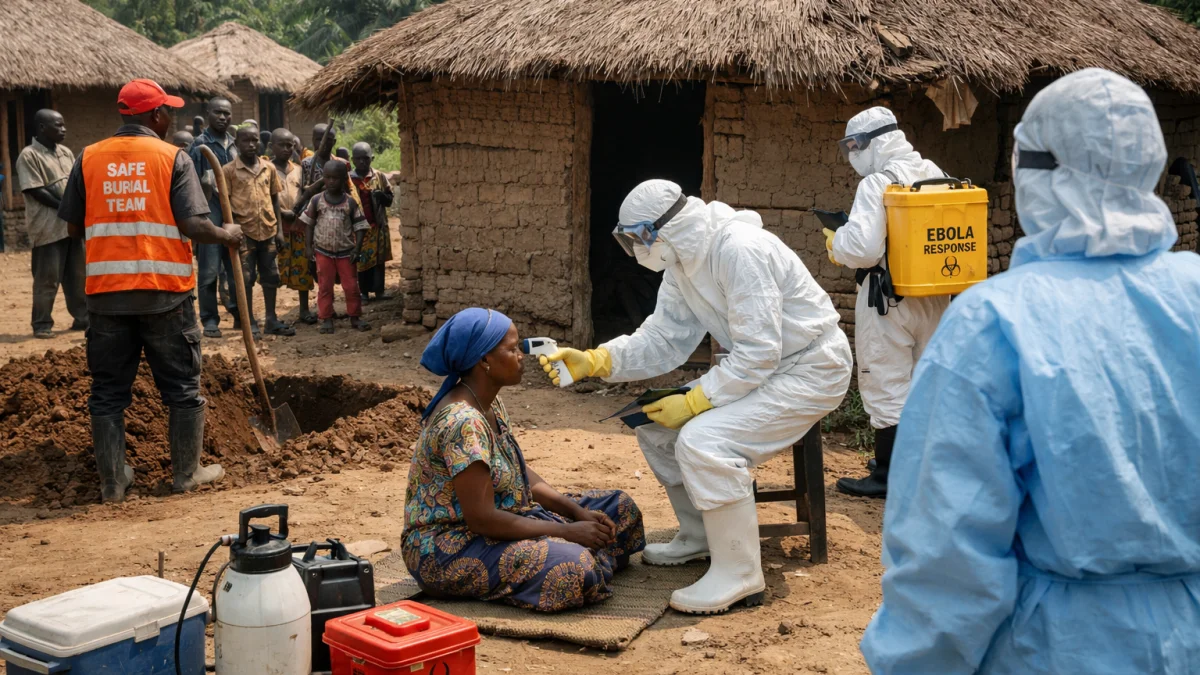
The challenges are not only medical. Ebola response depends heavily on trust. Contact tracing, isolation, safe burials and early treatment require cooperation from communities that have experienced years of instability and, in some cases, disruption of basic services. WHO has said community engagement is central to bringing the outbreak under control.
The government of the Democratic Republic of Congo, working with international partners including WHO, has expanded surveillance, laboratory testing, treatment capacity and community outreach. The measures are designed to find cases earlier and reduce transmission, but officials have acknowledged that the scale and speed of the outbreak have placed pressure on response systems.
By late June, Congo had reported more than 1,200 confirmed Ebola cases and hundreds of deaths during the outbreak, according to government data cited by Reuters. The numbers reflect a national emergency, but behind them are villages and neighbourhoods where families have had to adjust daily routines around a disease that can spread through contact with infected bodily fluids and contaminated materials.
The outbreak has also attracted international concern. WHO declared the Bundibugyo Ebola outbreak in Congo and Uganda a public health emergency of international concern in May 2026, as cases expanded and health authorities worked to prevent further spread.
Yet in Ituri, the response remains focused on practical steps: finding people who may have been exposed, caring for those who become sick and explaining how the virus spreads. Without a specific treatment or widely available vaccine for this strain, the tools are familiar ones from past Ebola outbreaks: speed, medical support and cooperation between health workers and communities.
The outbreak’s course will depend not only on laboratory results and treatment centres, but also on whether response teams can reach the communities where Ebola is appearing — and whether those communities trust them enough to open the door.