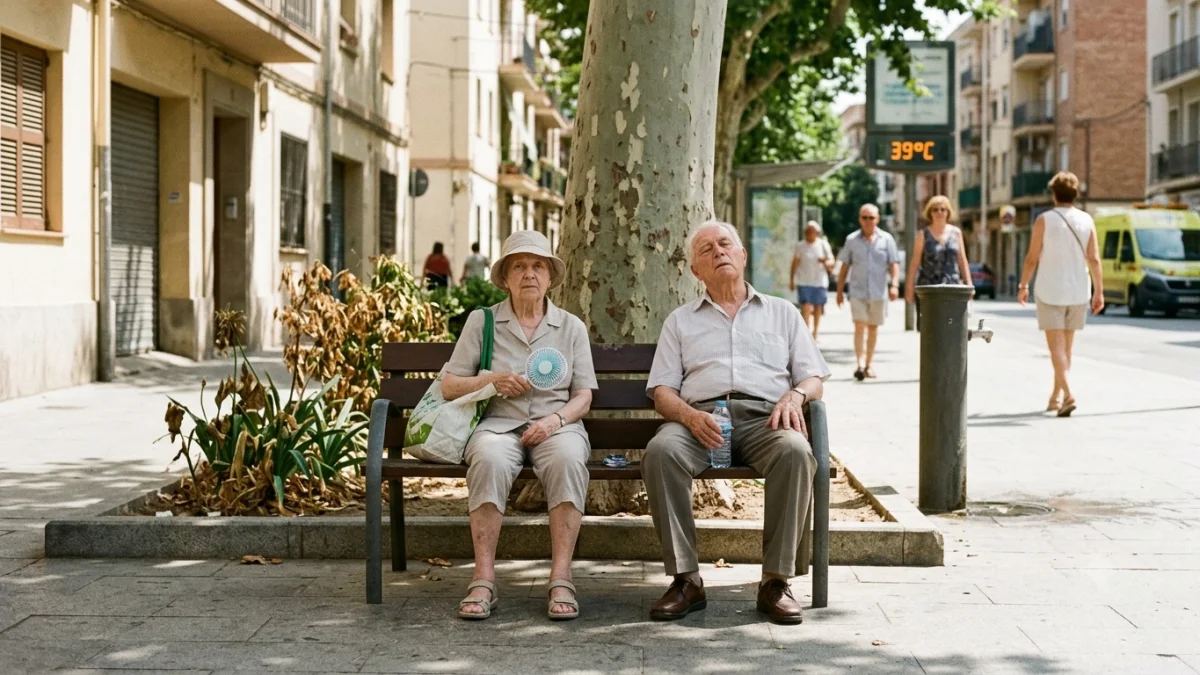
The water mist drifting across a public square in Paris offered brief relief as people paused beneath it, shielding their faces from temperatures that climbed well above seasonal norms. Similar scenes unfolded across western Europe in late June, where cooling stations, shaded parks and air-conditioned public buildings became refuges during what officials described as one of the most intense heatwaves the continent has experienced.
For many older Europeans, however, relief came too late.
Official mortality data released in July showed that more than 10,000 excess deaths were recorded across Europe during the late-June heatwave, with more than 9,000 of those deaths occurring among people aged 65 and older. The figures, compiled by EuroMOMO, a mortality monitoring network supported by the European Centre for Disease Prevention and Control and the World Health Organization, offered one of the clearest indications yet of how extreme heat continues to exact its heaviest toll on older populations.
The numbers transformed a weather event into a public health story measured not only in temperature records but also in lives quietly lost behind apartment doors, in hospitals and care homes, and in communities where aging populations face increasing exposure to hotter summers.
Extreme heat rarely appears as the sole cause on a death certificate. Instead, it worsens existing cardiovascular and respiratory illnesses, increases the risk of dehydration and heat stroke, and places additional strain on people whose bodies are less able to regulate temperature.
"To have this kind of excess at this time of year is unusual. It's really high," Lasse Vestergaard, chief physician at Denmark's Statens Serum Institut, which hosts EuroMOMO, told Reuters after the figures were published. He added that it was difficult to explain the unusually high mortality by anything other than the extreme heat.
The heatwave swept across France, Spain, Belgium, Britain, the Netherlands and other parts of western Europe during the final weeks of June. Temperatures surpassed 40 degrees Celsius in several areas, disrupting transport networks, reducing power generation, forcing school closures and increasing pressure on emergency services. Scientists said the event would have been virtually impossible without human-caused climate change, which has made heatwaves more frequent and more intense.
For health authorities, the mortality figures reinforced a pattern observed repeatedly during recent European summers: older adults remain disproportionately vulnerable even as governments expand heat warning systems.
Earlier national estimates had already pointed to a rising death toll. France reported more than 2,000 excess deaths linked to the heatwave, while Belgium recorded its highest heatwave-related mortality since records began in 2000. Dutch authorities estimated about 480 excess deaths during the hottest week, most among people aged 80 and older. Those national assessments later became part of the broader European picture reflected in the EuroMOMO data.
The burden extended beyond continental Europe. A separate study by researchers from Imperial College London, the UK Met Office and the London School of Hygiene & Tropical Medicine estimated that approximately 2,700 people died from heat-related causes in England and Wales during the May and June heatwaves. Researchers concluded that roughly 42% of those deaths were attributable to the additional heat associated with global warming.
Public health specialists note that heat-related mortality is often underestimated because the immediate medical cause may be recorded as heart failure, respiratory disease or kidney complications rather than heat itself. Excess mortality analysis compares observed deaths with the number normally expected, providing a broader picture of the health consequences during periods of extreme weather.
The findings also underscore demographic realities confronting Europe. It is among the world's oldest regions, with millions of residents living alone or managing chronic illnesses that heighten sensitivity to prolonged heat. Urban neighborhoods, where concrete and asphalt retain warmth overnight, can leave vulnerable residents exposed even after sunset.
Governments across Europe activated emergency measures as temperatures climbed. Municipal authorities opened cooling centers, extended operating hours for public facilities, issued health alerts and urged neighbors to check on elderly residents. Hospitals prepared for additional admissions linked to dehydration, heat exhaustion and worsening chronic illnesses.
Even with those precautions, officials acknowledged that preventing every heat-related death remains difficult when temperatures remain exceptionally high for days.
Scientists say the challenge is likely to grow. Climate research consistently projects that Europe will experience more frequent and longer-lasting heatwaves as global temperatures continue to rise. Public health planning increasingly focuses on improving early warning systems, expanding access to cooling spaces, adapting housing for hotter conditions and strengthening outreach to older people living independently.
Those longer-term adaptations are becoming part of routine summer planning rather than emergency responses.
The EuroMOMO figures illustrate how rapidly mortality can increase during extreme heat. Before the late-June event, mortality across participating countries had been running below seasonal expectations. During the week when the heatwave peaked, excess deaths rose sharply, leaving researchers with little evidence that another widespread health event could explain the increase.
As Europe enters another summer shaped by rising temperatures, the late-June heatwave stands as a reminder that the greatest impact of extreme weather is often measured quietly. The highest temperatures may last only days, but official mortality records show that for thousands of older Europeans, the consequences endured long after the forecasts changed.