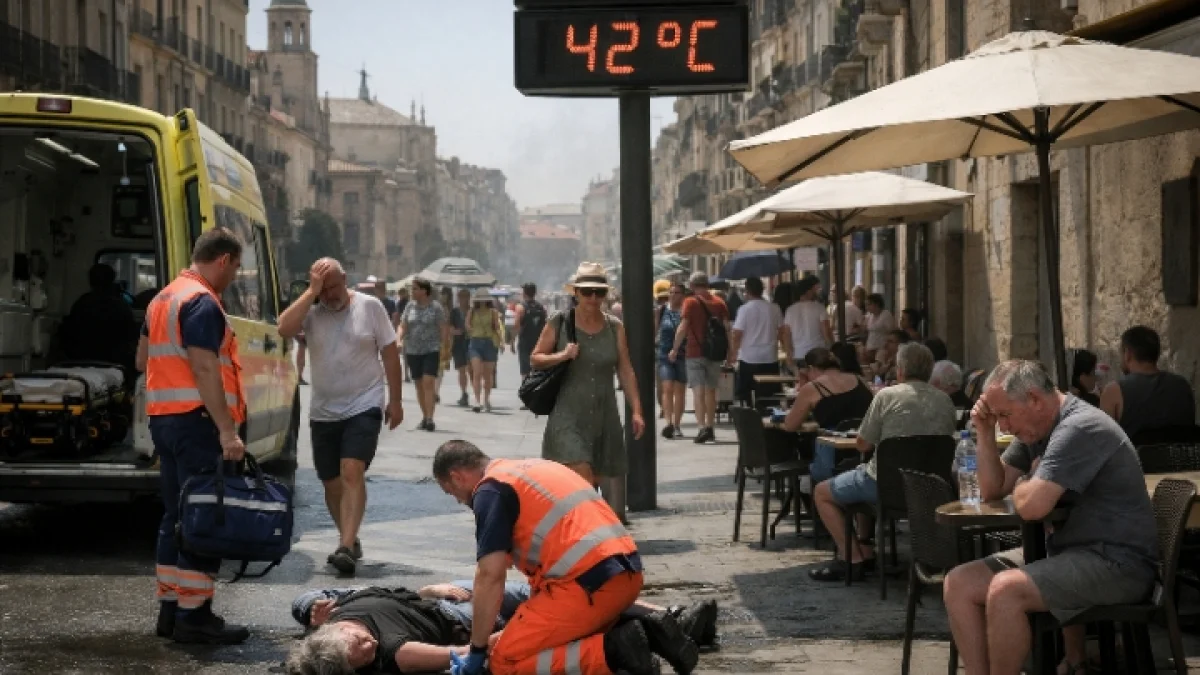
Excess mortality estimates from European public health authorities indicate that the prolonged heat wave that swept across much of the continent in late June has become one of the deadliest heat events in recent decades, reinforcing concerns that extreme heat is emerging as a persistent public health threat rather than an episodic weather emergency. Updated official data released in France this week substantially increased the estimated toll, while Europe-wide monitoring continues to show unusually elevated mortality across multiple countries.
The latest figures are significant because they shift the discussion beyond isolated temperature records toward measurable impacts on population health. Excess mortality compares the total number of deaths during a period with the number expected under normal conditions, capturing both direct heat-related deaths and fatalities in which extreme temperatures aggravated underlying cardiovascular, respiratory or other medical conditions. Public health experts regard the measure as one of the most reliable indicators of the true health burden of heat events because many deaths linked to extreme temperatures are not recorded as heat-related on death certificates.
France's public health agency estimated at least 5,764 excess deaths between June 17 and July 2, an increase of more than one-third above expected mortality during the period. The agency described the event as the country's deadliest heat episode since the catastrophic summer of 2003, although mortality remained below the level recorded during that crisis. Nearly the entire mainland population experienced the heat wave as exceptionally high temperatures arrived unusually early in the summer, while schools and workplaces remained fully operational. Officials stressed that the estimates remain preliminary pending more comprehensive seasonal analysis later this year.
The broader European picture suggests the impact extended well beyond France. EuroMOMO, the European mortality monitoring network supported by the European Centre for Disease Prevention and Control and the World Health Organization, reported more than 10,000 excess deaths during the peak week of the late-June heat wave across participating countries. More than 9,000 of those deaths occurred among people aged 65 and older, highlighting the disproportionate vulnerability of elderly populations even in countries with established heat warning systems.
The concentration of deaths among older adults is consistent with decades of epidemiological research. Extreme heat can overwhelm the body's ability to regulate temperature and can worsen chronic heart, lung and kidney diseases. Frailty, social isolation, limited mobility and inadequate cooling further increase risk. However, French authorities noted that elevated mortality extended beyond the oldest age groups, indicating that prolonged exposure affected a wider share of the population than is often observed during shorter heat events.
Another notable feature of the 2026 episode is its timing. Major European heat waves have traditionally peaked later in the summer, but this event developed in June and affected nearly the entire French mainland simultaneously. Health authorities said the combination of early-season timing, geographic extent and sustained intensity likely increased exposure because schools, workplaces and public services were operating normally rather than under traditional summer schedules.
Scientists also continue to distinguish between meteorological records and attribution science. The World Weather Attribution research group concluded that the late-June heat wave would have been virtually impossible without human-caused climate change. While attribution studies do not assign responsibility for individual deaths, they assess how climate change alters the likelihood and intensity of extreme weather events. Those findings increasingly influence public health planning because they suggest similar events are becoming more probable rather than exceptional.
The latest mortality estimates also highlight the growing importance of excess-death surveillance as a public health tool. Unlike immediate counts of heatstroke fatalities, excess mortality captures indirect impacts that accumulate over days or weeks. Public health agencies therefore caution that final assessments often increase as more complete mortality data become available and statistical reviews are completed. This reporting delay explains why official estimates have risen substantially since initial assessments released during the heat wave itself.
Governments across Europe have expanded heat alert systems, public cooling guidance and health surveillance since the devastating 2003 European heat wave, which prompted major reforms in emergency preparedness. The 2026 experience nevertheless suggests that adaptation measures are facing increasing pressure as more frequent, earlier and longer-lasting heat events expose larger populations. Parallel outbreaks of major wildfires across southern Europe have further complicated emergency responses by degrading air quality and placing additional demands on health and civil protection services.
Public health authorities continue to emphasize that excess mortality figures should not be interpreted as final counts of deaths directly caused by heat. Instead, they represent statistical estimates of deaths above expected seasonal levels, with detailed attribution requiring further epidemiological analysis. Officials across Europe are continuing to monitor mortality trends, evaluate the effectiveness of heat response measures and assess whether additional public health adaptations are needed as the summer progresses.