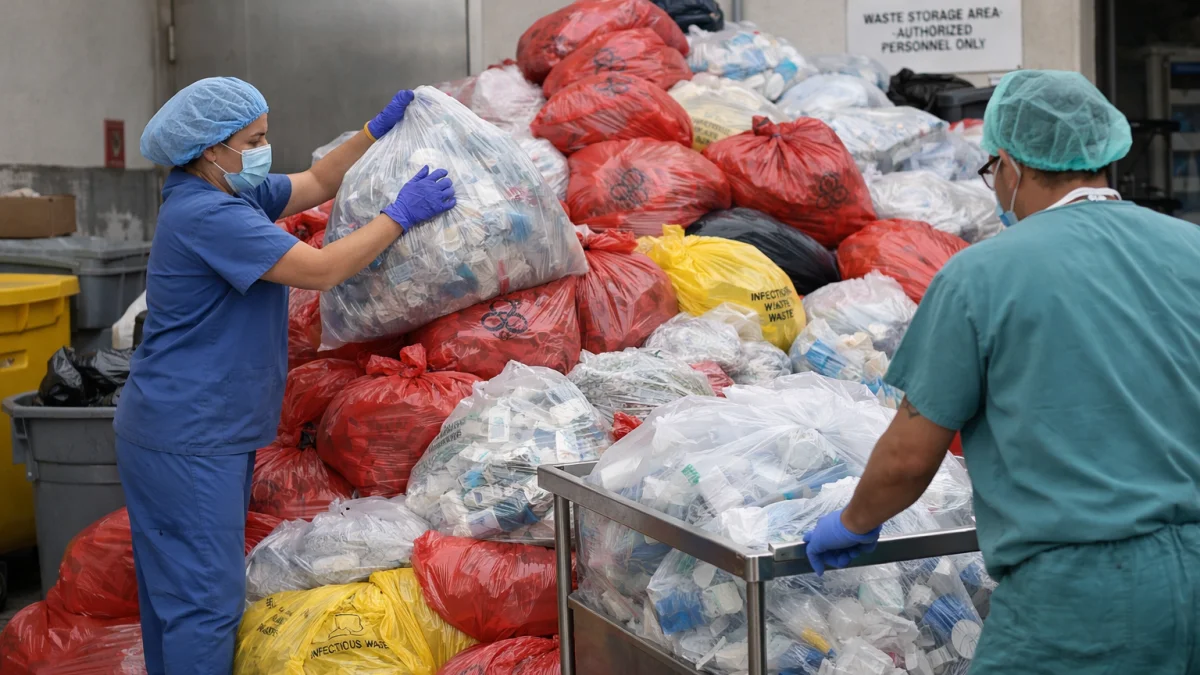
Every shift begins with the same ritual in hospitals around the world. Nurses pull on gloves, open sterile packages, prepare syringes, hang intravenous lines and dispose of wrappers before a patient has even received treatment. Housekeeping staff move through corridors collecting bags marked for infectious waste, while environmental services workers sort containers that must be handled under strict safety rules.
The stream of discarded materials rarely slows. It is one of the least visible but most constant by-products of modern health care: the accumulation of medical waste generated as hospitals work to protect patients and staff from infection.
For many hospital workers, managing that waste has become an essential part of patient care rather than a task that begins after treatment ends. Every used needle, blood-stained dressing, laboratory sample container and disposable protective gown follows a carefully regulated path intended to prevent injuries, disease transmission and environmental contamination.
The challenge extends far beyond individual hospitals. According to the World Health Organization (WHO), about 85% of waste produced by health-care activities is comparable to domestic waste, while the remaining 15% is considered hazardous because it may be infectious, toxic, radioactive or otherwise dangerous. Safe separation is crucial because mixing ordinary and hazardous waste increases disposal costs and health risks.
Those statistics translate into daily decisions made by thousands of workers who rarely appear in discussions about health care. Nurses determine which bin receives each item after treating a patient. Laboratory technicians handle contaminated materials under strict protocols. Environmental services teams transport sealed containers through hospitals before licensed contractors remove them for treatment or destruction.
The work intensified during the COVID-19 pandemic, when the use of disposable masks, gowns, gloves and testing materials expanded dramatically. WHO said the surge exposed weaknesses in waste-management systems worldwide, particularly in countries where many health facilities already lacked adequate services for handling medical waste safely.
Even after the emergency phase of the pandemic ended, many of the infection-control practices that increased waste volumes remained embedded in hospital operations.
Hospital staff often describe the tension between maintaining rigorous infection prevention and witnessing the sheer volume of discarded materials. In a WHO feature describing daily clinical practice, a respiratory physiologist in the United Kingdom recounted using multiple sets of personal protective equipment during a routine day, with each mask, visor and apron arriving in separate plastic packaging. While emphasizing the necessity of protective equipment, the clinician questioned whether so much packaging remained unavoidable.
Those concerns are echoed across health systems that increasingly face pressure to reduce their environmental footprint without compromising patient safety.
WHO warns that unsafe disposal can expose waste handlers, health workers and surrounding communities to needle-stick injuries, infectious materials and hazardous chemicals. Open burning or poorly managed incineration may also release harmful pollutants, while improperly managed landfills risk contaminating groundwater and surface water.
The burden is especially heavy where waste-management infrastructure has not kept pace with expanding health services. WHO and UNICEF data cited by the agency show that only 61% of hospitals worldwide had basic health-care waste services in 2021, with substantially lower coverage in fragile settings.
For environmental health officers inside hospitals, that reality has encouraged closer attention to waste segregation before materials ever leave a ward. Correctly separating hazardous from non-hazardous waste reduces both risks and treatment costs, since specialized disposal methods such as autoclaving or high-temperature incineration are reserved for dangerous materials.
Some hospitals have begun redesigning internal systems to reduce unnecessary waste while preserving infection-control standards. In Indonesia, WHO highlighted efforts at Dr. Sardjito Hospital in Yogyakarta, where environmental health staff oversee collection, disinfection, shredding and recycling programmes alongside external partners. The hospital reported measurable recycling of portions of both medical and domestic waste while maintaining regulated handling procedures.
Technology is also beginning to play a larger role. Researchers have developed computer-vision systems capable of assisting staff with identifying categories of medical waste, while logistics specialists are studying more efficient collection and treatment networks. Although many of these projects remain in development, they reflect growing recognition that waste management has become a strategic part of hospital operations rather than simply a disposal service.
Experts caution, however, that technological solutions cannot replace careful day-to-day practice. Safe management depends on training, adequate supplies, reliable collection systems and sustained investment, particularly in lower-resource settings.
WHO recommends prioritizing waste reduction through measures such as green procurement, minimizing unnecessary packaging where feasible, increasing safe reuse when appropriate, improving recycling of non-hazardous materials and strengthening systems for segregating hazardous waste from general refuse. The organization says these steps can reduce both environmental impacts and occupational risks while supporting safer health-care delivery.
Back inside hospital corridors, the cycle repeats with every patient admitted, every laboratory test performed and every procedure completed. Clinical care generates waste almost as inevitably as it generates healing.
For the workers who tie, lift, label and transport countless bags each day, the task remains largely invisible to patients. Yet their work helps ensure that the materials left behind after treatment do not become the source of another public health threat. In hospitals where lives are saved around the clock, managing what must be thrown away has become as indispensable as the care itself.