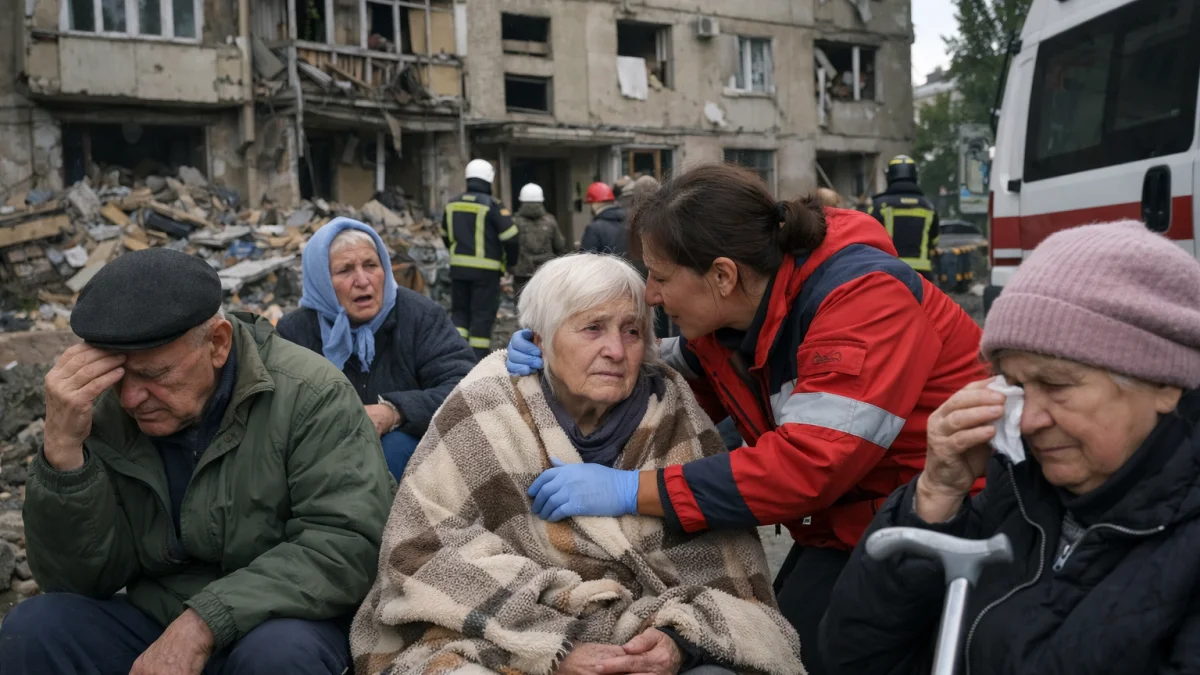
The blast shattered the quiet before dawn, sending rescue workers into another race against collapsing concrete and drifting smoke. Outside a heavily damaged apartment block in Kyiv, elderly residents stood among broken glass and scattered belongings, watching emergency crews search for survivors after one of the deadliest attacks on the Ukrainian capital this year.
For many older Ukrainians, the destruction carried a familiar weight. Years after Russia's full-scale invasion began, each overnight barrage revives memories of previous attacks while adding new layers of fear, loss and uncertainty to lives already shaped by prolonged war.
The latest assault, carried out with hundreds of drones and dozens of missiles, killed at least 25 people and injured more than 90, according to Ukrainian authorities. Around 130 buildings were damaged across the capital, including apartment blocks and medical facilities. Kyiv declared a day of mourning as rescue teams continued searching through the rubble for those still missing. Russia said the strikes were retaliation for Ukrainian attacks on Russian fuel infrastructure, while Ukraine said residential neighborhoods bore much of the damage.
For older residents, leaving home is often difficult even when air raid sirens sound. Some rely on walking aids, others hesitate to descend multiple flights of stairs to underground shelters, and many have lived in the same apartments for decades. The destruction of familiar buildings represents not only material loss but the disappearance of places that anchored daily life.
The psychological burden has accumulated over more than four years of full-scale war. Repeated nights interrupted by explosions, uncertainty over where the next strike will land and the constant need to monitor air raid alerts have created persistent stress for civilians across Ukraine. Elderly people, who may have limited mobility, chronic health conditions or fewer opportunities to relocate, often face additional challenges in coping with the conflict.
As daylight revealed the scale of the latest attack, emergency responders continued pulling victims from damaged residential buildings. Reuters footage showed firefighters working through the remains of a nine-storey apartment block that had partially collapsed after a direct strike.
Volunteer rescuers from the Ukrainian Red Cross joined official emergency services at multiple locations across the city. Among them was Max, a graphic designer who helps search for survivors before returning to his regular job. He is one of roughly 700 trained volunteers supporting rescue operations in Kyiv.
The volunteers assess injuries, help evacuate residents and provide immediate assistance while professional rescue teams work to stabilize damaged structures. Their work has become an increasingly familiar part of life in the Ukrainian capital as repeated attacks strain emergency services.
Taras Didenko, deputy commander of the volunteer unit, said teams often reach impact sites quickly despite the dangers that remain after missiles and drones have struck. Another volunteer, 21-year-old Anet, described the unpredictable nature of entering heavily damaged buildings while rescue operations continue.
For elderly survivors, the assistance frequently extends beyond emergency medical care. Volunteers and neighbors help retrieve medications, locate personal documents and arrange temporary shelter after homes become uninhabitable.
The latest strike also underscored how prolonged conflict has transformed ordinary routines. Thousands of Kyiv residents again sought refuge in underground metro stations as explosions echoed across the city overnight. While younger families may be able to move quickly, older residents often require additional help reaching shelters before incoming missiles arrive.
President Volodymyr Zelenskiy said the attack highlighted Ukraine's continuing need for additional air defence systems from its international partners. Ukrainian officials have argued that stronger air defences remain essential to reducing civilian casualties during increasingly large aerial assaults.
International leaders, including United Nations Secretary-General António Guterres and European officials, condemned the attack. Kyiv observed a day of mourning as flags flew at half-mast and rescue operations continued.
Mental health specialists have repeatedly warned that repeated exposure to bombardment can have lasting psychological effects, particularly among older adults who may already face isolation, declining health or limited access to support services. Humanitarian organizations working in Ukraine have expanded psychological assistance alongside emergency relief, though demand continues to outpace available resources in many areas.
The war has forced many younger Ukrainians to relocate, leaving some elderly residents living alone in neighborhoods that have endured repeated attacks. Community volunteers increasingly fill gaps by checking on vulnerable neighbors, delivering supplies and helping those unable to evacuate independently during emergencies.
Yet many older Kyiv residents remain determined to stay despite the risks. Their apartments hold decades of memories, family photographs and personal histories that cannot easily be replaced elsewhere.
As rescue workers continued clearing debris from shattered buildings, investigators searched for further victims beneath collapsed concrete while residents gathered what belongings they could salvage.
For Kyiv's elderly, the latest assault added another chapter to years marked by interrupted sleep, damaged homes and recurring uncertainty. Even as crews removed rubble and volunteers assisted survivors, the city's air raid alert system remained part of everyday life—a reminder that recovery often begins before the danger has fully passed.