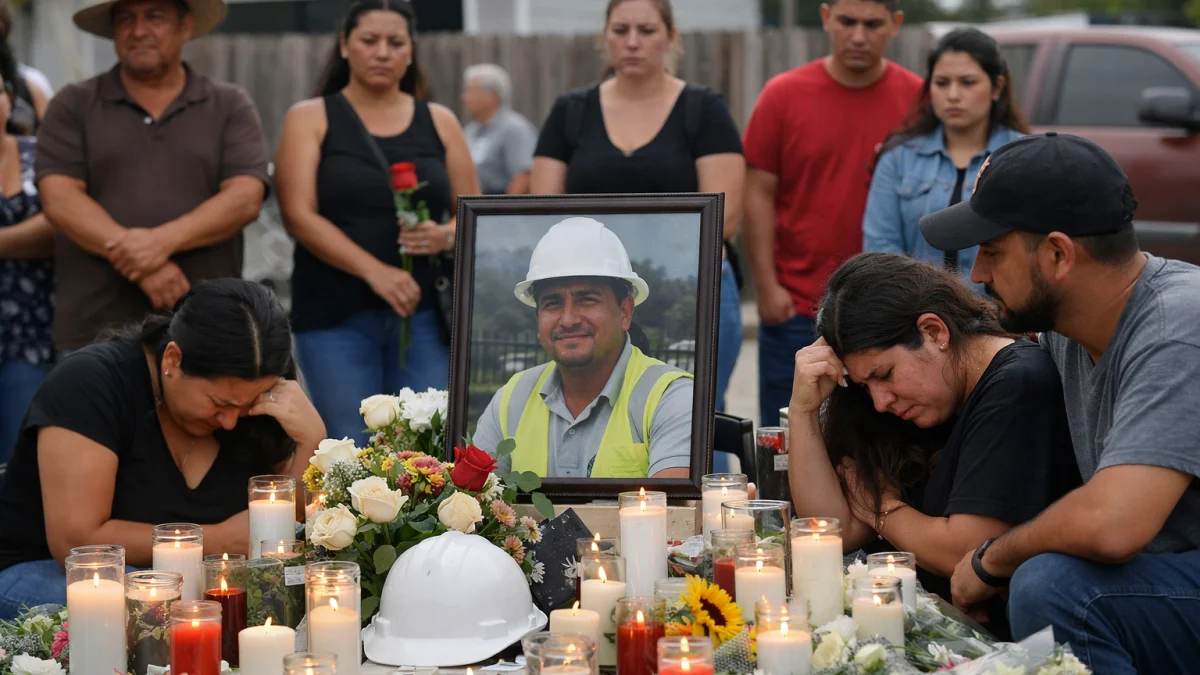
Flowers, candles and handwritten messages continued to gather along Canal Street in Houston's East End days after construction worker Lorenzo Salgado Araujo was fatally shot by a U.S. Immigration and Customs Enforcement officer. The memorial grew in a neighborhood where many residents have long known Salgado as a builder who left home each morning for construction jobs and, according to his family, was driving to collect members of his work crew when the encounter with federal agents turned deadly.
The memorial has become more than a place of mourning. It reflects the uncertainty that has spread through one of Houston's oldest Latino communities as immigration enforcement intensifies across the United States. Salgado's death has prompted demonstrations, calls for an independent investigation and renewed questions about the use of force during immigration operations, while underscoring the risks faced by families whose daily routines now unfold against a backdrop of expanded federal enforcement.
According to ICE, officers attempted to stop Salgado's vehicle during what the agency described as a targeted enforcement operation. ICE said Salgado rammed an agency vehicle, ignored repeated verbal commands and attempted to run over an officer, who then fired in self-defense. Reuters has reported that it could not independently verify the circumstances surrounding the shooting, and no publicly available video has confirmed ICE's account of the moments leading to the fatal gunfire.
For Salgado's family, the public account differs sharply from the man they say they knew. His son, Ronaldo Salgado, described his father during a Houston news conference as a peaceful construction worker who had spent roughly 35 years in the United States supporting his family. He said his father had been working toward legal immigration status and was close to obtaining it.
"He dedicated his life in the United States to giving his family the American dream," Ronaldo Salgado said. He also called for "a full investigation" into the shooting. Recounting how he learned of his father's death, he said he recognized him in a video circulating on social media "not from his appearance, but from his voice, crying for help as he lay on the street, bleeding out."
Family members say Salgado was driving to pick up his construction crew before heading to a homebuilding site in north Houston. That routine, familiar to many contractors and day laborers across the city, has become central to how neighbors remember him—not through the circumstances of his death, but through years spent earning a living in Houston's construction industry.
Magnolia Park, often called Houston's "Little Mexico," has long served as a gateway neighborhood for Mexican families seeking work and community. Local historians trace its development to the late nineteenth century, with successive generations helping build the nearby industrial corridor and the city's expanding neighborhoods. Residents interviewed by Reuters said the shooting has shaken that sense of stability, leaving many worried that ordinary activities such as driving to work now carry new risks.
The response extended well beyond the immediate neighborhood. More than 1,000 demonstrators marched through Houston's East End, carrying Mexican flags and signs calling for justice and transparency. The gathering remained peaceful as protesters demanded an independent investigation rather than relying solely on internal federal reviews. By evening, many participants returned to the shooting site for a candlelight vigil.
Among those urging additional scrutiny were Houston Mayor John Whitmire, Representative Sylvia Garcia and Latino civil rights organizations. Garcia called for independent investigations and greater transparency surrounding immigration enforcement operations. Roman Palomares, president of the League of United Latin American Citizens, criticized the handling of the case and urged authorities to release evidence surrounding the shooting.
ICE has said its parent agency, the Department of Homeland Security, is investigating the shooting, while the FBI is examining the alleged assault on a federal officer that ICE says preceded the gunfire. City officials have said they support a transparent investigation while acknowledging that federal authorities are leading the inquiries.
The case has also drawn attention beyond Texas. Mexican President Claudia Sheinbaum said her government was preparing legal measures following what she described as another death of a Mexican national whose only fault, she said, was lacking legal immigration documents. The incident comes amid a broader increase in immigration arrests under the Trump administration's expanded deportation campaign, which Reuters reported has accelerated in recent weeks. According to Reuters, Salgado's death is at least the sixth fatal shooting connected to immigration enforcement operations since January 2025.
Even as official investigations continue, the makeshift memorial on Canal Street remains a focal point for neighbors who stop to leave flowers or pause in silence. It stands as a reminder that beyond the legal and political debates surrounding immigration enforcement lies the loss of a construction worker whose final journey began as another drive to a Houston worksite, and whose death has left a community waiting for answers that investigators have yet to provide.