For decades, the advice from neuroscientists has been remarkably consistent: humans do not truly multitask. What feels like doing two demanding things at once is usually the brain switching attention back and forth so quickly that the transitions become difficult to notice.
A new study is challenging part of that long-held view—not by claiming people are naturally good at multitasking, but by showing how the brain can change after extensive practice.
Researchers at Georgetown University School of Medicine report that the brain appears to reorganize itself as a skill becomes deeply learned, allowing certain tasks to bypass the prefrontal cortex—the region associated with planning, reasoning and conscious decision-making—and instead rely on specialized neural circuits. The findings, published in the Journal of Cognitive Neuroscience, suggest that some well-practiced activities can eventually run alongside other mental tasks in a way researchers describe as genuine multitasking.
The work offers a glimpse into one of the most familiar yet least understood features of everyday life: why activities that once demanded complete concentration can eventually become almost automatic.
Learning to drive provides one example frequently cited by neuroscientists. Early lessons require deliberate attention to mirrors, pedals, steering and traffic. Years later, experienced drivers may safely hold a conversation or listen to a podcast while navigating familiar roads, though researchers stress that distractions requiring visual attention—such as texting while driving—remain dangerous because they compete for the same sensory resources.
"The question is: how does your brain do that?" senior author Maximilian Riesenhuber, a professor of neuroscience at Georgetown University School of Medicine and co-director of the university's Center for Neuroengineering, said in describing the motivation behind the research.
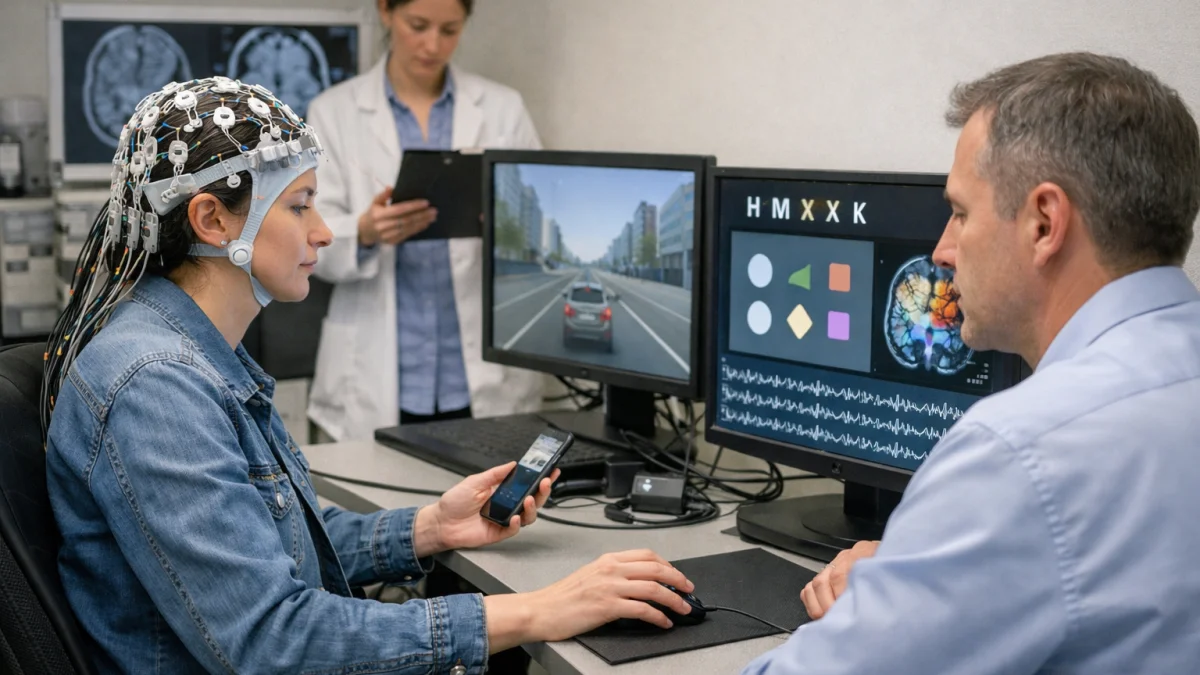
To investigate, researchers recruited volunteers between 18 and 29 years old and asked them to learn a demanding visual categorization task. Participants sorted computer-generated images of cars into two categories by identifying subtle differences between them. Over five to ten weeks, they completed more than 30,000 sorting trials using a smartphone application designed as a game. Before and after the training period, scientists measured brain activity using functional magnetic resonance imaging (fMRI) and electroencephalography (EEG).
The brain scans revealed a clear shift.
During the early stages of learning, participants relied heavily on the prefrontal cortex, a region widely viewed as a cognitive bottleneck because it typically manages only one demanding task at a time. After weeks of intensive practice, however, researchers found that information related to the learned task could instead travel through newly established pathways involving the temporal cortex before reaching areas responsible for producing responses.
According to the researchers, that change effectively frees the prefrontal cortex to focus on other activities.
"What we show is that the circuitry actually changes so the brain can do two things at once," Riesenhuber said. "This really is true multitasking."
The study also found that participants whose brains showed greater evidence of shifting the practiced task away from the prefrontal cortex performed better when asked to complete a second task simultaneously. That relationship strengthened the researchers' argument that the observed changes reflected more than faster task switching.
Even so, the findings come with important limits.
The research does not suggest that people can effortlessly train themselves to perform any two activities simultaneously. Instead, it indicates that extensive repetition may allow specific, highly practiced skills to become sufficiently automatic that they no longer compete for the brain's limited executive resources.
Patrick Cox, an assistant professor of psychology at Lehigh University and a co-author of the study, said one of the next questions is identifying which combinations of tasks can become compatible through learning.
"We can walk and chew gum at the same time, but looking at our phones to text while driving will never be safe, because we take our eyes away from the road," Cox said. "It comes down to being able to train fully separate neural circuits for two tasks to become compatible."
The distinction matters beyond laboratory experiments.
Professionals across medicine, aviation, emergency response, manufacturing and elite sports routinely spend years repeating complex procedures until many actions become automatic. Understanding how those skills migrate within the brain could help researchers design better training methods, rehabilitation programs following neurological injury and future artificial intelligence systems capable of building on previous learning instead of repeatedly solving familiar problems from scratch.
The findings also refine rather than overturn decades of research on human attention.
Previous studies have consistently shown that attempting to perform two demanding cognitive tasks simultaneously usually leads to slower responses and more mistakes because both compete for the same limited neural resources. The Georgetown study suggests that extensive learning can reduce that competition by changing where one task is processed, rather than by expanding the brain's overall capacity for attention.
For people hoping the research validates juggling emails, meetings and messages all at once, the scientists offer a more measured conclusion.
Automation takes time.
In this experiment, participants invested tens of thousands of repetitions over several weeks before researchers observed measurable changes in brain organization. The brain's flexibility—its capacity to reorganize through experience—remains one of neuroscience's defining discoveries, but the process depends on sustained practice rather than shortcuts.
The researchers now plan to investigate the biological signals that move learning from one neural system to another and to determine where the limits of this process lie. Those answers could reshape understanding of skill acquisition across fields ranging from education to artificial intelligence.
For now, the study offers evidence that the brain's greatest strength may not be an innate ability to divide attention, but its remarkable capacity to reorganize itself after experience—turning what was once effortful into something that can, eventually, run almost on its own.