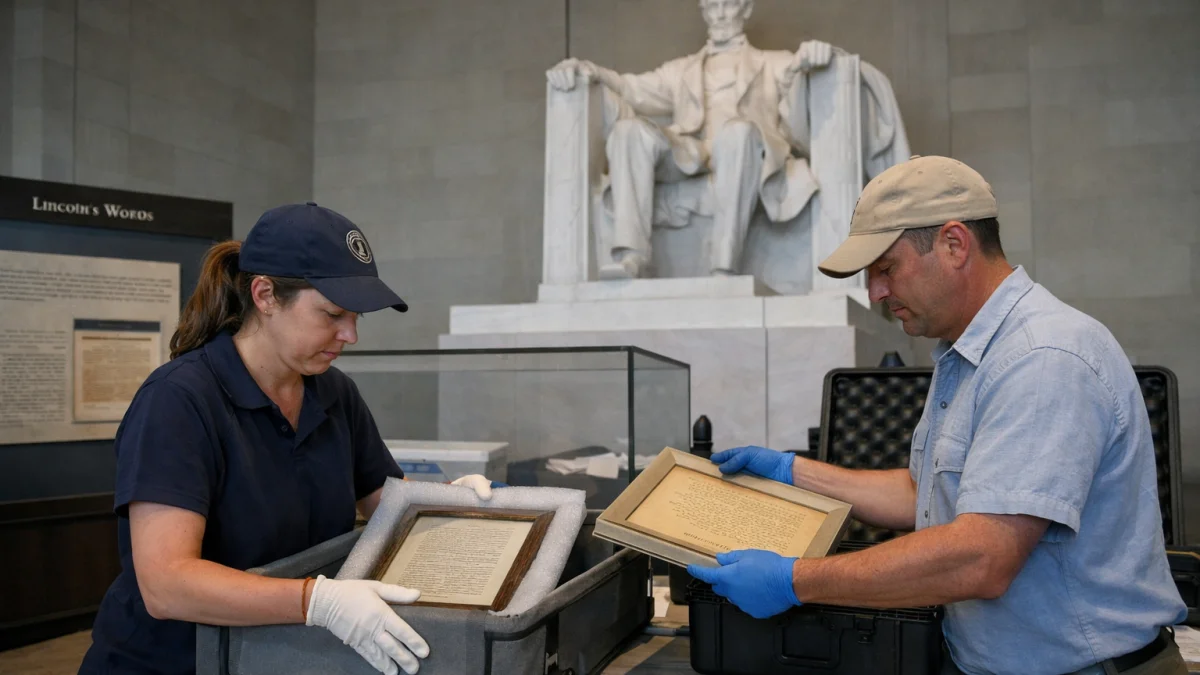
WASHINGTON — Rare original copies of the Emancipation Proclamation and the 13th Amendment bearing President Abraham Lincoln's signature have been removed from public display at the Lincoln Memorial's new undercroft museum after concerns that unusually high temperatures inside the exhibit could threaten their preservation, according to officials and reports citing National Park Service employees.
The documents, on loan for the memorial's recently opened exhibition beneath the Lincoln Memorial, were taken out of display after questions emerged about environmental conditions inside their display cases during a period of extreme summer heat in the U.S. capital. The exhibit opened as part of broader commemorations leading up to the United States' 250th anniversary in 2026.
The National Park Service has not publicly reported damage to either document. However, City Cast DC, citing three National Park Service employees and internal communications, reported that temperatures inside the exhibit approached levels considered unsuitable for long-term preservation of historic manuscripts. The report said the documents were removed as a precaution while officials evaluated environmental controls.
Conservation specialists say historic paper documents require tightly controlled temperature, humidity and light conditions to minimize deterioration. Katie Lowe, a preservation specialist with the Conservation Center for Art and Historic Artifacts, told City Cast DC that archival materials generally should not be exposed to temperatures above about 75 degrees Fahrenheit (24 degrees Celsius) without carefully managed environmental controls because heat can accelerate chemical degradation.
The National Archives, which houses the U.S. Constitution, Declaration of Independence and Bill of Rights, maintains those documents in sealed, climate-controlled cases at substantially cooler temperatures, according to agency guidance cited in the report.
The Lincoln-signed copies were loaned from the Kenneth C. Griffin Collection for display in the new museum space beneath the memorial. The rare documents are regarded as among the most significant surviving artifacts associated with the abolition of slavery in the United States.
The temporary removal comes amid broader scrutiny of work at the Lincoln Memorial complex following separate controversies involving the nearby Reflecting Pool, which has undergone repeated repairs in recent months. Those issues are unrelated to the preservation concerns surrounding the historic documents.
As of Thursday, officials had not announced when the Emancipation Proclamation and 13th Amendment would return to public display. The National Park Service has not reported any permanent harm to the documents while reviews of exhibit conditions continue.