Residents of a riverside neighborhood in Pengshui county had already begun leaving their homes after an emergency warning when the mountainside gave way. Local authorities said a community worker noticed falling rocks early on the morning of July 17 and alerted residents to evacuate. Minutes later, thousands of cubic meters of rock and earth cascaded downhill, crushing residential buildings near the Wujiang River and turning a routine evacuation into a race against time.
The landslide, triggered after days of heavy rainfall in southwest China's Chongqing municipality, killed at least eight people and left dozens missing, according to local officials. Rescue teams continued searching unstable debris fields through the weekend while displaced families confronted a different reality: rebuilding daily life after losing homes, neighbors and a sense of security.
For many residents, the disaster underscored both the value and the limits of early warning systems in mountainous communities increasingly exposed to extreme weather. State broadcaster CCTV reported that officials had ordered more than 60 residents to evacuate after reports of falling rocks, a decision credited with reducing the potential loss of life even though the slope collapsed before everyone could reach safety.
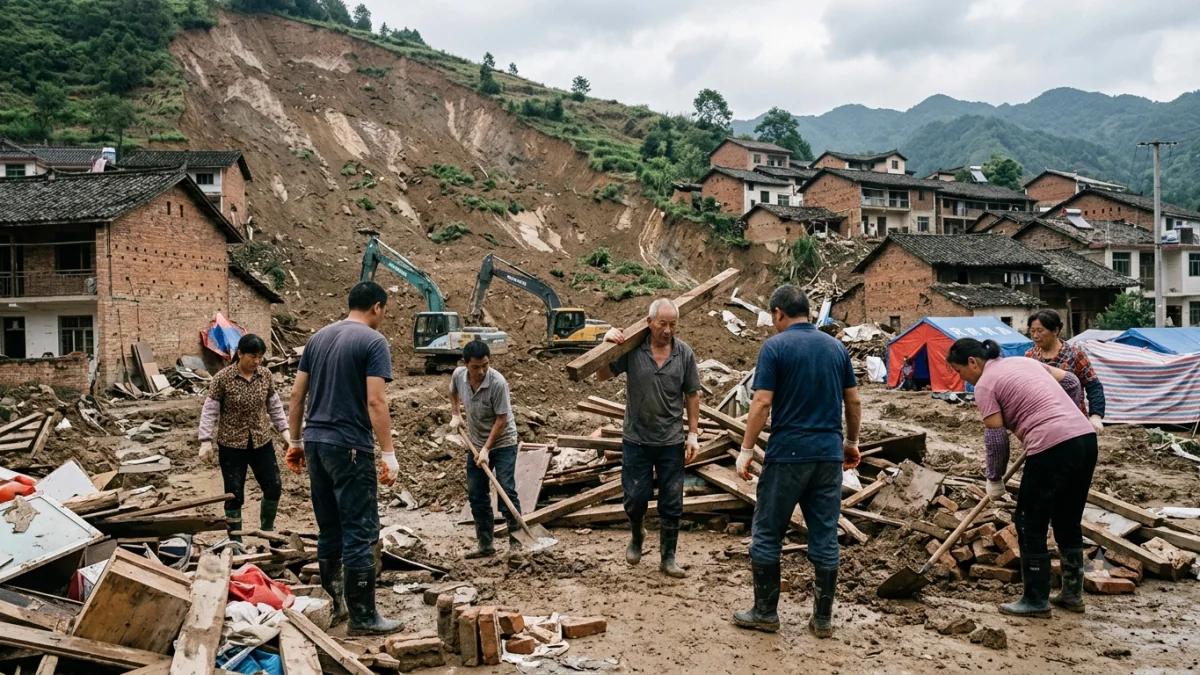
The rescue effort quickly expanded into one of the region's largest emergency responses this year. China's Ministry of Emergency Management activated a high-level emergency response, deploying specialist rescue teams alongside firefighters, engineers and medical personnel. Excavators worked carefully around massive boulders while rescue dogs, drones and life-detection equipment searched for signs of survivors. Authorities warned that unstable rock formations continued to threaten secondary collapses, slowing the operation and forcing rescuers to proceed cautiously.
Officials said more than 1,100 residents from nearby buildings were evacuated from areas considered at risk. Temporary shelters were established, providing beds, food and other emergency supplies as families waited for news about missing relatives and access to homes that remained standing but lay inside the danger zone. China's National Development and Reform Commission announced 30 million yuan (about $4.4 million) in reconstruction funding to support repairs to damaged infrastructure and emergency recovery.
The disaster unfolded in terrain that has long presented engineering and emergency-management challenges. Pengshui county lies within a mountainous karst landscape where steep slopes descend toward the Wujiang River. During the summer rainy season, prolonged rainfall can weaken hillsides, increasing the risk of landslides and rockfalls. Authorities have not yet announced the final cause of the collapse, saying investigations remain under way.
Video verified by Reuters captured the moment part of the hillside gave way, sending a cloud of dust across nearby roads and forcing vehicles to stop as debris swept through homes and businesses below. State television aerial footage later showed rescue crews navigating shattered concrete, exposed foundations and enormous rocks scattered across what had been a residential neighborhood only hours earlier.
The Chongqing disaster follows a series of weather-related emergencies across China during a summer marked by heavy rainfall in several regions. Earlier in July, another landslide in Gansu province killed at least five people and left others missing, highlighting the recurring risks facing communities in mountainous areas during periods of intense precipitation.
Experts have long warned that landslide hazards increase when prolonged rainfall saturates steep terrain. In southwest China, where many communities are built along river valleys beneath rocky slopes, local governments have invested in monitoring systems, geological surveys and evacuation planning. The events in Pengshui demonstrated both the importance of those precautions and the difficulty of predicting precisely when an unstable slope will fail.
As search operations continued, attention gradually shifted toward longer-term recovery. Families displaced from the affected neighborhood faced weeks or months before authorities could determine whether nearby homes remained safe. Engineers were expected to assess slope stability, while investigators examined the sequence of events leading to the collapse.
For residents, rebuilding will extend beyond replacing damaged buildings. It will involve restoring neighborhoods disrupted in moments by a natural hazard that transformed familiar surroundings into an emergency zone. Even as rescue crews continue combing through rock and debris, the emergency response has already entered another phase—helping survivors begin again while officials work to reduce the risk that another hillside could one day follow the same path.