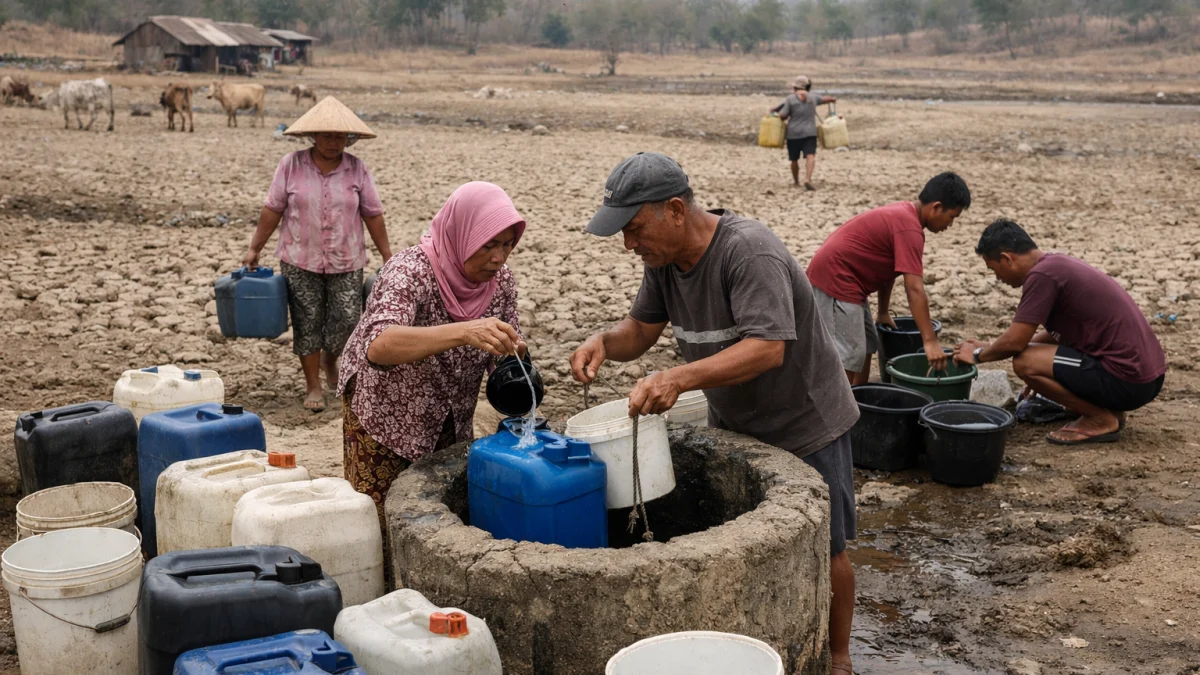
The dry season has settled over parts of Java earlier and more intensely than many residents expected, leaving wells lower, fields drier and daily routines increasingly shaped by the search for water.
For families in drought-prone communities, the effects are measured less by meteorological charts than by practical decisions: when to irrigate crops, whether to queue for water deliveries, and how long existing supplies can last before the next rain arrives.
Those individual adjustments are unfolding against a broader climate pattern that Indonesia's meteorological agency says is likely to make much of the country drier than normal during 2026. The season has become a test of how communities adapt as weather patterns grow less predictable and pressure on water resources increases.
Indonesia's Meteorology, Climatology and Geophysics Agency (BMKG) has forecast that much of the country will experience below-normal rainfall during the 2026 dry season, with the widest extent of peak dry-season conditions expected in August. Parts of Java are among the regions entering or approaching that peak, while the influence of developing El Niño conditions is expected to reduce rainfall across many areas.
For farmers, the forecasts are already influencing decisions that shape an entire growing season.
The Ministry of Agriculture has urged local governments to accelerate planting where irrigation water remains available and to encourage the use of drought-tolerant rice varieties. Officials hope earlier planting can reduce the risk that crops reach their most water-intensive stages after rainfall has diminished further.
In West Java, rice farmer Teguh Basuki told Reuters that adapting has become part of everyday farming as weather patterns have become harder to predict.
"We live from farming, so we have to adapt," he said, describing how producers have adjusted planting schedules in anticipation of a prolonged dry season.
Not every farmer expects to continue planting rice throughout the season. Reuters reported that another farmer in Cirebon, Misti, was considering forgoing a third rice crop or switching to mung beans, a crop that requires less water even if it offers lower returns.
"The heat is too high, and farmers worry the crop won't make it to harvest," Misti said.
Their choices illustrate the balancing act confronting many rural communities. Rice remains central to household incomes and national food security, yet planting decisions increasingly depend on uncertain rainfall, irrigation availability and the cost of taking risks.
BMKG has warned that while occasional rainfall may still occur because of regional atmospheric conditions, the broader trend points toward expanding dry-season conditions across Indonesia. Monitoring by the agency has also shown hundreds of observation points experiencing prolonged periods without rain, alongside temperatures exceeding 35 degrees Celsius in several regions, including parts of Java.
The drought's effects extend beyond agriculture.
Lower rainfall places additional pressure on household water supplies, particularly in areas that rely on shallow groundwater or seasonal springs. Local governments in drought-prone districts often prepare water distribution programs as reservoirs, rivers and village wells decline during the peak of the dry season.
Officials have urged communities to strengthen water conservation measures while ensuring essential supplies remain available for domestic use, agriculture and public health. BMKG has also called for greater preparedness across sectors, citing potential impacts on water availability, health and economic activity.
Climate specialists say Indonesia has long experienced alternating wet and dry seasons influenced by large-scale climate patterns, but recent years have underscored how those patterns can become more disruptive when combined with broader climate change.
The 2026 season follows forecasts that indicate the dry period arrived earlier than usual across many regions and is expected to be drier than average over much of the archipelago. BMKG projects that more than half of Indonesia's seasonal climate zones will experience below-normal rainfall during the dry season.
For policymakers, the challenge is to reduce immediate impacts while improving long-term resilience. That includes strengthening irrigation systems, promoting efficient water use and helping farmers adapt cropping schedules to changing seasonal conditions.
For residents living through the dry months, adaptation is often more immediate and personal. Water is stored more carefully, planting calendars are revised and daily routines shift around a resource that becomes more precious as rain clouds remain scarce.
Meteorologists continue to monitor evolving climate conditions through the remainder of the season. Although localized rainfall is still possible in some areas because of regional atmospheric dynamics, BMKG says the overall expansion of dry-season conditions is expected to continue through the coming weeks, with August forecast to bring the most widespread peak of the season.
Until then, communities across parts of Java are preparing for a season that is no longer defined simply by the absence of rain, but by the constant work of adapting to it.