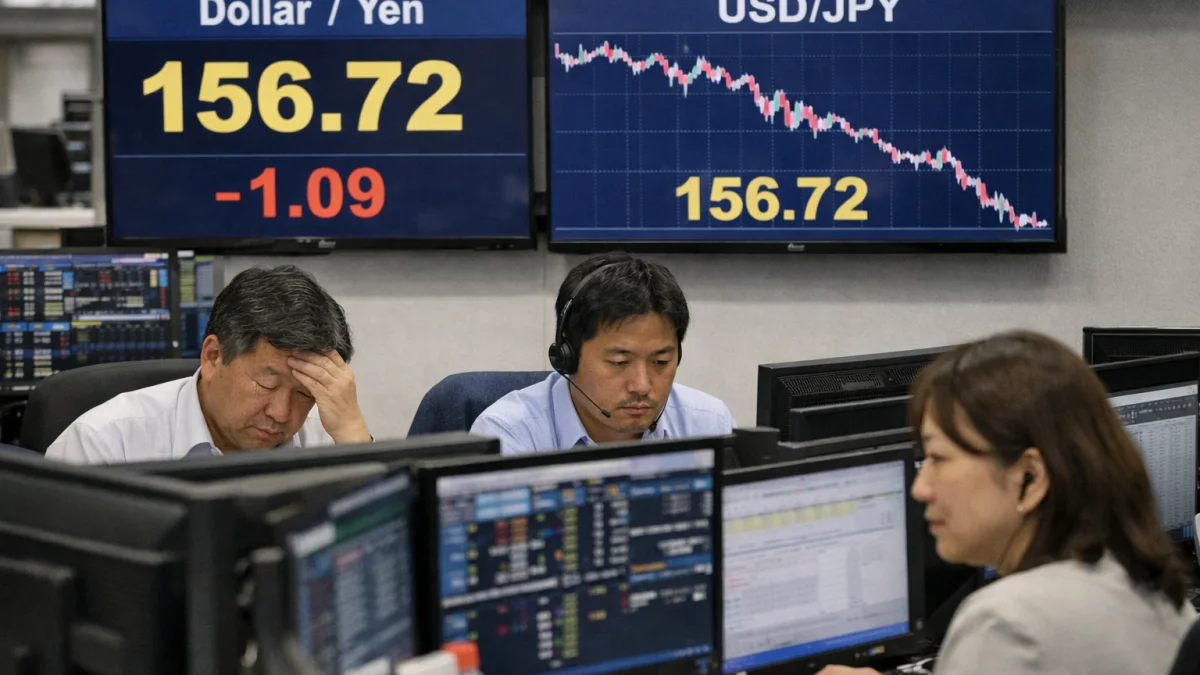
The Japanese yen's slide to its weakest level against the U.S. dollar in nearly four decades has heightened concerns over potential disruptions to global financial flows.
On June 30, 2026, the dollar climbed as high as 162.66 yen before settling around 162.59, pushing the yen to levels last seen in December 1986. This marks a continuation of the currency's depreciation, with the yen down roughly 1.8% over the past month and more than 13% over the last year.
The development matters because the yen serves as a key funding currency in global markets. A sustained weakness amplifies risks associated with the yen carry trade — where investors borrow cheaply in yen to invest in higher-yielding assets elsewhere — estimated by some market participants in the range of $4-8 trillion. An abrupt unwind could trigger volatility across equities, bonds, and currencies worldwide.
The immediate driver is the persistent gap in monetary policy between the U.S. Federal Reserve and the Bank of Japan. While the Fed has maintained relatively higher rates amid resilient U.S. growth, the BOJ has pursued a gradual normalization from ultra-loose settings, including recent rate hikes. This differential has encouraged capital outflows from Japan.
Japan's authorities have not stood idle. Between April and May 2026, the government deployed a record 11.7 trillion yen (about $73 billion) in foreign exchange intervention to support the currency. Despite this and BOJ policy tightening, the yen has resumed its decline, testing market expectations for further intervention. Japanese officials, including Finance Minister Satsuki Katayama, have signaled readiness to act as needed, emphasizing coordination with the United States.
For Japan's domestic economy, the weak yen presents a mixed picture. It boosts competitiveness for exporters such as automakers and electronics manufacturers by increasing the yen value of overseas earnings. However, it raises costs for imported energy, food, and raw materials in a resource-dependent economy, contributing to inflation pressures near 2% and eroding household purchasing power.
Historically, the yen has experienced sharp swings. The current episode echoes periods of intervention in 2022 and 2024, when authorities stepped in near similar thresholds to curb excessive volatility. Yet structural factors — including Japan's high public debt, demographic challenges, and cautious pace of monetary tightening — have limited the yen's recovery.
Globally, the implications extend through financial linkages. A further yen decline could encourage additional carry trade positioning, increasing leverage in markets from U.S. Treasuries to emerging-market assets. Conversely, a sudden reversal — whether from intervention, a shift in U.S. policy expectations, or risk-off sentiment — risks forced unwinding. Such dynamics contributed to market stress in prior episodes, including volatility in 2024 when yen strengthening forced repositioning.
Analysts differ on the severity. Some view the current weakness as manageable, supported by Japan's current account surplus and potential for further BOJ tightening. Others warn that prolonged depreciation could amplify imported inflation in Japan and prompt protectionist responses or capital flow reversals that ripple through global liquidity.
The yen's trajectory also intersects with broader economic divergences. Stronger U.S. growth and policy settings have reinforced dollar strength, while Japan's efforts to exit deflation and negative rates have proceeded unevenly.
As of July 1, 2026, the yen remains near its multi-decade lows amid ongoing interest rate differentials. Japanese authorities continue to monitor exchange rates closely and stand prepared to respond, while markets assess the likelihood and timing of additional intervention. Uncertainties persist around the scale of any future policy actions, the evolution of U.S. monetary policy, and the resilience of global carry trade positions. Officials in Tokyo and Washington are tracking developments for signs of disorderly movements.