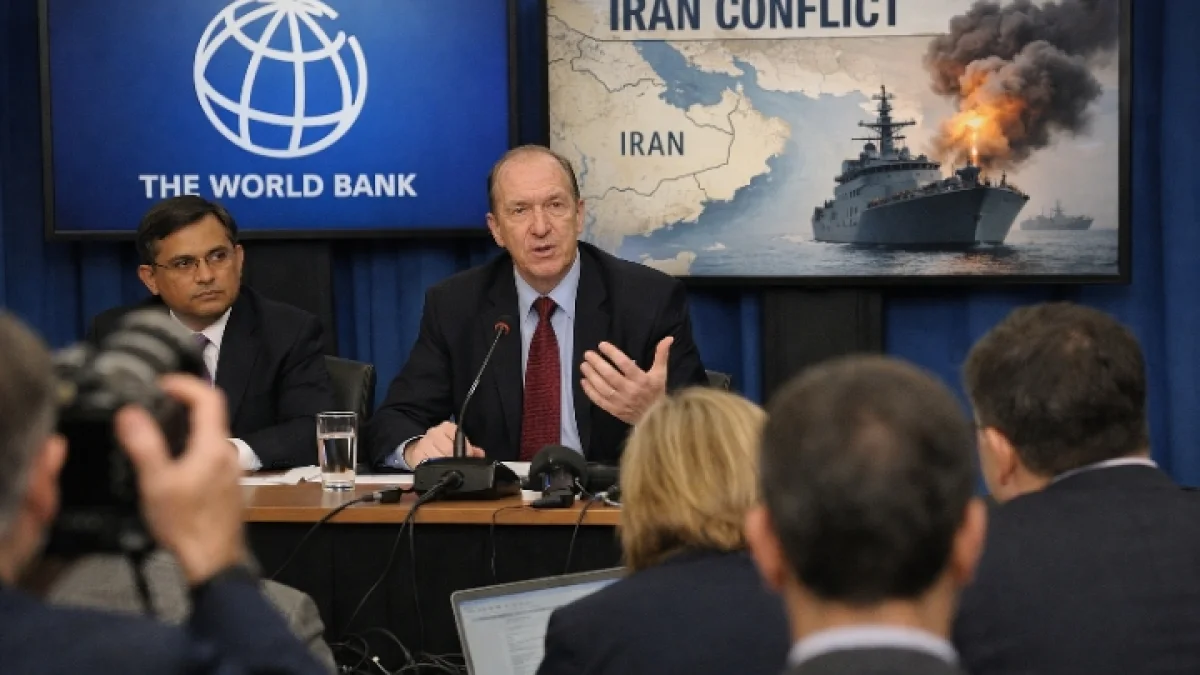
WASHINGTON—The World Bank's chief economist has warned that an escalation of the war involving Iran could sharply slow global economic growth this year, with a prolonged conflict potentially pushing growth to 1.3% as higher energy costs, inflation and financial stress weigh on economies.
Indermit Gill, the World Bank's chief economist, said in comments reported on Wednesday that an escalation of the conflict between the United States and Iran could reduce global growth in 2026 to 1.3%, from 2.9% in the previous year. In a worst-case scenario in which hostilities persist for six months or longer, global inflation could rise to 4.5%, according to the assessment.
The warning adds to concerns about the economic consequences of disruptions to energy supplies and shipping routes in and around the Middle East. The World Bank said in its June Global Economic Prospects report that the conflict was already expected to push global growth to its weakest level since the COVID-19 pandemic, with higher energy prices, inflation and borrowing costs creating pressure on economies worldwide.
The bank's June forecast projected global growth at 2.5% in 2026, down from 2.9% in 2025, while warning that more severe energy disruptions combined with financial stress could reduce growth to 1.3% and lift inflation to 4.4%. It said Brent crude prices were expected to average $94 a barrel in 2026 under an assumption that the worst disruptions would ease in July.
The Strait of Hormuz, a critical route for global energy shipments, has been a major source of concern. The World Bank said its closure had severely disrupted energy markets, while the conflict has also affected shipping and supplies of fertilizers and other agricultural inputs, raising risks to food security and inflation.
In a joint statement issued on July 8, the heads of the World Bank Group, International Monetary Fund, International Energy Agency and World Trade Organization said the global economy had remained broadly resilient but warned that the war's effects were uneven and could persist. They called for progress toward resolving the conflict and reopening the Strait of Hormuz.
The World Bank has said developing economies would be particularly vulnerable to higher energy and food prices and tighter financial conditions. Its June outlook projected growth in developing economies at 3.6% in 2026, down from 4.4% in 2025.