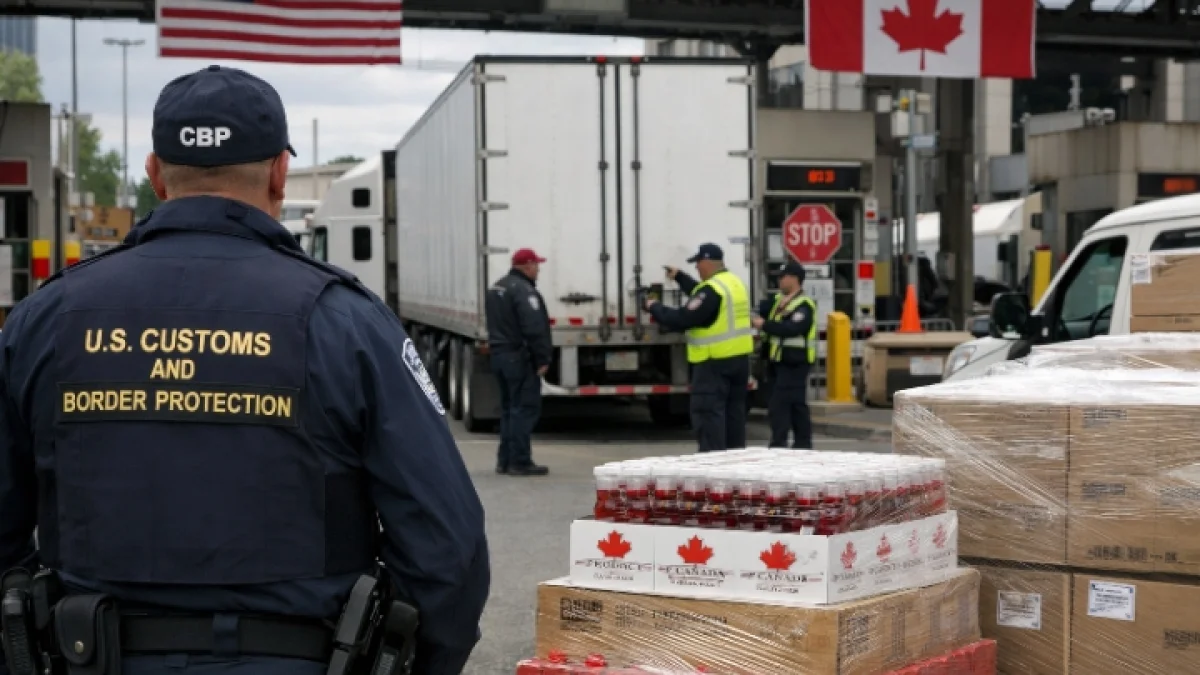
President Donald Trump’s decision to impose additional 50% tariffs on a range of Canadian goods marks a sharp escalation in a trade relationship that has long been anchored by North America’s integrated supply chains and a free-trade agreement. The measures, announced on July 20 and due to take effect in August, target products including wine, hockey sticks and cement, while exempting energy, potash, fish, critical minerals and goods already covered by separate national-security tariffs.
The immediate significance is less the value of the affected goods than the challenge the tariffs pose to the stability of the Canada-U.S. trading framework. The new duties apply even to covered goods that qualify under the United States-Mexico-Canada Agreement, or USMCA, potentially weakening the practical value of tariff preferences that businesses have relied on to organize cross-border production. Reuters reported on Wednesday that separate U.S. negotiations with Canada and Mexico are already putting pressure on the future of the trilateral pact, after Trump opted against extending it for another 16 years in favor of annual reviews.
Washington says the tariffs are a response to what it describes as discriminatory Canadian policies affecting U.S. automobiles, alcohol and dairy products. The White House said the additional duties, imposed under Section 338 of the Tariff Act of 1930, are intended to offset disadvantages to U.S. commerce and create greater opportunities for American producers. The administration has also argued that Canada's treatment of U.S. products warrants action even where the targeted Canadian goods otherwise receive preferential treatment under USMCA.
Ottawa disputes that interpretation. Prime Minister Mark Carney said the new tariffs were the latest in a series of unilateral U.S. trade measures that Canada considers inconsistent with the continental trade agreement. He said Canada had matched earlier U.S. measures and remained prepared to intensify negotiations over trade disputes and modernization of the pact. Canada's trade minister, Dominic LeBlanc, likewise said Ottawa had presented detailed proposals aimed at resolving outstanding issues and that talks with Washington were expected to continue.
The economic exposure is substantial because the two economies are unusually intertwined. Canada's merchandise exports to the United States reached about C$565 billion in 2025, according to Canada's chief economist, even after declining more than 5% from the previous year. U.S. Census Bureau data show that American goods imports from Canada totaled about $382 billion in 2025, compared with roughly $334 billion in U.S. exports to Canada.
That scale of integration means tariffs can have effects beyond the immediate Canadian exporter. Companies that depend on imported Canadian inputs may face higher costs or have to find alternative suppliers, while Canadian producers may seek other markets or reduce output if U.S. demand falls. The impact is likely to vary considerably by sector because the new measures exclude several strategically important Canadian exports, including energy and critical minerals. The White House's exemptions therefore limit the direct scope of the action while leaving a broad range of consumer and industrial products exposed.
The episode also illustrates the increasingly uncertain status of North American trade rules. USMCA was designed to provide businesses with a stable framework for cross-border commerce, but the latest tariffs show that compliance with the agreement does not necessarily shield all Canadian exports from new U.S. duties. Reuters reported that the shift toward bilateral negotiations is raising concerns about the long-term coherence of North America's integrated economic system, particularly as the three governments approach negotiations over the pact's future.
For Canada, the policy dilemma is how to respond without deepening the disruption. Ottawa has signaled that it will defend Canadian economic interests while continuing negotiations, but Canadian provincial leaders and business groups face pressure to prepare for retaliation or other protective measures. For Washington, the administration's stated objective is to pressure Canada to change policies it considers discriminatory and to strengthen U.S. producers. Whether the tariffs achieve those goals will depend in part on whether they produce concessions at the negotiating table or instead prompt reciprocal measures that raise costs on both sides.
The historical record provides competing lessons. Earlier tariff confrontations during Trump's first administration demonstrated that protectionist measures can shift trade flows and provide temporary relief to some domestic producers, while retaliation can impose costs on exporters in the country that initiated the tariffs. The economic consequences of the current dispute will depend on its duration, the scale of any Canadian response and the extent to which businesses alter established supply chains.
For now, the confirmed situation is that the United States has authorized additional 50% tariffs on specified Canadian goods, with significant exemptions, and that Ottawa and Washington remain engaged in negotiations. The principal uncertainties are the final scope of implementation, whether the measures are modified or suspended before taking effect, and whether Canada introduces further countermeasures. Officials and businesses are therefore closely monitoring the negotiations, the detailed tariff schedules and the broader review of USMCA, which will determine whether the latest escalation becomes a temporary negotiating instrument or a more durable shift in North American trade relations.