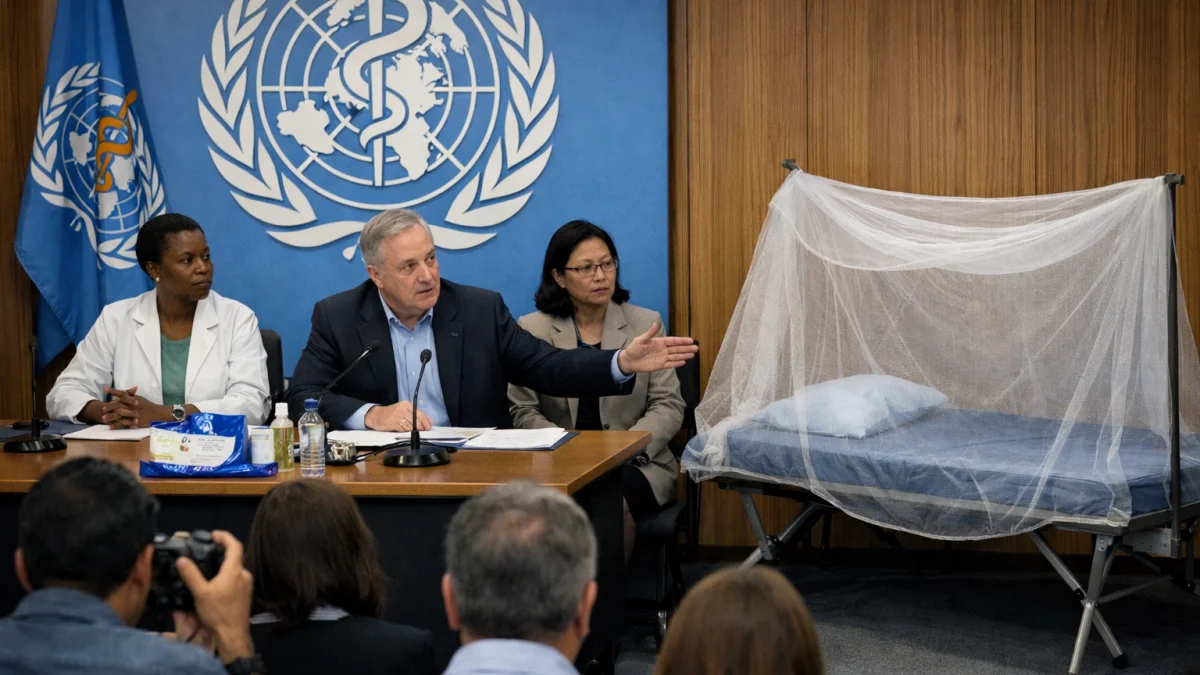
GENEVA — The World Health Organization has updated its malaria guidelines to reflect the latest recommendations on insecticide-treated nets (ITNs), reaffirming the central role of mosquito nets in malaria prevention while incorporating evidence on newer dual-insecticide products designed to address growing insecticide resistance.
The updated guidance, published through WHO's living WHO Guidelines for malaria, comes as countries continue to face challenges from pyrethroid-resistant mosquitoes, a factor that has reduced the effectiveness of conventional insecticide-treated nets in some malaria-endemic areas. WHO said the guidelines are reviewed and revised periodically as new scientific evidence becomes available.
According to WHO, insecticide-treated nets and indoor residual spraying remain the two principal vector-control interventions recommended for most areas at risk of malaria. Depending on local conditions, these measures may be supplemented by additional interventions, including larval source management and other vector-control tools.
The organization said more than 3 billion insecticide-treated nets have been delivered to malaria-endemic countries since large-scale distribution efforts began, making them one of the most significant contributors to reductions in malaria transmission over the past two decades. However, WHO warned that the spread of insecticide resistance among Anopheles mosquitoes threatens those gains and requires countries to adopt evidence-based strategies tailored to local epidemiological conditions.
The guidelines continue to recommend the deployment of newer classes of dual-insecticide nets in settings where pyrethroid resistance has been confirmed. These include pyrethroid-chlorfenapyr nets, which WHO strongly recommends over pyrethroid-only nets in affected areas, and pyrethroid-pyriproxyfen nets, which are conditionally recommended in specific circumstances. The recommendations are based on WHO's guideline development process, which evaluates the quality of available evidence before issuing new or revised guidance.
“These new types of nets were designed to have a greater impact against pyrethroid-resistant mosquitoes,” said Dr. Jan Kolaczinski, who leads the Vector Control and Insecticide Resistance unit within WHO's Global Malaria Programme, when the organization announced recommendations for the newer net classes. “By including two active ingredients in an ITN, the likelihood of mosquitoes being resistant to both is greatly reduced.”
WHO said its malaria guidelines are maintained as a living resource, allowing recommendations to be updated whenever sufficient new evidence becomes available. The organization also noted that countries should select WHO-prequalified products and adapt implementation to local transmission patterns, mosquito behavior and operational capacity.
The latest version of the WHO malaria guidelines remains available through the organization's online platform, and WHO said future revisions will be issued as additional evidence on malaria prevention tools is reviewed through its established guideline development process.