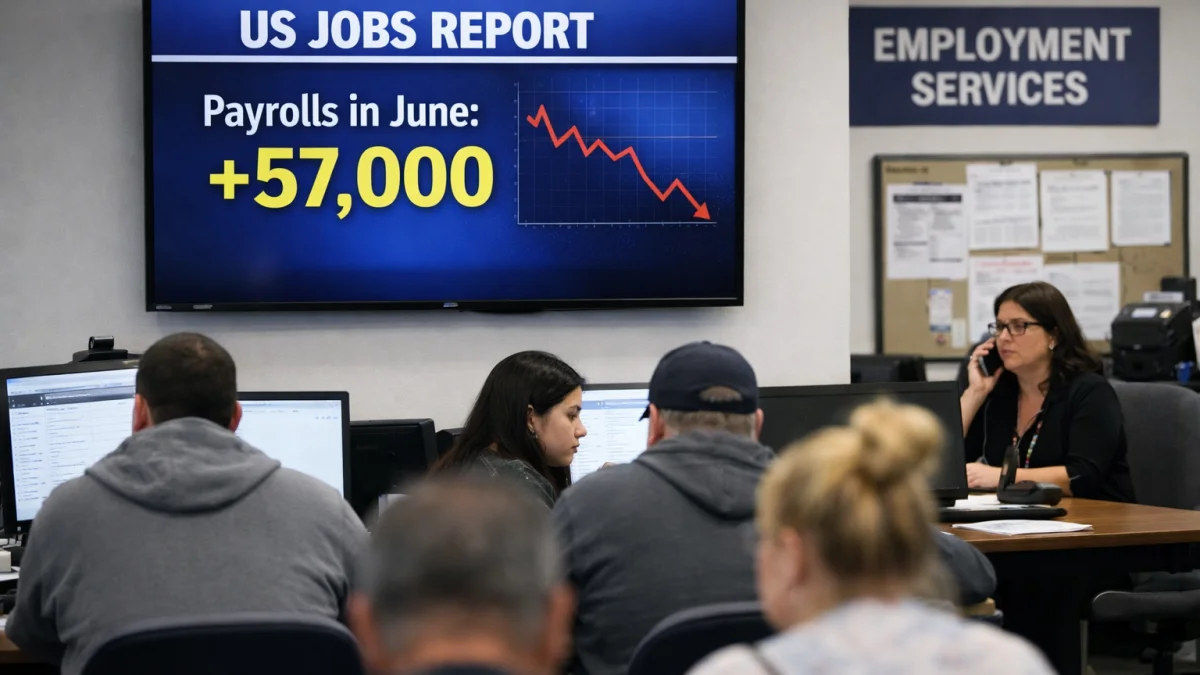
WASHINGTON — U.S. employers added just 57,000 jobs in June, marking a sharp slowdown in hiring and underscoring signs that the labor market is losing momentum, according to data released by the Labor Department, while the unemployment rate edged down as fewer Americans participated in the workforce.
The Labor Department's Bureau of Labor Statistics said nonfarm payrolls increased by 57,000 last month, well below economists' expectations of roughly 100,000 to 115,000 new jobs. The agency also revised April and May payroll figures down by a combined 74,000 jobs, indicating hiring had been weaker than previously reported.
The unemployment rate fell to 4.2% from 4.3% in May. However, the decline coincided with a drop of about 720,000 people from the labor force, pushing the labor force participation rate down to 61.5%, its lowest level since 2021, suggesting the lower jobless rate reflected reduced labor force participation rather than stronger employment growth.
Hiring gains were concentrated in private education and health services, as well as professional and business services. Construction, manufacturing and government also posted modest increases. Leisure and hospitality recorded the largest decline, shedding about 61,000 jobs after seasonal hiring proved weaker than expected. Employment also fell in retail trade and the information sector.
Average hourly earnings rose 3.5% from a year earlier, trailing the most recent inflation reading, while the weaker payroll figures added to evidence that labor demand has cooled after several years of robust job creation.
Financial markets interpreted the report as reducing the likelihood of near-term monetary tightening by the Federal Reserve. Treasury yields fell and investors scaled back expectations that the U.S. central bank would raise interest rates at its next policy meeting, although policymakers have continued to emphasize that future decisions will depend on incoming economic data.
The June employment report arrives as Federal Reserve officials continue to balance persistent inflation pressures against signs of moderating economic activity. Economists said the combination of slower payroll growth, downward revisions to prior months and declining labor force participation points to a labor market that remains resilient but is cooling more noticeably than earlier in the year.