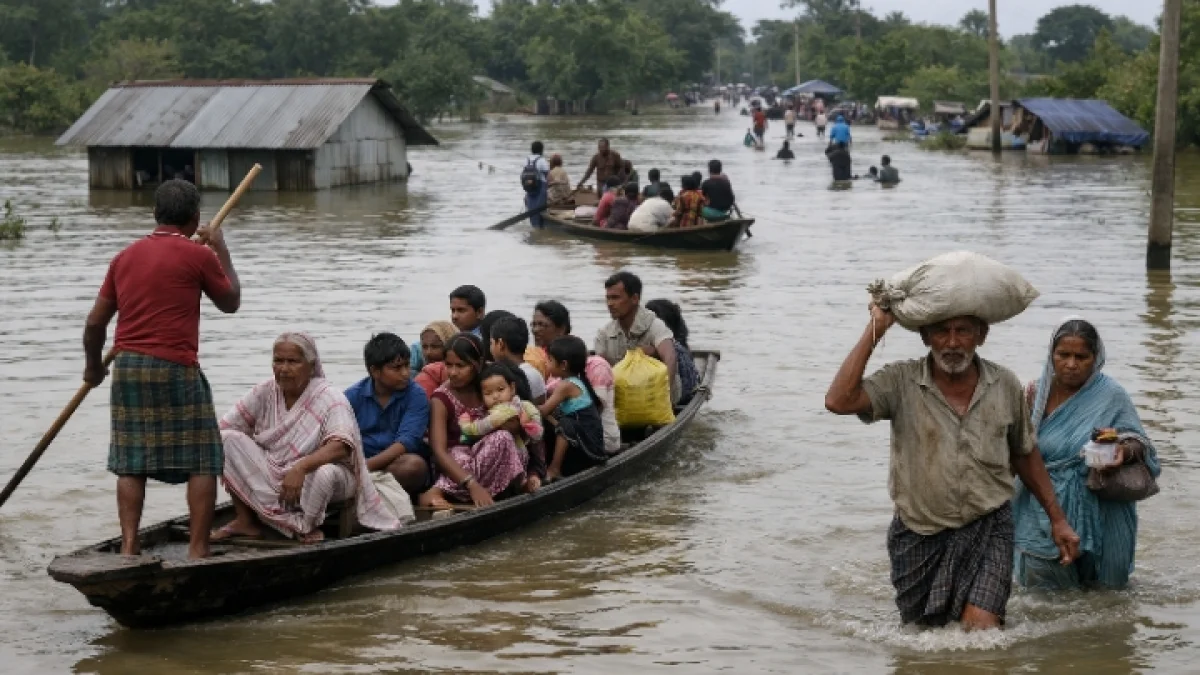
BEIJING — Chinese authorities expanded evacuations and emergency response measures on Monday as Typhoon Bavi moved inland after making landfall on the country's eastern coast, triggering severe flooding, disrupting transport and raising the risk of flash floods across several provinces.
More than 1.8 million people were evacuated before the storm reached eastern China over the weekend, according to state media and official authorities, while emergency measures remained in place as heavy rain spread northward. Reuters reported that flooding intensified in parts of Hebei and Liaoning provinces, where roads were submerged, vehicles swept away and around 1,800 residents stranded in Kuancheng county.
Typhoon Bavi made landfall twice in Zhejiang province late on Saturday before weakening as it tracked inland, according to China's meteorological authorities. Officials warned that although the storm's winds had diminished, its extensive rain bands continued to pose significant flooding risks across eastern and northern China.
China's Ministry of Water Resources said dozens of rivers nationwide had risen above flood-warning levels, while authorities issued the highest-level alerts for flash flooding in some affected regions. Emergency management agencies said relocating residents and providing temporary shelter remained their top priorities.
The storm caused widespread disruption to transport networks. Thousands of flights were cancelled, train services were suspended in several cities, and schools and ferry services were halted in areas along Bavi's path. Shanghai and other major cities imposed traffic restrictions and suspended some public transport services as the typhoon approached before conditions gradually improved.
State media described Bavi as the strongest typhoon to strike Zhejiang in July since modern records began in 1949. Officials warned that saturated ground conditions increased the risk of landslides, flash floods and urban waterlogging even after the storm weakened.
Before reaching mainland China, Bavi affected Japan's southern islands and Taiwan, where authorities evacuated residents from vulnerable areas and suspended flights and public services. In the Philippines, the storm enhanced seasonal monsoon rains that triggered deadly landslides, according to local authorities.
China's emergency agencies said monitoring would continue as Bavi moved farther inland, with heavy rainfall forecast for parts of Hebei, Liaoning, Jilin, Shandong, Jiangsu and Anhui. Authorities urged local governments to maintain flood-control operations and continue relocating residents from areas at high risk of flooding and geological disasters.