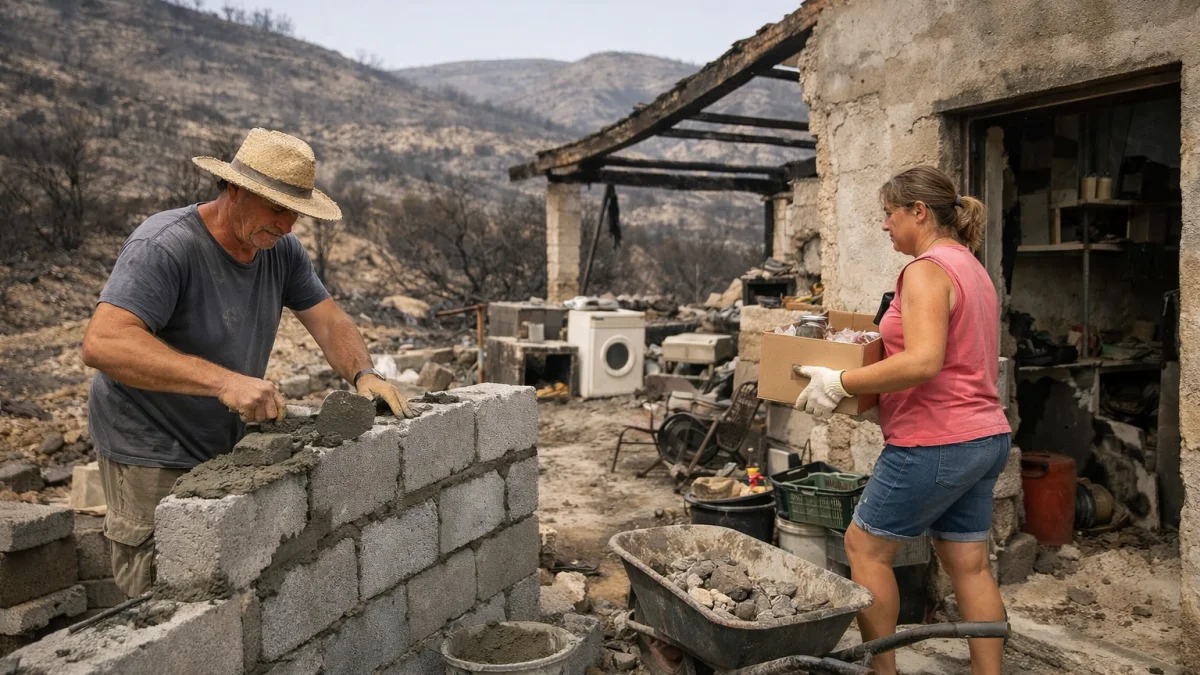
The first residents returning to the hills above Los Gallardos found landscapes transformed into shades of black and ash. Police checkpoints slowed the flow of cars back toward scattered homes in Bédar and nearby hamlets, while emergency crews continued to assess damage left by one of Spain's deadliest wildfires in more than four decades. Some houses remained standing amid burned vegetation. Others had been reduced to scorched foundations. Donations collected at temporary shelters waited to be distributed to families beginning the uncertain process of rebuilding.
The return marks only the beginning of recovery after the wildfire that swept through Almería province in early July killed 13 people, burned roughly 7,000 hectares and forced around 1,500 residents to evacuate. Authorities have gradually lifted evacuation orders after stabilising the blaze, allowing communities to confront not only physical destruction but also the loss of neighbours, friends and relatives.
For many survivors, recovery has unfolded alongside unanswered questions about how such a fast-moving fire overwhelmed a region where wildfire planning has become an increasingly familiar part of summer life.
Antonio Rubio, a handyman from Bédar, told Reuters that smoke had already become overwhelming before flames reached his property. Although authorities had instructed residents in his area to shelter in place because evacuation routes were considered unsafe, he said the deteriorating conditions convinced him to leave.
"We had to leave," Rubio said, explaining that the smoke alone made remaining at home impossible. His house ultimately survived after the fire stopped short of the property, but many others were not as fortunate.
The disaster unfolded differently across neighbouring communities. Emergency officials directed residents in some areas around Los Gallardos to evacuate along designated routes, while others were advised to remain inside their homes. Officials later said several of those who died had attempted to flee despite shelter-in-place guidance, becoming trapped as flames spread rapidly across rugged terrain dotted with isolated houses.
Among those left grieving is Malcolm Timbrell, a British resident of Bédar who survived after sheltering inside a vehicle while the fire passed. His wife, Annette Kilgore, was among those believed to have died after becoming separated during the chaos. Speaking publicly after the disaster, Timbrell described returning briefly to rescue the couple's cats before finding that others had tried to escape on foot as conditions worsened. "She had no chance," he told The Times.
Authorities have identified victims from several countries, reflecting the international population that has made southeastern Spain home. Those confirmed dead include citizens of the United Kingdom, Belgium, France and Spain. Forensic teams have relied on DNA analysis to identify several victims because of the severity of the fire.
The wildfire has also exposed the complexity of emergency decision-making when fires accelerate under extreme weather conditions. Andalusian emergency chief Antonio Sanz said rapidly changing fire behaviour contributed to the tragedy. Officials have stressed that recommendations differed between communities according to local terrain, road conditions and the predicted path of the flames.
Scientists say such disasters are becoming more challenging across the Mediterranean. Spain has experienced increasingly intense wildfire seasons as prolonged heat, drought and changing rainfall patterns alter vegetation and create abundant fuel for fires. In this case, experts cited by Reuters said unusually heavy spring rainfall produced dense vegetation that later dried during intense summer heat, allowing flames to spread quickly across the landscape.
For residents now returning, those broader climate trends remain secondary to immediate concerns: restoring electricity and water, checking whether homes remain structurally safe and replacing possessions lost in the fire.
Photographs from the affected villages show homes standing alone within circles of burned earth, while hillsides that once supported Mediterranean scrub have been stripped bare. Volunteers, charities and local authorities have organised donations ranging from clothing to household essentials for evacuees housed temporarily in convents and emergency accommodation.
Community recovery is likely to extend well beyond rebuilding damaged property. The wildfire has left lasting psychological scars on residents who witnessed flames advancing through familiar valleys and on families waiting for confirmation about missing loved ones. Even after the fire alert was downgraded, forensic investigations continued as officials worked to identify all victims and document the sequence of events.
Spanish authorities have indicated that stabilising the fire is only one phase of the response. Environmental assessments, infrastructure repairs and investigations into the disaster continue alongside efforts to support affected communities. Local leaders have also acknowledged that rebuilding confidence may prove as difficult as restoring damaged landscapes.
As residents cross police checkpoints and unlock doors for the first time in days, they are returning not to the communities they left but to places reshaped by one of Spain's worst wildfire tragedies in a generation. The blackened hillsides surrounding Bédar and Los Gallardos now stand as visible reminders of both the destructive power of extreme wildfire conditions and the long, uncertain work of rebuilding lives after the flames have passed.