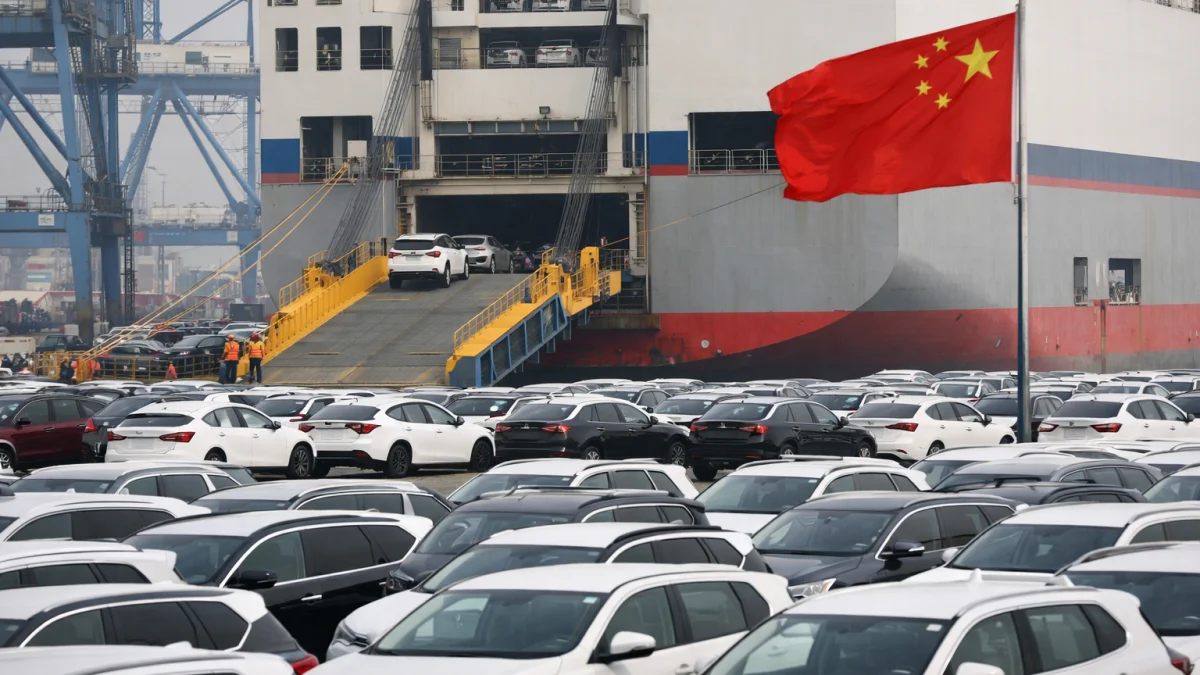
China's passenger car exports accelerated sharply in June, rising about 80% from a year earlier even as domestic sales fell by roughly 26%, underscoring a widening divide between the country's weakening consumer demand and the growing global reach of its automotive industry. Industry data show overseas shipments increasingly cushioning manufacturers from a prolonged slowdown at home, while reinforcing China's position as the world's largest vehicle exporter.
The latest figures are significant because they illustrate how Chinese automakers are responding to structural rather than temporary pressures in the domestic market. After years of rapid expansion, China's passenger vehicle sector is confronting softer household spending, an extended property market downturn, and intense competition that has driven persistent price wars. Rather than relying solely on domestic demand, manufacturers are increasingly treating export markets as a central component of their business strategy rather than a supplementary sales channel.
According to industry data, China exported more than 4.4 million passenger vehicles during the first half of 2026, while domestic passenger vehicle sales totaled nearly 8.3 million. June exports approached 905,000 vehicles, reflecting continued momentum after similarly strong gains earlier in the year. Although domestic sales remain larger in absolute terms, the contrasting trajectories highlight the industry's growing dependence on overseas markets to sustain production volumes.
Electric vehicles and plug-in hybrids remain central to that expansion. Chinese manufacturers have built competitive advantages through extensive battery supply chains, large-scale manufacturing capacity, and relatively low production costs. Growing international demand for new-energy vehicles has supported exports even as domestic incentive programs have become less generous and local consumers have delayed purchases amid expectations of further price reductions.
The domestic slowdown reflects several overlapping economic challenges. Analysts point to weaker consumer confidence linked to China's prolonged property sector difficulties, which have weighed on household wealth and discretionary spending. At the same time, fierce competition among automakers has resulted in aggressive discounting, reducing profit margins while encouraging some buyers to postpone purchases in anticipation of additional price cuts. Consultancy AlixPartners has projected that China's light vehicle sales could decline by around 10% in 2026, reflecting these persistent headwinds.
For manufacturers, expanding abroad offers both an opportunity and a necessity. Companies including BYD and other Chinese automakers have accelerated investment in overseas assembly plants, dealer networks and distribution partnerships. Establishing production within foreign markets can reduce logistics costs and help companies navigate rising trade barriers while improving long-term competitiveness. Industry executives have described international expansion as increasingly essential for companies seeking sustained growth in China's crowded automotive market.
The export surge also has broader implications for global automotive competition. Chinese brands have continued gaining market share in Europe, Southeast Asia, Latin America and other emerging markets, intensifying competitive pressure on established manufacturers. At the same time, traditional global automakers continue to face declining sales within China itself, where domestic brands have strengthened their positions in both electric and premium vehicle segments. Recent results from Volkswagen, for example, highlighted the challenges international manufacturers face as demand in China weakens and local competitors gain market share.
However, stronger exports also increase geopolitical and trade risks. Governments in several major markets have scrutinized imports of Chinese vehicles, citing concerns ranging from industrial policy and state support to supply chain security. High tariffs have effectively restricted direct Chinese electric vehicle exports to the United States, while manufacturers have explored alternative production and export strategies. Industry analysts note that expanding overseas manufacturing could help Chinese companies mitigate some of these barriers, although regulatory uncertainty remains an important consideration.
Forecasts suggest export growth could remain robust through the rest of 2026. Analysts at S&P Global Ratings have estimated that China's passenger vehicle exports could increase by roughly 30% to 50% this year, while AlixPartners projects total vehicle exports could approach 10 million units, up from around 7 million in 2025. Such projections indicate that overseas demand may continue offsetting domestic weakness, although the pace will depend on economic conditions, consumer demand in key export markets, and evolving trade policies.
The latest data therefore point to an automotive industry undergoing a structural transition. China's manufacturers are increasingly balancing subdued domestic demand with expanding international sales, supported by competitive electric vehicle production and broader overseas investment. Whether that strategy can sustain growth over the longer term will depend on the durability of global demand, the evolution of trade restrictions, and any recovery in Chinese consumer spending. Those factors remain the principal developments being monitored by automakers, industry associations and policymakers.