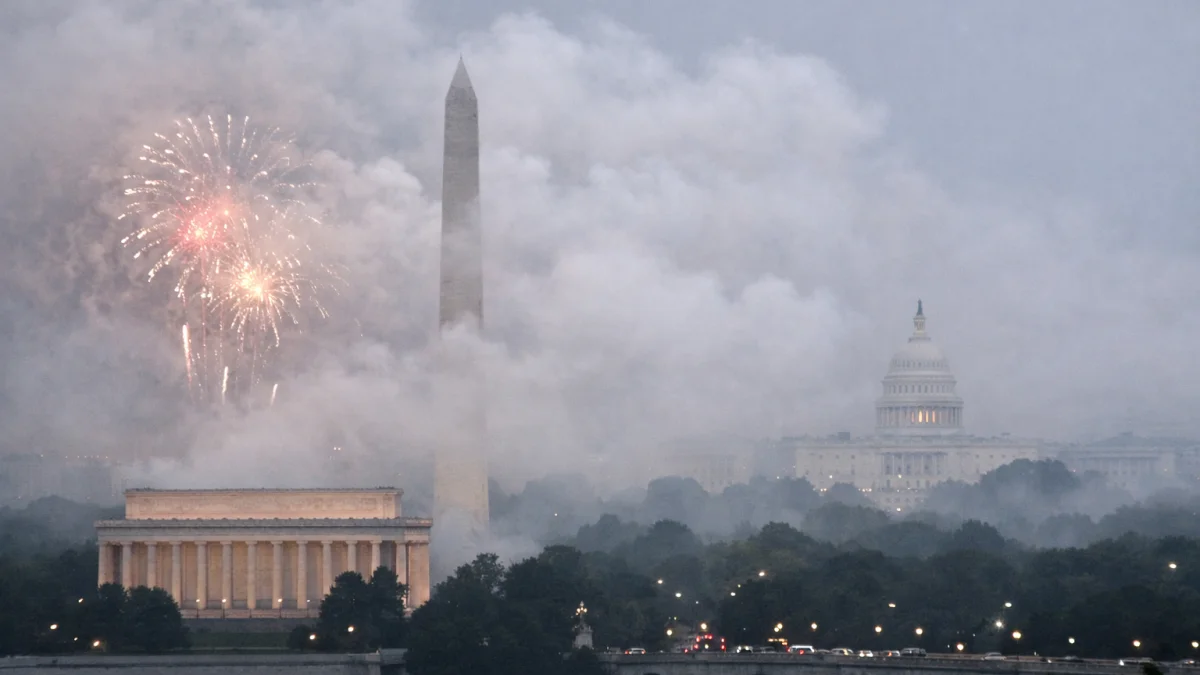
WASHINGTON — Fireworks from Washington’s record-setting Independence Day display are expected to sharply degrade air quality across central parts of the U.S. capital on the night of July 4, according to internal National Park Service modeling and local environmental officials.
The massive pyrotechnic show, featuring an estimated 850,000 fireworks shells launched over roughly 40 minutes from multiple sites near the National Mall, is billed as the largest in history and is projected to produce hazardous levels of fine particulate matter, or PM2.5, around the Mall and very unhealthy conditions in broader parts of central D.C.
A draft air-quality analysis prepared by the National Park Service predicts that pollution could reach hazardous levels near the display sites, prompting recommendations that people avoid prolonged outdoor exposure. Officials have advised sensitive groups, including those with respiratory conditions, children and the elderly, to limit time outdoors and consider wearing N95 masks when necessary.
The concerns are heightened by forecast hot and humid conditions with light winds, which are expected to hinder dispersion of the smoke. Temperatures in the D.C. area are projected to approach or exceed 100 degrees Fahrenheit (about 38 degrees Celsius) on Saturday, adding to ground-level ozone from daytime heat and vehicle emissions.
Fireworks generate PM2.5 through combustion of chemicals used for color and effect, along with metals that can irritate the lungs and heart. Studies of typical July 4 displays across the United States have shown average 24-hour increases in PM2.5 of around 42 percent, with spikes far higher near launch sites. Pollution often peaks shortly after the show and can linger for several hours to a day before dissipating.
This year’s event is roughly 40 times larger than a typical D.C. Fourth of July show, which has historically used 10,000 to 20,000 shells. Capital Weather Gang and other forecasters have noted that the scale, combined with stagnant overnight air and humidity, is likely to trap significant smoke over the city.
The D.C. Department of Energy and Environment has urged residents and visitors to monitor real-time air quality data through AirNow.gov and local alerts. Mayor Muriel Bowser’s office has encouraged use of public transportation and AlertDC notifications amid the broader holiday crowds and heat.
National Park Service officials have internally flagged the air-quality risks in planning documents, though the Environmental Protection Agency is not issuing permits for the display itself. Organizers of the Salute to America celebration have proceeded with the record attempt.
Air pollution from the fireworks is not expected to persist beyond the immediate aftermath. Modeling and historical data indicate that elevated levels typically decline within three to six hours after the display ends, though some residual effects may be detectable the following morning.
The National Mall fireworks are scheduled to begin around 10:30 p.m. or 11 p.m. Saturday following daytime events. Authorities continue to advise the public to stay informed via official channels as conditions develop.