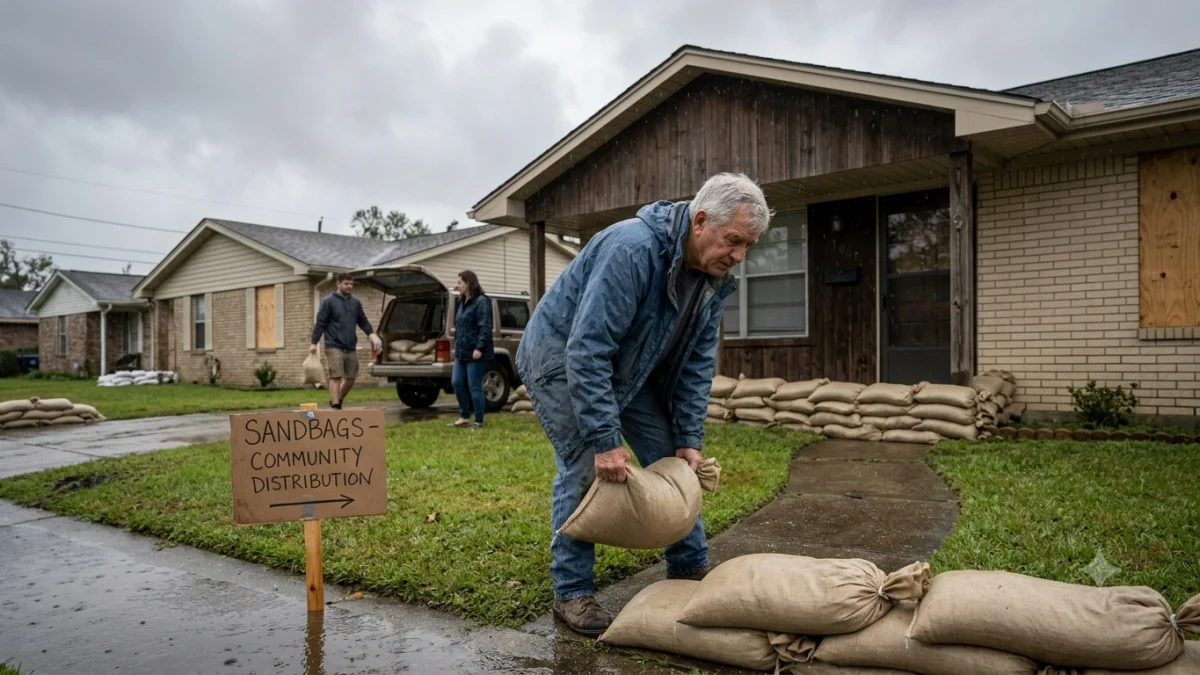
The stack of filled sandbags outside the Escambia County emergency distribution site grew steadily as residents loaded pickups and family cars under a humid Gulf Coast sky. Some came with trailers, others with only a few plastic bins and a plan to move treasured belongings to higher shelves before Tropical Storm Bertha arrived. For many, the preparations reflected a familiar routine shaped by years of living with hurricane seasons in which flooding, rather than wind alone, often determines how communities fare.
Across the northern Gulf Coast on Tuesday, families from Florida's Panhandle through Alabama, Mississippi and Louisiana watched forecasts that showed Bertha moving unusually slowly. Emergency officials urged residents in low-lying areas to prepare for prolonged heavy rainfall, coastal flooding and storm surge, warning that the storm's sluggish pace could increase flood risks even if it remained relatively modest in strength.
The storm's approach has become another reminder that for many Gulf Coast residents, hurricane preparation is measured not only by forecast wind speeds but by the possibility of water lingering for days.
The National Hurricane Center said Bertha strengthened into a tropical storm with maximum sustained winds of about 50 mph while moving only a few miles per hour toward the northern Gulf Coast. Tropical storm warnings stretched from the Florida-Alabama border into southeastern Louisiana, while storm surge watches covered vulnerable coastal areas. Forecasters warned of rainfall capable of triggering flash flooding from western Florida to parts of Texas later in the week, with isolated areas expected to receive significantly higher totals than surrounding communities.
In Pensacola, Florida, county officials opened sand distribution sites for residents in neighborhoods with a history of flooding. According to emergency management officials, the goal was to help households complete preparations before heavy rain began, reducing the need for travel once conditions deteriorated. The steady stream of vehicles reflected lessons learned from previous storms in which rising water cut off streets long before peak winds arrived.
Along Alabama's coast, red warning flags flew over beaches as authorities cautioned against dangerous surf and rip currents generated by the storm. The warnings affected not only tourists but also local businesses whose summer trade depends on beach visitors. Restaurant operators, charter fishing captains and hotel managers faced another interruption during what is normally one of the busiest periods of the year.
For families living near bays, rivers and marshes, flooding often represents the greatest uncertainty. Unlike stronger hurricanes that may pass quickly, slow-moving tropical systems can repeatedly send rain bands over the same communities. Emergency managers have increasingly emphasized that relatively weak tropical storms can still produce life-threatening flooding, particularly where drainage systems are already stressed or neighborhoods sit only slightly above sea level.
The Gulf Coast has experienced repeated examples in recent years of storms whose rainfall caused more lasting disruption than their winds. Those experiences have shaped how residents prepare. Many households now elevate important documents, move vehicles to higher ground and check on elderly relatives before conditions worsen, while schools, churches and community organizations coordinate support for vulnerable neighbors.
The preparations extend well beyond homes. Energy companies operating in the Gulf of Mexico began reducing offshore activity as the storm developed. Chevron said it had started shutting production at its Petronius platform and evacuated personnel from several offshore facilities while removing nonessential workers from additional sites. Although other operations continued, the company said it was taking precautionary measures as forecasts evolved.
The Gulf of Mexico plays a central role in the U.S. energy system, accounting for a significant share of domestic crude oil production and supporting roughly half of the nation's refining capacity. Even relatively limited disruptions can ripple through regional economies that depend on offshore employment, shipping and port operations. Utilities, including Houston-area provider CenterPoint Energy, also activated emergency preparations for the possibility of power outages if the storm tracked farther west.
Meteorologists said Bertha's slow forward speed complicated forecasting because small shifts in its track could change where the heaviest rain falls. While tropical cyclone forecasts have improved substantially over recent decades, rainfall remains one of the most difficult hazards to pinpoint precisely, particularly in slow-moving systems whose rain bands can repeatedly develop over the same locations.
That uncertainty leaves many residents balancing preparation with patience.
For longtime Gulf Coast families, storm readiness has become woven into seasonal routines. Emergency kits are refreshed, generators tested and evacuation plans reviewed even when officials stop short of recommending that people leave. Parents monitor school announcements while employers weigh business closures against the possibility that the storm's impacts may ultimately fall elsewhere.
Officials have continued urging residents not to focus solely on the forecast track but also on the hazards expected well beyond the storm's center. The National Hurricane Center warned that Bertha could produce storm surge, isolated tornadoes and several days of heavy rainfall across portions of the northern Gulf Coast, emphasizing that flooding can occur far from where the center eventually comes ashore.
As forecasts continued to update through the day, the lines for sandbags, the boarded storefronts and the stocked grocery carts reflected a familiar calculation repeated every hurricane season: preparing enough for the worst while hoping the water never rises high enough to test those preparations.