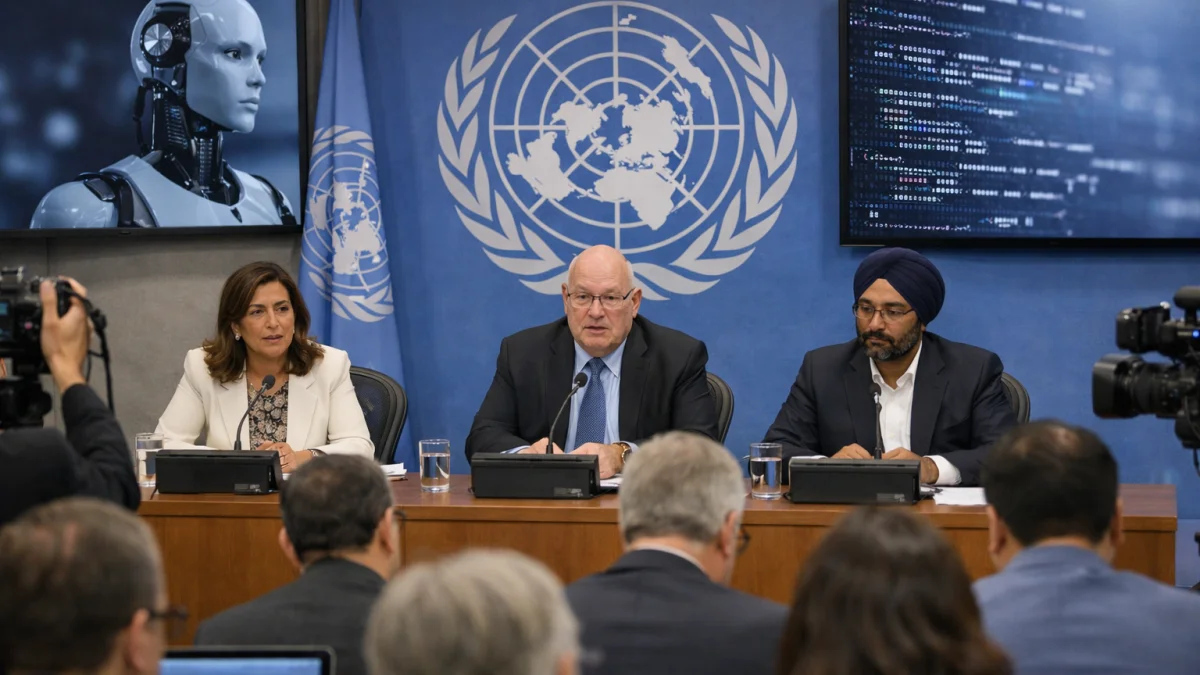
GENEVA — A United Nations independent scientific panel said artificial intelligence offers the potential to transform fields including healthcare, education, agriculture and scientific research, while warning that the technology’s rapid development is outpacing scientific understanding and government oversight, increasing the risk of serious harm if left unchecked.
The findings are contained in the preliminary report of the Independent International Scientific Panel on Artificial Intelligence, which is being presented at the inaugural U.N. Global Dialogue on AI Governance in Geneva on July 6-7. The report is the first global independent scientific assessment of AI commissioned under a U.N. mandate and is intended to provide governments with a common evidence base for future policy discussions.
The 40-member panel, composed of experts from all U.N. regions and operating independently of governments, companies and institutions, said AI systems are advancing faster than the evidence needed to assess their impacts and faster than regulatory frameworks can adapt. It said policymakers increasingly face decisions based on incomplete or rapidly changing information.
The report highlights opportunities for AI to improve productivity, accelerate scientific discovery and expand access to services such as healthcare and education. At the same time, it identifies growing risks including the spread of disinformation, cyberattacks, threats to human rights, environmental pressures from expanding computing infrastructure, and widening inequalities between countries with differing levels of access to advanced AI technologies.
Among the panel's concerns are increasingly capable autonomous, or "agentic," AI systems, the possibility of deceptive behavior by advanced models, and the lack of standardized independent methods for evaluating the safety of frontier AI systems. The report says many current safety assessments rely heavily on information supplied by AI developers, limiting governments' ability to independently verify risks.
U.N. Secretary-General António Guterres said at the report's launch that independent scientific evidence is essential for effective governance of AI. "The science is here," Guterres said. "We can no longer say we did not know. What we do with it is now up to all of us." He urged governments not to delay efforts to establish shared approaches for managing the technology's benefits and risks.
The panel emphasized that its preliminary report does not prescribe regulatory policies but instead synthesizes existing scientific evidence to support future international deliberations. It said consultations with researchers and additional thematic studies will continue before a more comprehensive report is issued in 2027 to inform the second Global Dialogue on AI Governance.