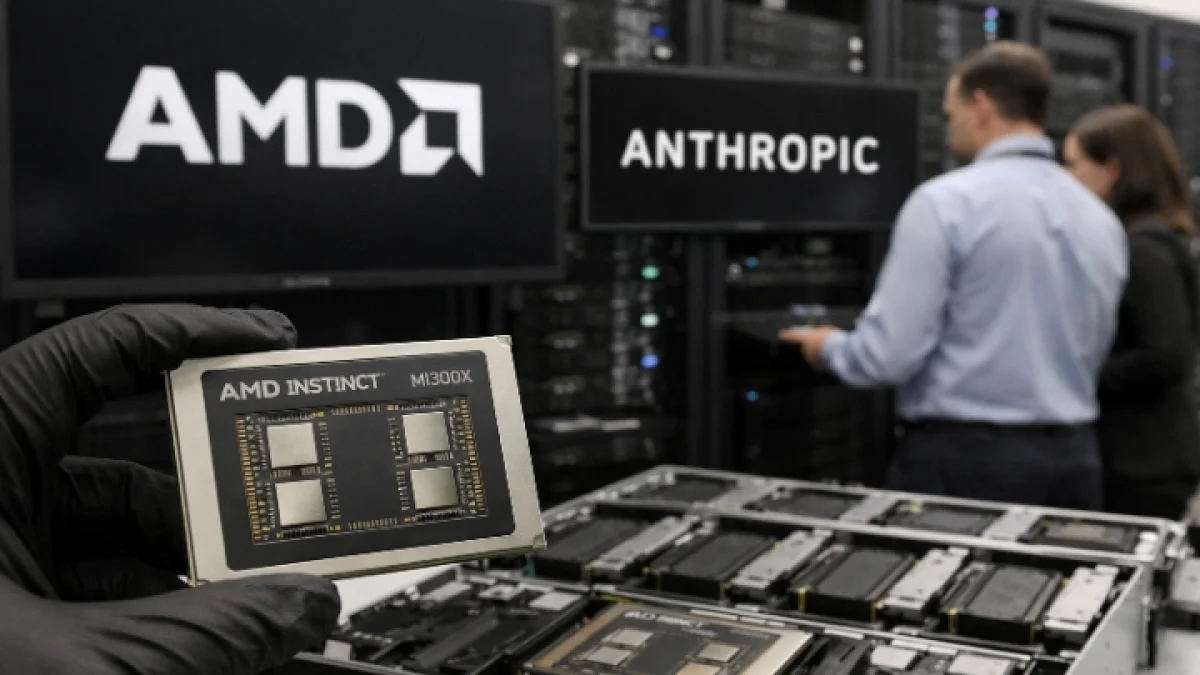
AMD’s agreement to supply Anthropic with a large-scale deployment of artificial intelligence chips marks one of the semiconductor industry’s most significant commercial wins outside Nvidia’s ecosystem, underscoring intensifying competition to provide the computing infrastructure underpinning advanced AI models.
The partnership, announced on July 23, combines a multibillion-dollar hardware agreement with a strategic investment by Advanced Micro Devices in Anthropic. Under the arrangement, Anthropic plans to deploy up to 2 gigawatts of AMD’s Instinct MI450-series GPUs through AMD’s Helios rack-scale systems, with the first phase scheduled to begin in the first half of 2027. AMD also said it intends to invest up to $5 billion in Anthropic as deployment milestones are met, representing its first direct equity investment in the AI developer.
The significance of the agreement extends beyond its financial scale. It provides AMD with another high-profile customer building frontier AI models, reinforcing its effort to establish itself as the leading alternative to Nvidia in a market where access to computing capacity has become a defining competitive advantage. The deal follows AMD’s expanding AI partnerships with companies including Microsoft, OpenAI and Meta, reflecting a broader strategy to build an integrated hardware and software ecosystem capable of serving the largest AI developers.
For Anthropic, the agreement represents another step toward diversifying its sources of computing infrastructure. The company already relies on cloud and hardware relationships involving Amazon, Google and Nvidia. By adding AMD as a major supplier, Anthropic reduces dependence on a single hardware platform while expanding the computing resources required to train and deploy increasingly sophisticated Claude models. Company executives said the partnership includes long-term engineering collaboration to optimize AMD hardware for Anthropic’s workloads.
The transaction also reflects an increasingly important shift in the economics of AI development. Rather than functioning solely as component suppliers, semiconductor companies are becoming strategic infrastructure partners that help finance, deploy and optimize massive computing systems. AMD indicated it may support future data-center deployments alongside its hardware supply, illustrating how AI infrastructure agreements increasingly combine chip sales, capital investment and software collaboration.
Industry analysts have argued that these arrangements acknowledge the enormous capital requirements associated with frontier AI systems. Training and operating advanced foundation models requires sustained access to vast quantities of graphics processors, networking equipment and data-center capacity. As demand has accelerated, technology companies have sought long-term supply agreements to secure future computing resources rather than relying solely on spot purchases.
For AMD, demonstrating that another frontier-model developer is willing to deploy its latest AI accelerators addresses one of the central questions facing investors: whether customers view AMD's hardware and software stack as sufficiently mature for production-scale AI workloads. Nvidia continues to dominate the market for AI accelerators, supported by its CUDA software ecosystem and extensive developer base. AMD has sought to narrow that gap through its ROCm software platform and successive generations of Instinct accelerators. The inclusion of Anthropic engineers in optimizing software and hardware integration may strengthen AMD's broader ecosystem if resulting improvements become available to other enterprise customers.
The timing is also notable. The announcement coincides with AMD's broader push to position itself as a full-stack AI infrastructure provider rather than a manufacturer of individual chips. Recent announcements have highlighted integrated rack-scale systems combining GPUs, EPYC processors, networking technology and software designed to compete with increasingly comprehensive AI platforms offered by rivals. Microsoft's decision earlier this week to deploy AMD's Helios systems for Azure AI services demonstrated growing hyperscale support for that strategy.
From a competitive perspective, the agreement suggests that the AI infrastructure market is becoming more diversified even as overall demand continues to expand. Major AI developers increasingly appear willing to source hardware from multiple vendors to improve supply resilience, manage costs and reduce dependence on a single supplier. While Nvidia remains the dominant provider of AI accelerators, large customers are investing in alternative hardware ecosystems as AI deployments scale globally.
The investment component also highlights the increasingly intertwined relationships between chipmakers and AI developers. Financial investments can strengthen long-term commercial partnerships while helping AI companies finance the infrastructure needed to expand model development. At the same time, such arrangements may draw greater attention from investors and regulators regarding competitive dynamics and governance as technology companies deepen strategic ties across the AI supply chain.
The announcement does not immediately alter the competitive balance of the AI chip market, where Nvidia retains a substantial lead in shipments, software adoption and installed infrastructure. However, securing another large frontier AI customer provides AMD with additional commercial validation at a time when customers are evaluating long-term hardware roadmaps rather than individual product generations.
The confirmed development therefore represents more than a single procurement contract. It illustrates how AI competition is increasingly defined by long-term infrastructure alliances combining semiconductor technology, cloud deployment, software optimization and financial investment. Officials from AMD and Anthropic have confirmed deployment plans beginning in 2027, while industry observers will monitor execution milestones, data-center expansion, software performance and broader customer adoption to assess how the partnership affects competition in the rapidly evolving AI infrastructure market.