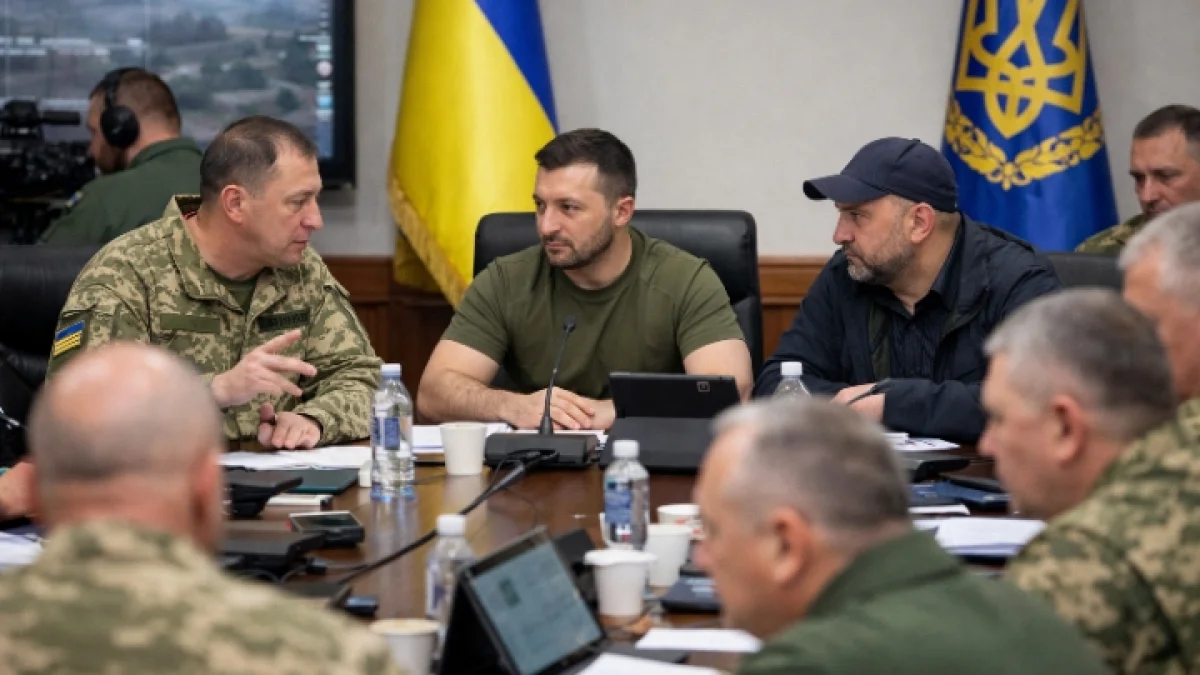
Ukraine’s decision to replace its top military commander, General Oleksandr Syrskyi, with Major General Mykhailo Drapatyi is the clearest sign yet that Kyiv is seeking to align its wartime command structure with a more technology-intensive model of fighting, while also addressing longstanding questions about military management and manpower. President Volodymyr Zelenskiy announced the change on July 21, praising Syrskyi’s record while saying he had discussed changes to the General Staff with Drapatyi and other senior officials. The reshuffle follows the recent removal of Defence Minister Mykhailo Fedorov and the appointment of Evgeniy Khmara as acting defence minister.
The significance lies less in the replacement of one general than in the institutional direction Kyiv is now emphasizing. Ukraine has spent the past two years building a defence system in which drones, electronic warfare, autonomous systems, digital procurement and domestic weapons production play an increasingly central role. The leadership changes come as the government seeks to make those capabilities more closely connected to battlefield requirements and military command, potentially reducing the gap between technology developers, procurement agencies and frontline units.
The scale of the technology push is substantial. Ukraine’s Defence Procurement Agency said it signed contracts worth 333.6 billion hryvnias for drones during the first half of 2026, roughly twice the value contracted in the same period a year earlier. The ministry said frontline units can use the DOT-Chain Defence marketplace to select equipment directly from allocated budgets, with average delivery times for in-stock products ordered through the platform at nine days. Such mechanisms are intended to shorten the traditional procurement cycle and give commanders greater influence over what reaches units.
The government is also trying to institutionalize the defence-technology ecosystem. Brave1, Ukraine’s defence innovation cluster, said this month it had identified 53 technology priorities across nine areas and was offering grants of up to 8 million hryvnias for projects ranging from concept validation to finished prototypes. The programme reflects a broader effort to move innovation from small-scale experimentation toward systems that can be rapidly tested, adopted and produced at scale.
That approach has been reinforced at the highest political level. Zelenskiy said in early July that Ukraine was expanding production of drones, unmanned ground systems, missiles and electronic-warfare equipment, while arguing that domestic production could eventually exceed Russia’s capacity in some technologically advanced weapons. Ukraine has also deepened international cooperation around defence technology: a July agreement with the Netherlands covers drones, cybersecurity, research and development and joint production, with Dutch military support pledged through 2029.
The change in military leadership therefore comes against a backdrop in which technology is increasingly treated as a strategic capability rather than simply another category of equipment. Ukraine’s Defence Ministry said in June that drones accounted for more than 90% of enemy targets hit in its reported operations since the beginning of 2026, although those figures are Ukrainian government claims and are not independently verifiable from the available public information. The ministry’s broader reporting illustrates how unmanned systems have become integral to Ukraine’s approach to reconnaissance, strike operations and battlefield attrition.
The reshuffle also carries a management dimension. Syrskyi, who became commander-in-chief in early 2024, leaves after a period in which Ukraine has continued to conduct offensive and defensive operations but has faced persistent challenges over manpower, command structures and the efficiency of military decision-making. Reuters reported that Syrskyi said Ukraine had recaptured about 700 square kilometres in 2026, while emphasizing that the armed forces remained capable of both defence and offensive action. His replacement, Drapatyi, is a younger combat commander whose appointment gives the new leadership an opportunity to reassess operational priorities and the relationship between battlefield command and rapidly evolving technology.
There are competing interpretations of what the shakeup means. One is that Kyiv is attempting a deliberate modernization of military leadership, placing greater emphasis on technology, faster procurement and adaptation. Another is that the changes reflect unresolved institutional tensions over how scarce resources should be allocated between conventional forces and emerging technologies. The recent departure of Fedorov, who had been associated with digitalization and defence innovation, underlines that technology reform alone does not eliminate disagreements over operational priorities. The appointment of Khmara as acting defence minister, with instructions to continue defence-sector reform and technology-enabled strike programmes, suggests that the modernization agenda itself remains in place despite the personnel changes.
The immediate test will be whether the new command structure can translate Ukraine’s technological advantages into sustained battlefield effectiveness while addressing manpower, logistics and coordination. The confirmed changes show a government seeking tighter integration between military leadership, defence procurement and innovation. What remains uncertain is how quickly Drapatyi and the wider leadership team will reshape the General Staff, how the new structure will affect frontline decision-making, and whether Ukraine can maintain the pace of technological development amid continued Russian attacks. Those issues, along with the implementation of ongoing defence reforms and the delivery of military support from international partners, will be closely monitored as the new leadership takes control.