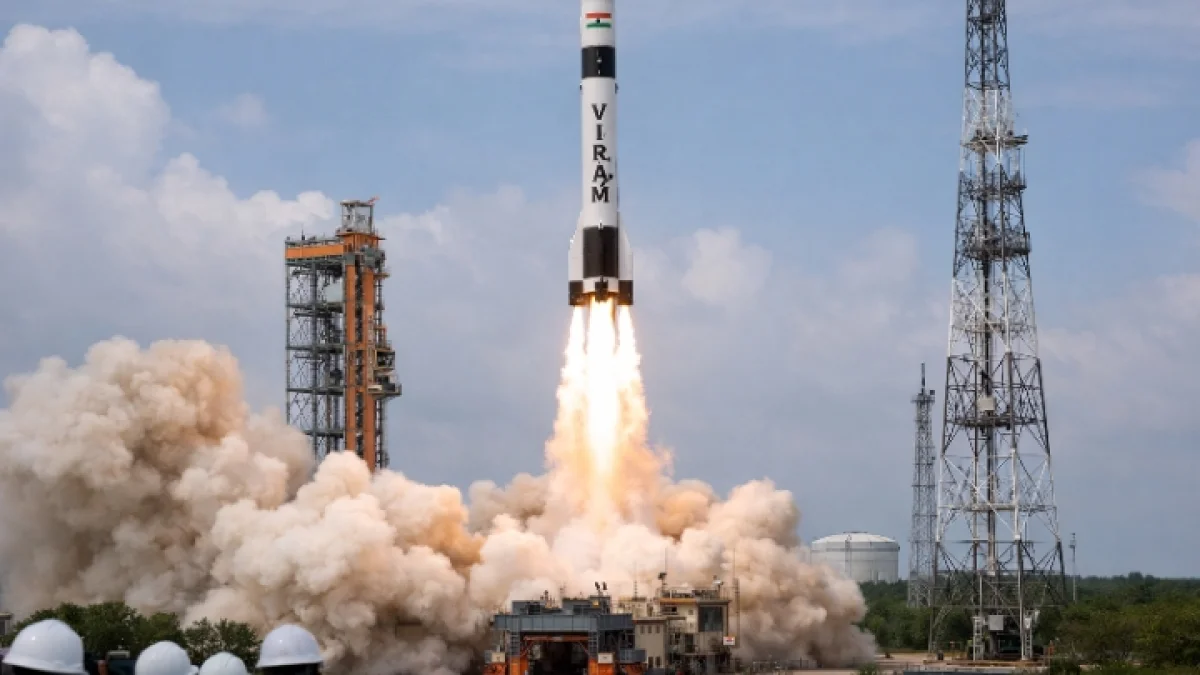
SRIHARIKOTA, India—India's push to expand its role in the global commercial space industry gained momentum after Skyroot Aerospace successfully launched the Vikram-1 rocket into low Earth orbit, completing the country's first privately developed orbital launch and marking a milestone for its rapidly growing private space sector.
The Vikram-1 rocket lifted off from the Indian Space Research Organisation's (ISRO) Satish Dhawan Space Centre at 12:05 p.m. local time on July 18 as part of its maiden "Mission Aagaman" flight. ISRO said the mission successfully deployed multiple payloads into low Earth orbit, making Skyroot the first private Indian company to achieve an orbital launch from Indian soil.
Developed by Hyderabad-based Skyroot Aerospace, Vikram-1 is designed to carry payloads of up to about 350 kilograms into low Earth orbit. According to the Indian government, the vehicle incorporates an all-carbon composite structure, solid-fuel propulsion stages and a 3D-printed liquid engine, reflecting advances in India's domestic launch capabilities.
The maiden mission carried several commercial and technology demonstration payloads, including Skyroot's SCOPE satellite, Grahaa Space's SOLARAS S3 satellite, Germany-based DCUBED's technology payload and Cosmoserve Space's Embrace orbital debris-capture demonstration. ISRO said two satellites, SCOPE and Grahaa, were successfully injected into orbit during the mission.
The launch follows reforms introduced by the Indian government in 2020 that opened the country's space sector to greater private participation. Those measures led to the establishment of new regulatory mechanisms and accelerated investment in space startups seeking to compete in the global small-satellite launch market. ISRO said the successful mission demonstrates the impact of those policy changes and strengthens India's commercial launch capabilities.
India joins a small group of countries with privately developed orbital launch capabilities, underscoring intensifying international competition in the race to provide lower-cost access to low Earth orbit as demand for satellite deployment continues to grow. Industry analysts say the expanding market is being driven by communications, Earth observation and technology demonstration missions, although sustained commercial success will depend on regular launch operations and customer demand.
The Vikram-1 mission concluded after meeting its primary objectives, according to ISRO and Skyroot Aerospace. Officials have not announced a date for the company's next orbital launch, but said data collected from the maiden flight will support future commercial missions.