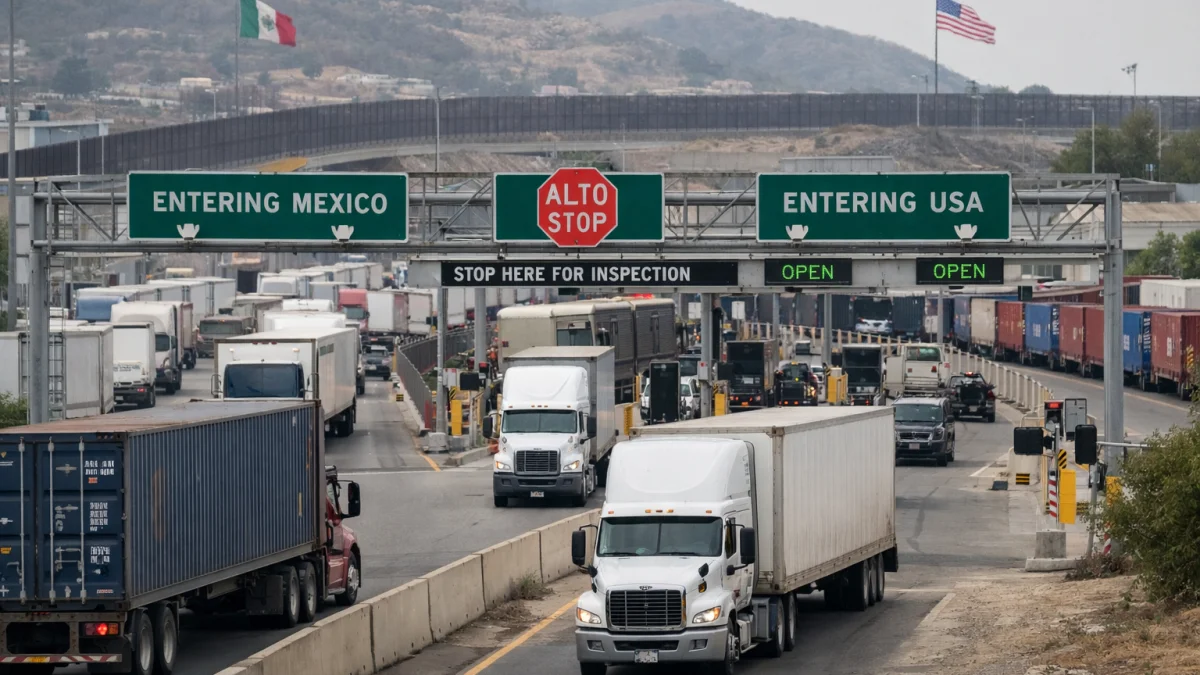
The United States' decision not to renew the United States-Mexico-Canada Agreement (USMCA) in its current form has shifted North America's trade framework into a prolonged period of annual reviews rather than delivering the long-term certainty that many businesses had expected from the agreement's first mandatory six-year review. While the pact remains fully in force, the outcome marks a significant change in the region's policy outlook because it introduces an extended period of negotiation over rules governing roughly $1.6 trillion in annual trade among the three economies.
The immediate legal consequences are limited. USMCA's tariff preferences, rules of origin, dispute settlement mechanisms, and other provisions continue to apply. Under the agreement's review clause, failure to approve a 16-year extension does not terminate the pact. Instead, the three governments will conduct annual reviews, and the agreement will remain effective until 2036 unless the parties either agree to extend it earlier or one chooses to withdraw under the treaty's provisions.
The significance lies less in today's commercial rules than in the uncertainty surrounding tomorrow's. Trade agreements are intended to reduce policy risk by giving manufacturers, investors and exporters confidence that production networks can operate under stable rules for many years. The absence of a long-term extension means companies planning investments in automotive production, semiconductors, agriculture, energy and advanced manufacturing must now evaluate the possibility of recurring negotiations over market access, tariffs and regional content requirements.
The Trump administration has argued that the agreement has not sufficiently reduced U.S. trade deficits or secured improved market access in areas including agriculture and energy. U.S. Trade Representative Jamieson Greer said the administration intends to pursue revisions rather than maintain the agreement unchanged. Officials have also indicated that stricter rules of origin, particularly for industrial products and automobiles, will be a priority during upcoming negotiations.
For Canada and Mexico, the decision creates a more complex negotiating environment. Both governments have indicated their willingness to continue discussions while emphasizing the importance of preserving the integrated North American market. Mexican Economy Minister Marcelo Ebrard has acknowledged U.S. concerns while warning against measures that could undermine Mexico's automotive sector, which has become deeply integrated with U.S. and Canadian manufacturing over decades of continental supply-chain development.
The automotive industry illustrates why the review matters beyond trade policy. Modern vehicle production depends on components crossing borders multiple times before final assembly. USMCA strengthened regional content requirements compared with its predecessor, the North American Free Trade Agreement (NAFTA), encouraging greater North American sourcing. Additional tightening of those requirements could support some domestic manufacturing objectives while also increasing compliance costs and production complexity for manufacturers operating across the three countries. Industry groups have warned that greater regulatory uncertainty could delay investment decisions and raise costs if negotiations remain unresolved for an extended period.
Agriculture represents another area where stability carries substantial economic importance. Canada and Mexico remain among the largest export markets for U.S. agricultural products, while U.S. consumers rely heavily on imports of seasonal produce and other goods from Mexico. Farm organizations have generally supported preserving the trilateral framework, arguing that predictable market access is essential for long-term production and investment decisions. At the same time, longstanding disputes over dairy, corn and sanitary regulations remain central issues in the current negotiations.
The broader economic implications extend to corporate investment planning. Economists have long argued that businesses respond not only to current tariff levels but also to expectations about future policy. North America's recent push toward supply-chain resilience and near-shoring has encouraged manufacturers to expand production closer to the U.S. market. Analysts note that recurring annual reviews may complicate those decisions because firms considering multi-billion-dollar investments generally prefer regulatory certainty over prolonged negotiations, even when existing trade rules remain unchanged.
Historical context underscores the importance of the current review. USMCA entered into force in 2020 after replacing NAFTA, incorporating updated provisions on digital trade, labor standards and automotive rules while introducing the six-year review mechanism. Supporters argued that the review process would ensure the agreement remained current. Critics cautioned that the mechanism could periodically introduce uncertainty into investment decisions. The present outcome demonstrates how that review clause can become a focal point for broader economic and political negotiations rather than a routine assessment.
Financial markets have so far reacted relatively calmly, reflecting expectations that negotiations will continue rather than produce an immediate disruption to continental trade. Nevertheless, policy analysts note that uncertainty itself can influence corporate behavior, particularly in sectors with long investment horizons such as manufacturing, infrastructure and energy. The eventual economic impact will depend less on the July decision itself than on whether the three governments can reach agreement on revisions that preserve confidence in North America's integrated trading system.
For now, the confirmed position is that USMCA remains fully operational while annual reviews begin. Negotiators from the United States, Canada and Mexico are expected to continue discussions on market access, rules of origin and other contested provisions. Governments, businesses and investors will be closely monitoring those negotiations for evidence of whether they move toward a revised long-term agreement or a prolonged period of recurring trade-policy uncertainty.