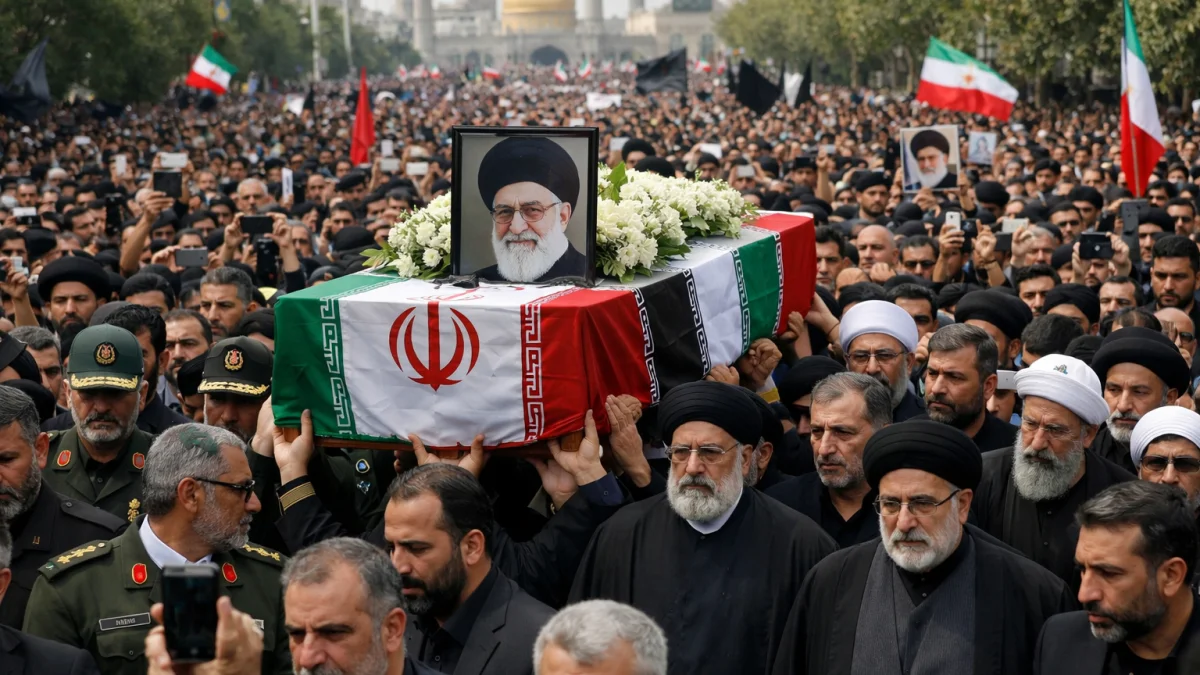
The public funeral for Iran's late Supreme Leader, Ayatollah Ali Khamenei, has become more than a national mourning ceremony. Held months after his death in the opening phase of the 2026 U.S.-Israeli war against Iran, the week-long series of processions has emerged as the first major nationwide test of political authority under the country's new leadership, offering an early indication of how the Islamic Republic is managing its most consequential succession since 1989.
The significance extends beyond the scale of the ceremonies. Iran's leadership transition occurred under extraordinary circumstances: the killing of the country's supreme leader during wartime, extensive military losses among senior officials, and continuing uncertainty surrounding a fragile ceasefire. In that context, the state's ability to organize mass public events, maintain security, and project institutional continuity has become a measure of regime stability as much as an expression of public mourning.
Iranian state institutions have devoted substantial resources to the funeral, which spans multiple cities, including Tehran, Qom, Mashhad, and religious sites in Iraq before Khamenei's burial. Officials have presented the ceremonies as a demonstration of national unity, religious devotion, and resilience after months of conflict. Reuters reported that tens of thousands gathered in Tehran for the opening ceremonies despite the country's recent military and political upheaval.
For analysts of Iranian politics, however, the funeral's importance lies less in attendance figures than in institutional continuity. Iran's political system has historically sought to demonstrate that authority resides not solely in an individual leader but in interconnected institutions including the Supreme Leader's office, the Islamic Revolutionary Guard Corps, the Assembly of Experts, and the broader clerical establishment. A smooth transition after Khamenei's death would reinforce that narrative by showing that succession mechanisms remain functional even during external conflict.
Historical precedent supports this interpretation. The transition following Ayatollah Ruhollah Khomeini's death in 1989 was managed rapidly to minimize uncertainty and preserve political order. Today's transition is more complex because it follows a wartime assassination rather than a natural succession and occurs amid continuing geopolitical tensions and economic pressure. Nevertheless, state institutions have continued operating without visible signs of constitutional breakdown.
Another closely watched aspect has been the public profile of Khamenei's successor, Mojtaba Khamenei. According to Reuters, he has not appeared publicly during the funeral, with reports indicating he was injured during the February strike and remains absent for security reasons. His absence has inevitably attracted attention because major state ceremonies traditionally offer new leaders opportunities to consolidate public authority. Iranian officials have instead emphasized continuity of governance rather than personal leadership, suggesting security considerations currently outweigh symbolic public appearances.
That absence has generated differing interpretations. Some observers argue that a limited public profile could delay the personal consolidation of authority normally associated with a new supreme leader. Others contend that Iran's leadership is intentionally prioritizing institutional legitimacy over individual visibility while security risks remain elevated. Neither interpretation can yet be confirmed, and available evidence does not indicate institutional paralysis.
The funeral also illustrates the dual nature of political legitimacy in the Islamic Republic. Large state-organized gatherings reinforce official narratives of popular support and religious solidarity. At the same time, independent analysts caution that participation in state ceremonies alone cannot fully measure broader public opinion, particularly after years of economic hardship, domestic protests before the war, and political polarization. Opposition figures outside Iran have characterized the ceremonies differently, arguing that they primarily reflect state mobilization rather than universal public sentiment. Those competing interpretations remain difficult to verify independently.
Internationally, the funeral carries diplomatic significance as well. It takes place while Iran seeks to stabilize its regional position following months of conflict and amid a fragile ceasefire with the United States and Israel. The leadership transition therefore affects not only domestic governance but also future decision-making on security, diplomacy, and economic recovery. Foreign governments are watching for evidence that Iran's command structure remains coherent and capable of implementing policy consistently despite leadership change.
Security arrangements surrounding the ceremonies further underscore official concerns about stability. Extensive protective measures, combined with the reported decision to limit the new leader's public exposure, reflect assessments that symbolic national events could present security vulnerabilities. Such precautions are consistent with the broader environment created by the recent conflict rather than evidence of political fragmentation.
Taken together, Khamenei's funeral suggests that Iran's governing institutions remain operational during an unprecedented leadership transition, even as questions persist about the long-term consolidation of authority under the new supreme leader. The ceremonies have so far demonstrated organizational capacity and institutional continuity, but they do not resolve broader uncertainties over Iran's future political trajectory, domestic legitimacy, or regional strategy. Those questions will be assessed over time through future policy decisions, the public role assumed by the country's new leadership, and the durability of the post-war political settlement.