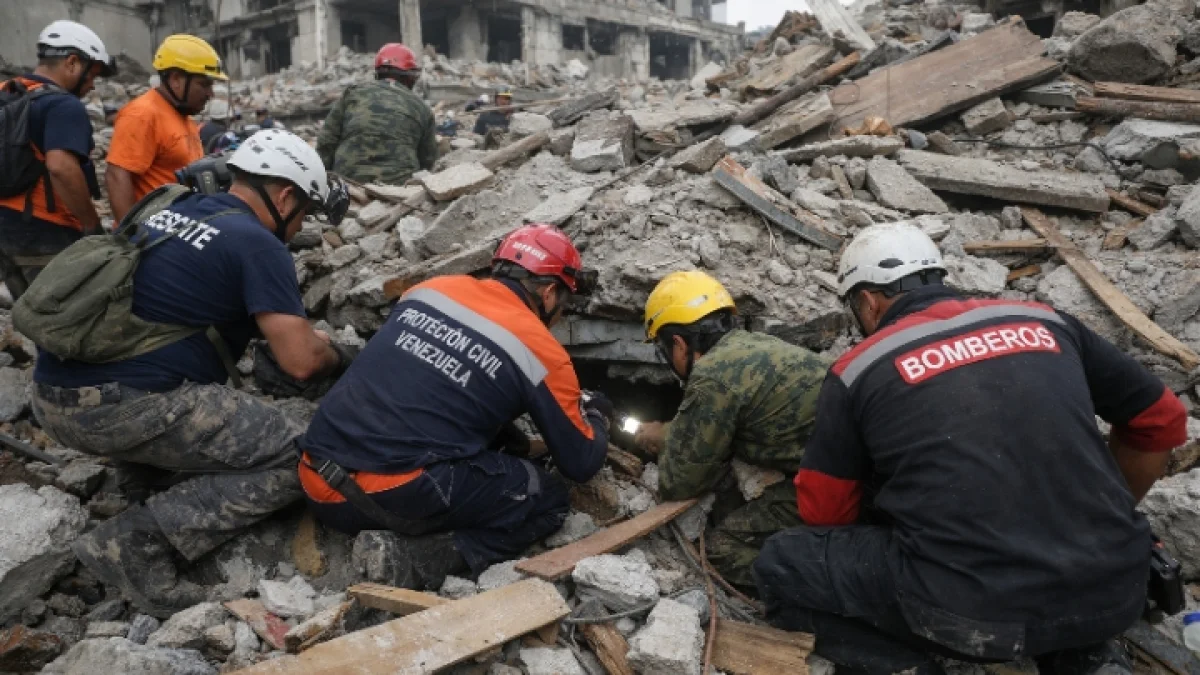
The search teams move carefully across unstable slabs of concrete, pausing at regular intervals to call for silence before listening for any sound beneath the rubble. Rescue dogs weave through shattered buildings while engineers monitor damaged structures for signs they could collapse again. Weeks after twin earthquakes struck Venezuela's northern coast, the work has become slower, more methodical and increasingly focused on places where rescuers still believe someone could be alive.
The operations unfolding across parts of La Guaira and Caracas illustrate both the persistence of rescue workers and the uncertainty facing thousands of families still waiting for news of missing relatives. Although the chances of finding survivors diminish with each passing day, emergency crews have continued searching with thermal cameras, geophones and heavy machinery, encouraged by several rescues that occurred well beyond the period generally considered most critical after earthquakes.
For many residents, the search has become a daily ritual shaped by hope, exhaustion and community solidarity. In Caraballeda, resident Juan Andrade told Reuters he joined rescue efforts despite having no formal emergency training, driven by the possibility that members of his own family remained trapped.
"When I pulled out nine people, it was with my bare hands only, and I am not a rescuer, I am not a firefighter, I am not a paramedic," Andrade said while helping search a collapsed residential building. He added that although he had not found anyone alive after the first days, he intended to continue searching for his relatives and others still missing.
His experience reflects a broader pattern seen across the disaster zone, where neighbors, volunteers and international rescue specialists have worked side by side since the twin earthquakes struck on June 24. Teams from dozens of countries joined Venezuelan emergency personnel, bringing search dogs, specialized listening equipment and structural engineers to support local operations.
Authorities have repeatedly warned that the scale of destruction makes recovery slow. Thousands of buildings suffered damage or collapsed entirely, while continuing aftershocks complicated rescue efforts by weakening already unstable structures and forcing crews to suspend work periodically for safety inspections.
Official figures released in mid-July placed the death toll above 5,000, with more than 16,000 injured. Hundreds of buildings were damaged or destroyed, making the disaster one of Venezuela's deadliest natural catastrophes in modern history. Authorities said the casualty count continued to rise as debris removal reached previously inaccessible areas.
The disaster has also raised questions about the country's emergency response capacity. Reuters reported that delayed deployment orders, confusion over command structures and shortages of equipment slowed military assistance during the crucial first hours after the earthquakes. Multiple witnesses, soldiers and rescue personnel described civilians and volunteer groups beginning searches before significant official resources arrived. Government officials have defended their response, saying thousands of personnel were eventually deployed and international assistance was coordinated as conditions evolved.
For families, however, the immediate concern has remained finding relatives rather than assigning responsibility.
One family whose search drew national attention spent more than two weeks trying to recover the body of 23-year-old physiotherapist Alexandra Yarismar Guedez García after her apartment building collapsed. Relatives were joined by volunteers from their hometown, who eventually located her beneath the rubble before accompanying her remains home for burial. Their journey highlighted the long emotional and logistical process many families continue to face even after active rescue operations begin transitioning toward recovery.
Rescue workers say every successful recovery, whether of a survivor or someone who died, provides families with answers that many have lacked since the earthquakes struck.
The searches have occasionally produced moments that renewed optimism. International teams succeeded in rescuing several survivors days after the disaster, reinforcing the determination of crews to continue working despite increasingly difficult conditions. Such rescues, while rare, have underscored why emergency specialists often refuse to abandon searches solely because conventional survival timelines have passed.
Alongside rescue operations, humanitarian organizations and government agencies have expanded temporary shelters, medical services and food distribution for displaced residents. Engineers continue inspecting homes, schools and public infrastructure to determine which buildings can be safely occupied and which must be demolished. International aid agencies have warned that recovery will extend well beyond the end of search-and-rescue operations as communities rebuild housing, transportation networks and public services.
Even as the disaster gradually shifts from rescue to reconstruction, the work among the ruins has not entirely stopped.
At damaged buildings across the affected region, rescuers still pause periodically, asking everyone nearby to remain quiet before listening through layers of broken concrete. The silence lasts only moments before machinery starts again, but it reflects a commitment shared by professionals and volunteers alike: that as long as there remains a credible possibility of finding someone beneath the rubble, the search continues.