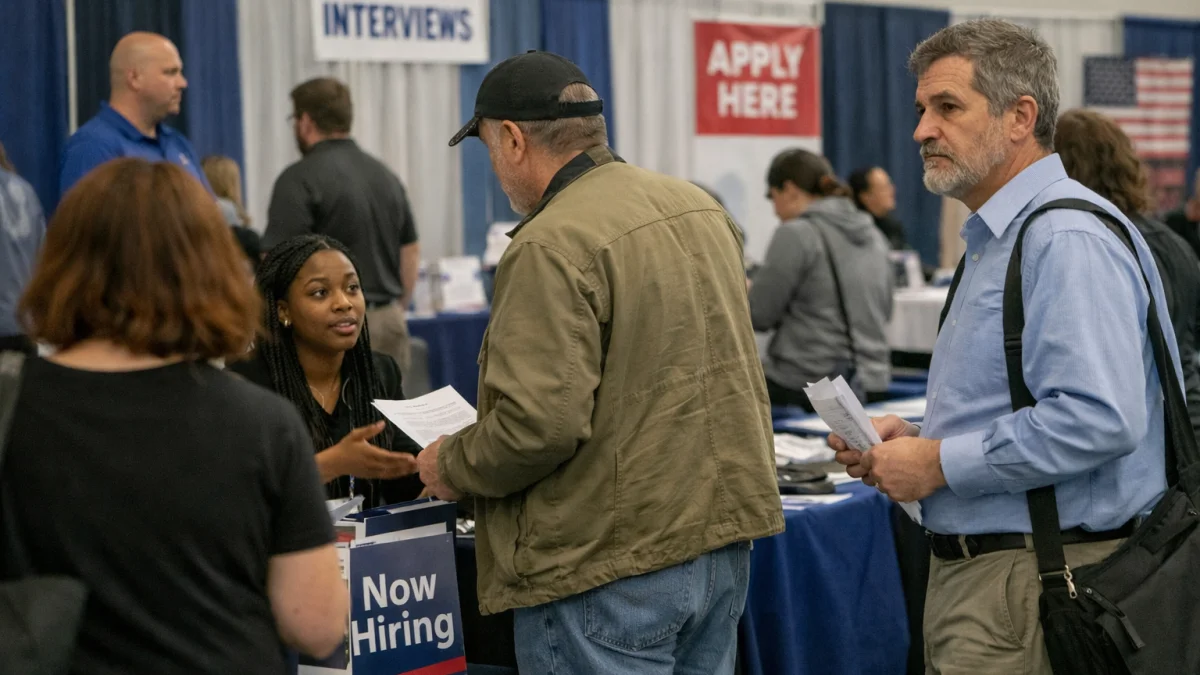
Private-sector hiring slowed in June 2026, with payroll processor ADP estimating that U.S. businesses added 98,000 jobs, a weaker pace than the prior month and below most economists’ expectations. The report, released ahead of the official government employment data, indicates a broad moderation in hiring momentum across key service industries, reinforcing signs that the U.S. labor market is gradually cooling after a multi-year period of resilience.
The significance of the data lies not in a sharp contraction but in the direction and consistency of the slowdown. The June figure marks a step down from May’s gain of about 122,000 jobs and continues a pattern of uneven monthly job creation. ADP data—derived from payroll records covering millions of private-sector workers—are closely watched as a high-frequency indicator of labor demand ahead of the Bureau of Labor Statistics’ more comprehensive Nonfarm Payrolls report. While the two series often diverge month-to-month, sustained directional alignment can shape expectations for broader employment trends and monetary policy.
Sector composition reinforces the cooling narrative. Hiring remained concentrated in education and health services, while financial activities, trade, transportation, and information services posted moderate gains. At the same time, leisure and hospitality continued to show comparatively weak momentum, and goods-producing industries contributed only marginally to overall growth. This uneven pattern suggests that demand is not collapsing but is becoming more selective, with employers prioritizing essential or structurally expanding sectors while scaling back discretionary hiring.
A key analytical implication of the report is the balance between labor demand and supply. ADP’s chief economist has characterized recent conditions as a combination of slower hiring and ongoing labor-market frictions, including longer job-finding times and localized labor shortages in certain industries. That combination is consistent with a “soft landing” dynamic, where job growth decelerates without triggering broad-based layoffs.
Wage dynamics provide additional context. ADP data indicate that pay growth for job stayers has remained relatively stable in recent months, even as hiring has slowed. This suggests that employers are not broadly reducing compensation pressure, which is typically a sign that labor demand, while cooling, remains sufficient to retain existing workers. For policymakers, stable wage growth alongside slower hiring complicates the interpretation of labor-market slack, as it may indicate a gradual rebalancing rather than a sharp deterioration.
The Federal Reserve is likely to view the report through the lens of its dual mandate, particularly as inflation dynamics remain a parallel concern. Softer hiring reduces the risk of sustained wage-driven inflation pressures, but the absence of significant labor weakening may reduce urgency for monetary easing. Market reactions following the ADP release have reflected this tension, with modest adjustments in rate expectations rather than a decisive repricing of policy outlooks.
Historical comparisons underscore the current transition. During prior U.S. labor-market slowdowns associated with monetary tightening cycles, private payroll growth typically decelerated in stages before broader employment indicators followed. However, the present cycle differs in that job growth has remained positive even as momentum slows, suggesting a less abrupt adjustment than in earlier downturns. This has reduced near-term recession signaling, but increased uncertainty around the timing and magnitude of any further cooling.
Looking ahead, attention is focused on the upcoming official employment report from the Bureau of Labor Statistics, which will provide a broader measure of job creation, unemployment, and wage growth across both public and private sectors. Analysts will be watching whether the ADP slowdown is confirmed in official data or whether it reflects sectoral or methodological divergence. Additional clarity is also expected from revised prior-month figures, which have in past cycles materially altered assessments of labor-market strength.
At present, the confirmed data point is a continued moderation in U.S. private payroll growth rather than a sharp downturn. The trajectory suggests a labor market that is gradually cooling, with uneven sectoral performance and stable wage growth, while remaining under close observation by policymakers and markets for signs of either stabilization or further softening in forthcoming government data releases.