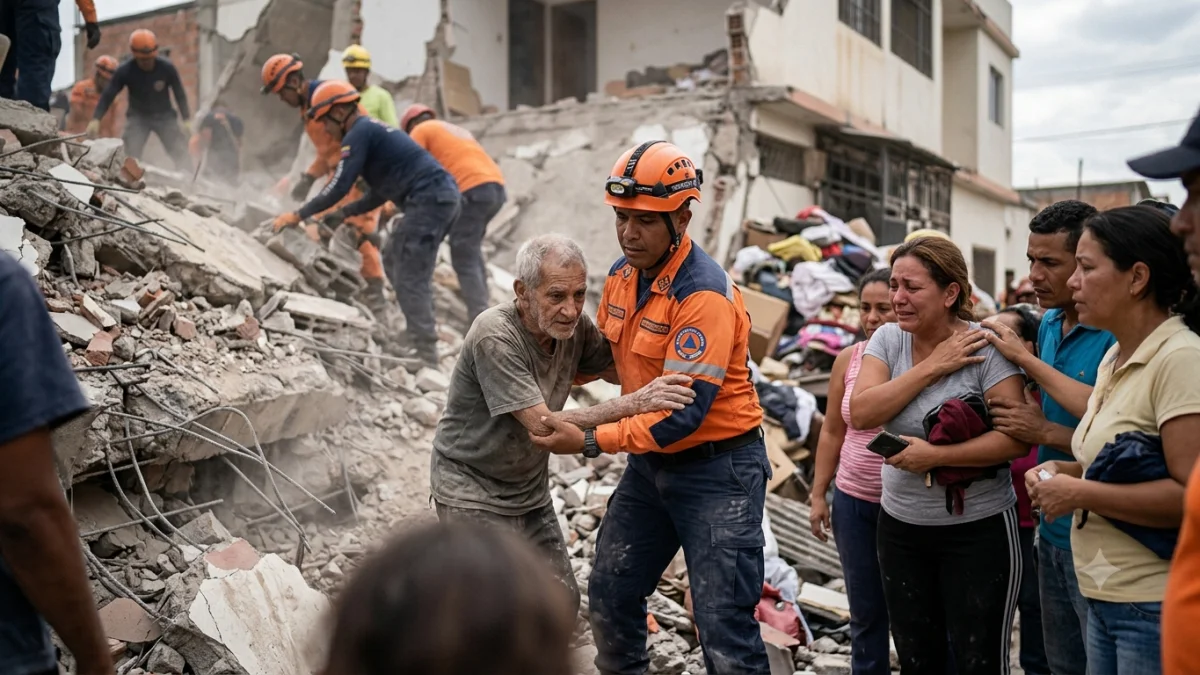
The search through shattered apartment blocks has stretched far beyond the period when earthquake rescues are typically expected to yield survivors, but in Venezuela's hardest-hit communities, families have continued to gather beside piles of broken concrete, hoping that every sound from beneath the rubble might still matter.
That hope has been sustained by a handful of extraordinary rescues since the twin earthquakes struck Venezuela's northern coast on June 24, devastating neighborhoods in La Guaira state and parts of Caracas. Emergency crews, international specialists, volunteers and relatives have worked side by side through weeks of dangerous recovery operations, sometimes celebrating the discovery of survivors, more often recovering those who did not escape.
For many families, the search has become about more than survival. It is also about finding loved ones, recovering personal belongings and bringing a measure of closure after one of the country's deadliest natural disasters in generations.
The earthquakes, measuring magnitudes 7.2 and 7.5, destroyed apartment buildings, damaged infrastructure and displaced thousands. Government figures released in mid-July put the death toll above 4,800, with more than 16,000 injured and nearly 18,000 left homeless. Officials have cautioned that the toll could continue to rise as recovery efforts progress.
In the first days after the disaster, many rescues were carried out not by professional emergency responders but by neighbors using their hands, shovels and improvised tools. Residents climbed unstable slabs of concrete, formed human chains and tunneled through collapsed buildings while waiting for heavier equipment.
Juan Andrade, searching for relatives in the wreckage, told Reuters during the first week that he had pulled nine people alive from collapsed buildings despite having no formal rescue training.
"When I pulled out nine people, it was with my bare hands only," Andrade said. "I am not a rescuer, I am not a firefighter, I am not a paramedic." Even after the chances of finding survivors diminished, he said his faith remained intact that more people could still be found alive.
Elsewhere in La Guaira, Alexander Delgado, a physical education teacher who became an impromptu rescue organizer, described volunteers waiting for heavy machinery capable of lifting massive concrete slabs.
"We're waiting for the state's heavy machinery," Delgado told Reuters. "Every minute counts for those people who are down there under the rubble." Volunteer Miguel Poleo likewise said he hoped to see greater involvement from public agencies while emphasizing that neighborhood crews would continue searching regardless.
As days turned into weeks, the focus in many locations shifted from rescue to recovery. Yet isolated discoveries of survivors reinforced the determination of rescuers and relatives alike, challenging assumptions about how long people could remain alive beneath collapsed structures when air pockets and limited access to water existed.
Those rare rescues became symbols of endurance in communities where thousands of families continued to wait for news.
For others, the wait ended only when bodies could finally be recovered.
Speaking to Reuters after recovering the remains of her daughter and mother more than two weeks after the earthquakes, Elena Paredes described relying largely on neighbors for help.
"It wasn't until today, after 15 days, that I was able to rescue my daughter and my mother," she said. Alongside the bodies, neighbors helped recover photographs and other possessions from the damaged building—items she described as keepsakes tied to family memories.
The prolonged searches have unfolded alongside growing scrutiny of the official emergency response.
A Reuters investigation published this week, based on interviews with military sources, witnesses and rescue workers, reported delays in deploying troops, confusion over command structures and shortages of equipment during the crucial early hours after the earthquakes. Civilians and international rescue teams were often first to reach collapsed buildings, according to those accounts, while government officials have defended the scale of their response and disputed criticism.
The disaster has also drawn substantial international assistance. Foreign rescue teams joined Venezuelan responders in the days after the earthquakes, bringing specialized equipment, rescue dogs and engineering expertise. Their arrival expanded search operations across some of the worst-hit neighborhoods, although residents in several communities said volunteers had already spent days digging before outside assistance reached them.
Beyond the search zones, displacement has reshaped daily life. Thousands remain in temporary shelters or improvised camps after losing homes that either collapsed or were declared unsafe. Families have worked to retrieve furniture, documents and treasured belongings from damaged buildings whenever engineers judged entry possible, even as aftershocks complicated those efforts.
The earthquakes have also exposed longstanding vulnerabilities in Venezuela's infrastructure and emergency preparedness after years of economic strain. Experts say recovery is likely to require months or years, extending well beyond the immediate humanitarian response.
For families still returning to damaged neighborhoods, however, the disaster remains intensely personal. Recovery often begins with simple acts: searching for photographs, identifying loved ones or standing beside rescue crews in the hope that uncertainty will finally give way to answers.
Weeks after the earthquakes, rescue workers continue to move carefully across unstable ruins while relatives wait nearby. Although the number of new survivors has dwindled, the persistence of those searches reflects the conviction shared by many Venezuelan families that every effort remains worthwhile until every missing person has been accounted for.