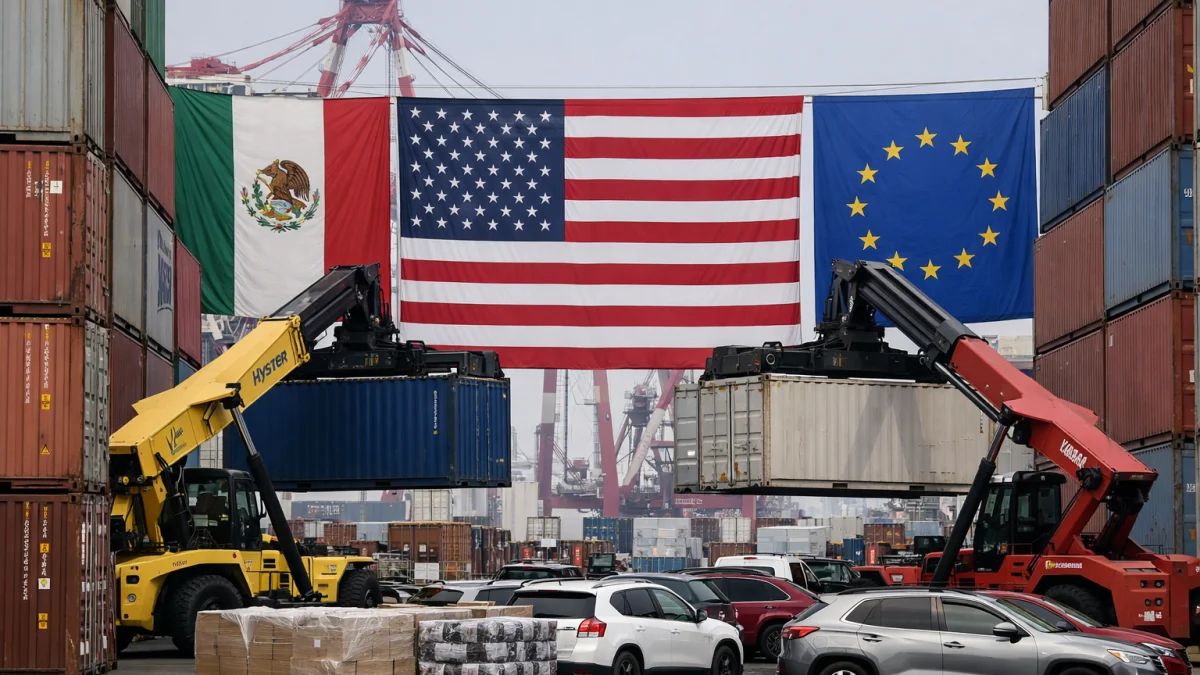
The Trump administration has intensified its use of tariffs against two of the United States' largest trading partners, Mexico and the European Union, marking another escalation in its broader effort to reshape global trade relationships through unilateral economic pressure. The latest measures, announced after negotiations failed to produce agreements acceptable to Washington, reinforce the administration's strategy of using import duties not only to address trade imbalances but also to pursue wider policy objectives, including border security, supply-chain resilience and domestic manufacturing.
The significance of the move extends beyond the tariff rates themselves. Mexico and the European Union account for a substantial share of U.S. trade, making any increase in import duties capable of affecting global supply chains, business investment decisions and consumer prices. The escalation also signals that the administration remains committed to employing tariffs as a negotiating instrument despite legal challenges and continued opposition from major trading partners.
President Donald Trump has argued that the measures are necessary to secure more balanced trade relationships and protect American industry. In the administration's assessment, tariffs encourage companies to relocate production to the United States, reduce dependence on foreign manufacturing and generate additional federal revenue. Previous White House fact sheets have described tariff policy as part of a broader effort to expand market access for U.S. exporters while encouraging investment in domestic production.
The administration has also linked tariffs on Mexico to broader concerns extending beyond trade. Earlier measures cited efforts to combat fentanyl trafficking and strengthen border enforcement, illustrating how trade policy has increasingly been integrated with national security and immigration objectives. That approach differs from traditional trade negotiations, which have generally focused on market access, tariff schedules and regulatory barriers rather than broader geopolitical concerns.
For the European Union, the dispute reflects longstanding disagreements over market access, industrial policy and what Washington characterizes as persistent trade imbalances. Although the United States and the EU reached a trade agreement in 2025 covering tariff reductions, investment commitments and expanded access for certain American exports, implementation has remained politically contentious. Delays in European ratification prompted repeated warnings from Washington that higher tariffs could follow if commitments were not fulfilled.
European officials have continued to argue that negotiated solutions remain preferable to retaliatory action. The European Commission has maintained that the transatlantic trading relationship remains one of the world's largest and most economically significant, supporting millions of jobs on both sides of the Atlantic. At the same time, EU officials have warned that additional U.S. tariffs could prompt proportionate countermeasures if negotiations fail to resolve outstanding disputes.
Mexico has likewise rejected the justification for additional tariffs while indicating that dialogue with Washington should continue. Mexican officials have emphasized the deep integration of North American manufacturing under the United States-Mexico-Canada Agreement (USMCA), particularly in the automotive, electronics and agricultural sectors. Because production frequently crosses borders multiple times before final assembly, higher tariffs have the potential to increase costs throughout regional supply chains rather than affecting only imported finished goods.
Economists remain divided over the long-term effectiveness of aggressive tariff policies. Supporters argue that higher import duties can encourage domestic investment, strengthen strategic industries and provide leverage during negotiations. Critics contend that tariffs often raise costs for manufacturers dependent on imported components, increase prices for consumers and invite retaliatory measures that reduce export opportunities for domestic producers. Academic research examining the recent trade disputes has suggested that while tariffs can generate government revenue, broader economic welfare may decline if trading partners respond with coordinated retaliation.
The latest measures also illustrate the growing legal complexity surrounding U.S. trade policy. Earlier this year, legal disputes over the administration's authority to impose certain tariffs under emergency powers created uncertainty about the scope of presidential trade authority. While the administration has continued pursuing alternative legal mechanisms and trade investigations, the evolving legal landscape may influence how future tariff actions are implemented and defended.
For businesses, the renewed escalation reinforces an environment of continuing uncertainty. Companies with integrated North American and European supply chains must evaluate whether to absorb higher costs, adjust sourcing strategies or relocate production. Financial markets have also become increasingly sensitive to tariff announcements because of their potential impact on inflation, corporate earnings and global economic growth. Although previous rounds of tariffs have not always produced immediate disruptions, repeated policy changes can complicate long-term investment planning.
The current situation leaves negotiations at a critical stage. The Trump administration has reaffirmed its willingness to use tariffs as leverage while maintaining that agreements remain possible if trading partners meet U.S. objectives. European and Mexican officials continue to favor negotiated outcomes but have also prepared potential responses should higher duties take effect. The principal issues now being monitored are whether further negotiations can avert additional escalation, whether retaliatory measures emerge, and how businesses adjust to an increasingly uncertain international trading environment.