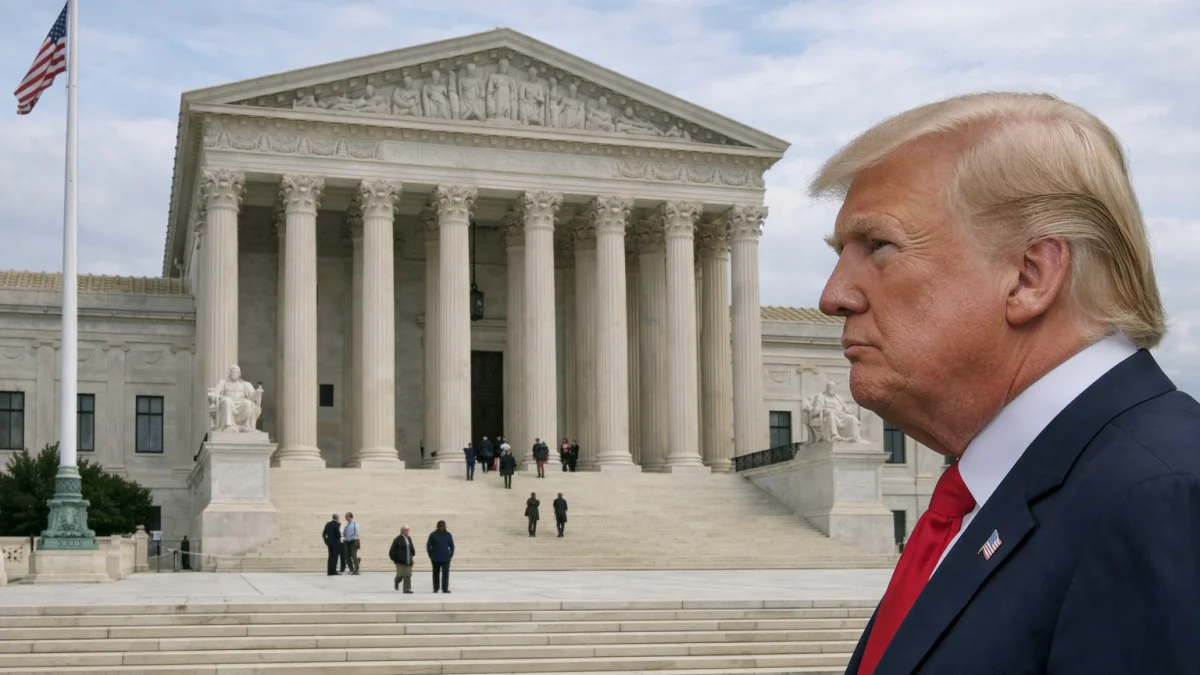
The U.S. Supreme Court’s latest term has reshaped the legal environment in which President Donald Trump’s administration is pursuing its policy agenda, producing a combination of significant victories and notable defeats that together redefine the balance between presidential authority, Congress, and the federal bureaucracy. While the court rejected some of Trump’s highest-profile initiatives—including efforts to narrow birthright citizenship through executive action and to sustain broad tariff powers—it simultaneously expanded presidential control over much of the executive branch by weakening long-standing protections for independent federal agencies.
The broader significance lies less in the outcome of any single case than in the cumulative effect of the court’s rulings. Together, they suggest that the court’s conservative majority continues to distinguish between limits imposed by the Constitution and those established through statutory or institutional arrangements. In practice, that approach has strengthened presidential authority over executive agencies while maintaining judicial willingness to block actions viewed as exceeding constitutional or statutory boundaries.
Among the term’s most consequential decisions was the court’s ruling allowing the president to remove members of independent regulatory agencies without the long-standing “for cause” protections established under the 1935 Humphrey’s Executor precedent. The decision substantially expands White House authority over agencies such as the Federal Trade Commission and potentially affects numerous other independent regulators whose fixed terms were designed to insulate them from political pressure.
Supporters of the ruling, including many conservative legal scholars, argue that agencies exercising executive power should ultimately answer to an elected president, strengthening democratic accountability. They contend that independent agencies have accumulated significant policymaking authority without sufficient electoral oversight and that clearer presidential control aligns with Article II of the U.S. Constitution.
Critics, including the court’s dissenting justices and many administrative law experts, argue that reducing agency independence could increase political influence over decisions involving antitrust enforcement, financial regulation, labor policy, consumer protection, and election administration. They caution that agencies historically structured to operate with bipartisan leadership may become more closely aligned with the priorities of whichever administration occupies the White House.
The administration’s victories were not absolute. The Supreme Court rejected Trump’s attempt to restrict birthright citizenship through executive action, reaffirming longstanding constitutional protections under the Fourteenth Amendment. It also ruled against the administration in litigation involving sweeping tariff authority, limiting the president’s ability to rely on emergency powers in that context. Those decisions demonstrated that the court remains willing to constrain executive action when it concludes constitutional text or statutory limits have been exceeded.
The mixed record illustrates an important feature of the court’s current jurisprudence. Rather than uniformly endorsing presidential initiatives, the justices have frequently distinguished between expanding executive control over the executive branch itself and permitting unilateral presidential action that conflicts with constitutional guarantees or congressional statutes. That distinction has become increasingly important as the administration seeks to reorganize federal agencies, reduce the size of government, and centralize decision-making authority.
The court’s growing reliance on its emergency, or “shadow,” docket has also drawn attention. Recent emergency orders have allowed the administration to implement major personnel and policy changes while litigation continues in lower courts. Several justices and legal scholars have expressed concern that increasingly consequential decisions are being made through expedited procedures with limited briefing and explanation, while supporters argue emergency intervention is necessary when nationwide injunctions threaten executive operations.
The practical consequences are already becoming visible across the federal government. The administration has continued pursuing agency restructuring, workforce reductions, and regulatory changes, many of which depend upon expanded presidential authority over executive personnel. At the same time, several of those initiatives remain subject to separate legal challenges concerning statutory authority, administrative procedure, and congressional authorization. Litigation over federal workforce restructuring, including challenges to planned reorganizations within the Department of Agriculture, illustrates that expanded presidential removal power does not automatically resolve disputes over how agencies implement broader institutional changes.
Historically, the latest term builds upon a broader judicial trend toward reassessing the modern administrative state. Recent Supreme Court decisions have narrowed judicial deference to agency interpretations, increased scrutiny of federal regulatory authority, and now expanded presidential control over executive officials. Together, these rulings represent one of the most significant shifts in federal administrative law in decades, although their full practical impact will emerge through future litigation and agency implementation.
For the Trump administration, the term provides both opportunities and constraints. Expanded authority over executive agencies strengthens the president’s ability to direct policy through the federal bureaucracy, while defeats on constitutional questions demonstrate continuing judicial limits on executive power. As agencies implement new policies and opponents pursue additional litigation, courts will continue to define how far those newly clarified presidential powers extend. The next phase will likely be shaped by lower-court rulings, further Supreme Court review where necessary, and congressional responses where statutory authority remains contested.