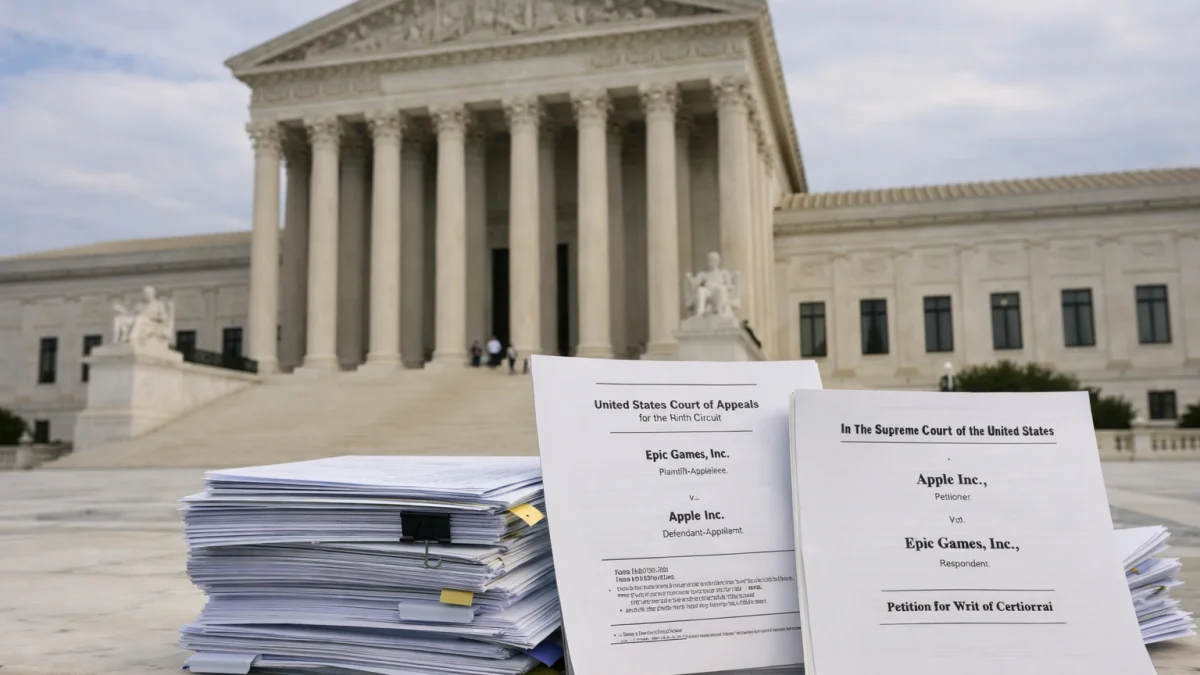
WASHINGTON — The U.S. Supreme Court has agreed to review Apple’s appeal of a civil contempt ruling arising from its long-running legal dispute with Epic Games, setting the stage for the justices to examine whether a federal judge exceeded her authority in finding the iPhone maker violated a court order governing its App Store payment rules.
The case stems from Epic Games’ 2020 antitrust lawsuit challenging Apple’s control over app distribution and in-app payments on iPhones. Although Apple largely prevailed in the underlying litigation, U.S. District Judge Yvonne Gonzalez Rogers in 2021 ordered the company to allow developers to direct users to payment options outside Apple’s in-app purchasing system.
After the injunction took effect, Apple permitted developers to include external payment links but imposed commissions of up to 27% on purchases completed through those links and adopted additional conditions governing their use. Epic argued those measures undermined the court’s order by discouraging developers from using alternative payment methods.
In 2025, Gonzalez Rogers held Apple in civil contempt, concluding the company had failed to comply with the injunction. The San Francisco-based 9th U.S. Circuit Court of Appeals later upheld the contempt finding while directing the district court to reconsider what, if any, commission Apple could lawfully charge for purchases completed through third-party payment systems.
Apple has argued that the contempt ruling was improper because the original injunction did not explicitly prohibit it from charging commissions on transactions completed outside its payment system. The company also contends the lower courts improperly based the contempt finding on the "spirit" rather than the specific terms of the injunction.
In addition, Apple argues the injunction should apply only to Epic rather than to all App Store developers because the lawsuit was not brought as a class action. The company has said the lower court's orders could have broad implications for digital marketplaces and app distribution.
Epic has maintained that Apple deliberately structured its compliance measures to preserve its App Store business model while frustrating the intent of the injunction. The game developer has urged the courts to leave the contempt ruling in place, arguing that Apple intentionally violated the order.
The Supreme Court is expected to hear the case during its next term. The justices will review the contempt issues but are not revisiting the broader antitrust findings from the original Epic Games lawsuit.