WASHINGTON — The U.S. Supreme Court ruled on Monday that law enforcement's use of a "geofence warrant" to obtain cellphone location data constitutes a search under the Fourth Amendment, sending a Virginia bank robbery case back to lower courts to assess whether the specific warrant was reasonable.
In a 6-3 decision, the court held that individuals have a reasonable expectation of privacy in their cell phone location records, even when that data is held by a third-party company such as Google. Justice Elena Kagan wrote the majority opinion.
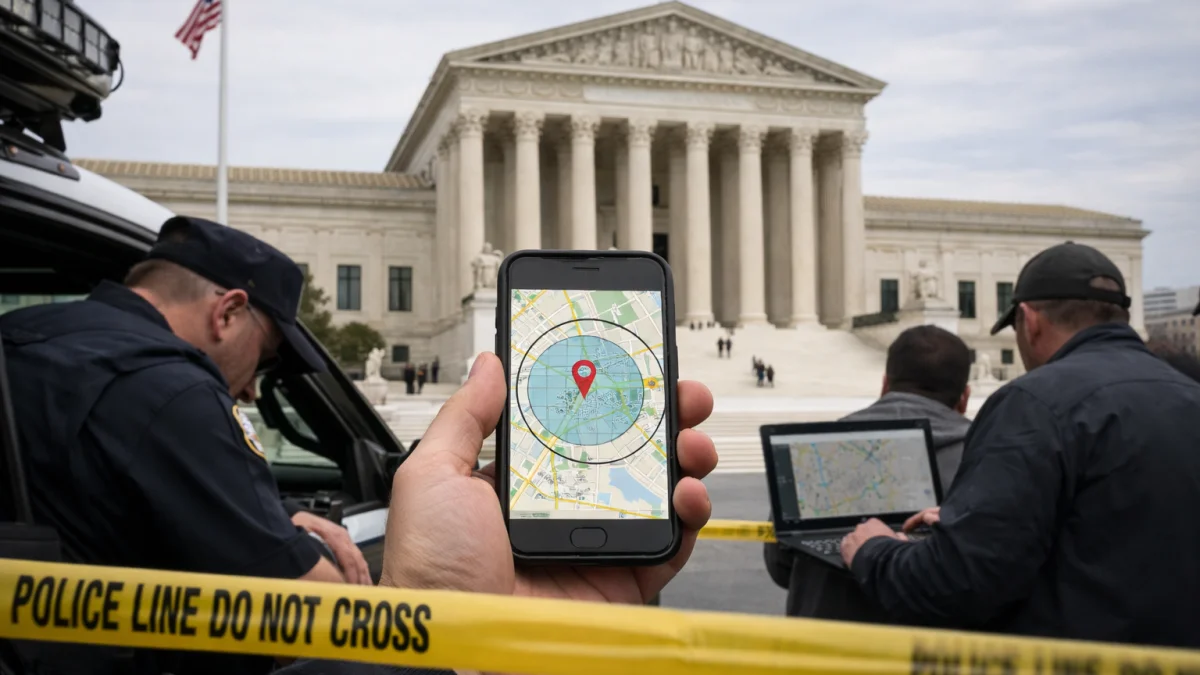
The case, *Chatrie v. United States*, stems from a 2019 armed robbery of a credit union in Midlothian, Virginia. Police obtained a geofence warrant directing Google to search its Location History database for devices present within a roughly 150-meter radius of the bank during a one-hour window around the time of the crime. The data helped identify Okello Chatrie, who was later convicted.
Geofence warrants compel technology companies to identify and disclose location information for all users whose devices were in a designated geographic area during a specified time, without prior individualized suspicion for those users. Critics argue the practice sweeps in data from innocent bystanders and functions as a digital dragnet.
Kagan emphasized that police intrude on constitutionally protected privacy interests when they demand such information. “An individual has a reasonable expectation of privacy in records about his cell phone’s location, and police intrude on that constitutionally protected interest when they demand the information—even though for only a limited time, and from a third-party tech company,” she wrote.
The ruling builds on the court's 2018 decision in *Carpenter v. United States*, which required warrants for historical cell-site location information. The justices vacated the Fourth Circuit's affirmation of Chatrie's conviction and remanded the case for further proceedings on whether the warrant satisfied Fourth Amendment requirements, including probable cause and particularity.
Justices Sonia Sotomayor and Ketanji Brown Jackson joined Kagan's opinion in full. Justice Neil Gorsuch concurred in the judgment. Chief Justice John Roberts and Justice Brett Kavanaugh also joined the majority.
In dissent, Justice Samuel Alito, joined in part by Justices Clarence Thomas and Amy Coney Barrett, argued that the majority's approach could hinder legitimate law enforcement efforts. Justice Barrett wrote a separate dissent.
The decision marks the Supreme Court's first direct ruling on geofence warrants, resolving splits among lower courts. The Fifth Circuit had previously deemed similar warrants overly broad, while the Fourth Circuit upheld the one used in Chatrie's case.
Privacy advocates welcomed the ruling as a safeguard against mass surveillance. The government had defended the tool as a targeted, court-supervised method essential for solving crimes when traditional evidence is lacking.
Google, which is not a party to the case, has previously adjusted its Location History policies, including shorter retention periods and local device storage, potentially limiting future availability of such data.
The case now returns to lower courts, where Chatrie's conviction could face renewed scrutiny. The Supreme Court's action does not automatically suppress the evidence or overturn the conviction but requires additional analysis of the warrant's validity.
Legal observers expect the decision to influence law enforcement practices nationwide and spark further litigation over emerging digital surveillance tools.