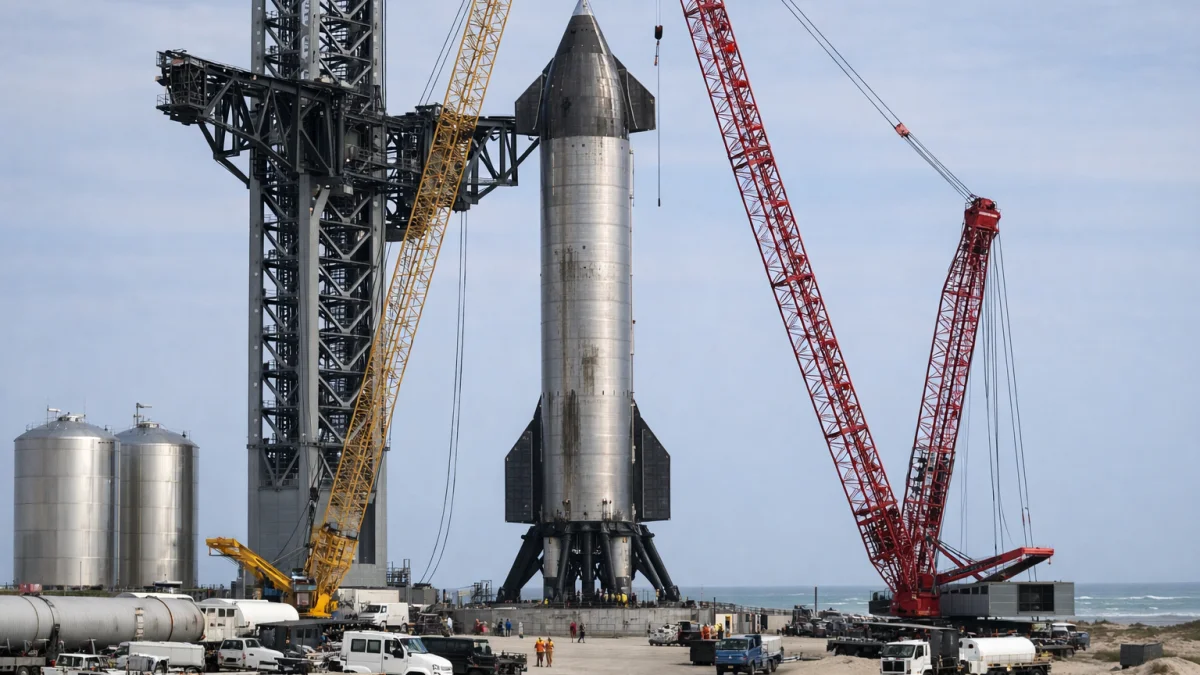
NEW YORK — Bullish analyst coverage of SpaceX has increasingly centered on the company's long-term investment in Starship, with several research firms arguing that achieving full rocket reusability would be key to lowering launch costs, expanding its satellite business and supporting new revenue streams, even as they caution that the technology remains unproven.
A series of analyst initiations and updated research notes published this week highlighted Starship as the central factor underpinning optimistic valuations for the aerospace company following its stock market debut. Several firms projected significant upside if SpaceX succeeds in making Starship fully reusable, while identifying execution risk as the principal uncertainty.
Wedbush analyst Dan Ives initiated coverage with an "Outperform" rating and a $190 price target, describing Starship as the foundation for a business model spanning launch services, Starlink satellite broadband and future artificial intelligence infrastructure. According to the firm's analysis, a reusable Starship could sharply reduce launch costs and substantially increase the number of Starlink satellites deployed per mission.
Other analysts have also adopted constructive views. Wolfe Research previously argued that near-zero launch costs enabled by Starship could strengthen SpaceX's competitive position over the long term, while several firms have issued price targets above current trading levels based on expectations for continued expansion in launch services, communications and AI-related businesses.
However, analysts also emphasized that much of the optimistic outlook depends on SpaceX demonstrating reliable and rapid reusability of Starship, a technical milestone the company has yet to achieve.
A Reuters analysis published in May said SpaceX's latest Starship test advanced the company's development program sufficiently to reinforce investor confidence but also showed that full reusability remains a work in progress. The report noted that Starship is central to lowering launch costs, supporting the expansion of the Starlink satellite network and enabling longer-term ambitions such as orbital computing infrastructure and deep-space missions.
Some research has taken a more cautious stance. Daiwa initiated coverage with a Hold rating, citing SpaceX's strong competitive position while warning that Starship development, high capital spending and execution challenges could weigh on future returns. Separately, other analysts have questioned whether current valuations already assume ambitious technological achievements and future markets that have yet to be proven commercially.
SpaceX has invested more than $15 billion in developing Starship, according to disclosures cited in its public filings, underscoring the rocket's importance to the company's long-term strategy. Company executives have consistently described full and rapid reusability as essential to increasing launch frequency, reducing costs and supporting future commercial expansion.