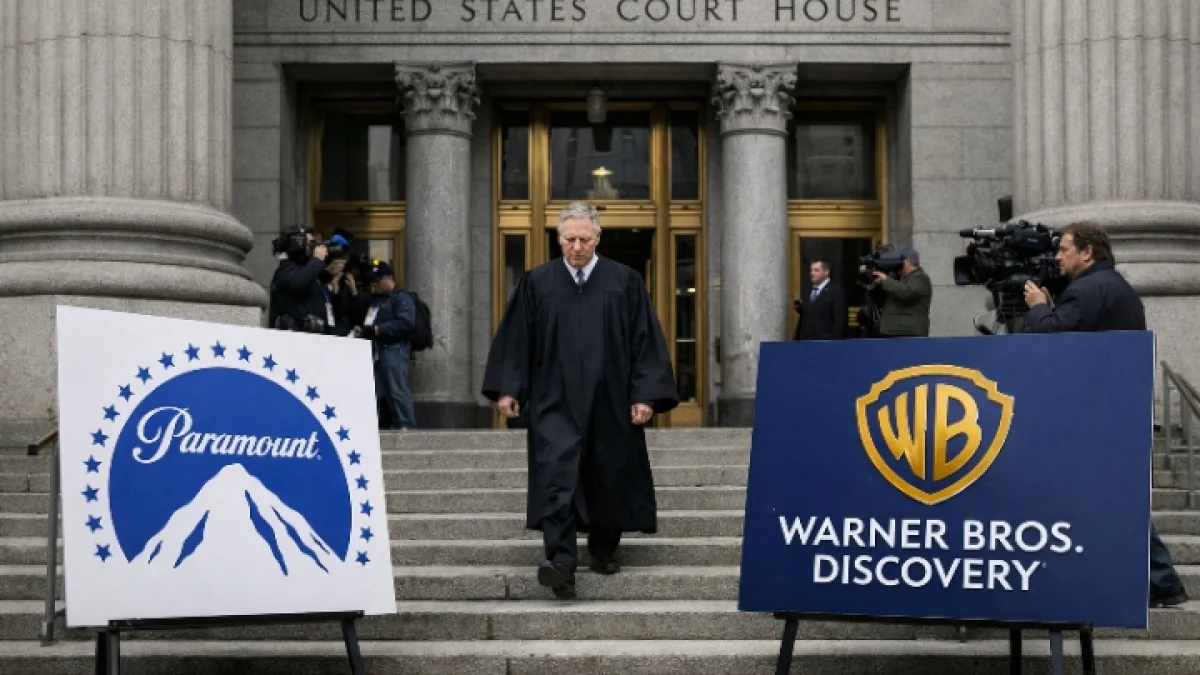
A U.S. federal judge's decision to temporarily block Paramount Skydance's proposed acquisition of Warner Bros. Discovery has transformed what had appeared to be one of the entertainment industry's largest completed regulatory reviews into a broader test of how antitrust law may be applied to media consolidation. The ruling, issued after a coalition of 12 states challenged the transaction, prevents the companies from closing the deal while the court considers whether a longer injunction is warranted.
The significance extends beyond a single merger. The case highlights growing divergence between regulatory authorities and state-level antitrust enforcement in the United States. Although the U.S. Department of Justice chose not to seek to block the transaction and the European Commission approved it subject to remedies, the states argue the combination would substantially lessen competition in key entertainment markets, particularly wide-release theatrical film distribution. The judge concluded that the states had presented sufficient evidence at this preliminary stage to presume the merger could violate U.S. antitrust law, justifying a temporary restraining order while the litigation proceeds.
The dispute reflects a broader shift in merger enforcement in which state attorneys general have increasingly pursued antitrust challenges even when federal regulators decline to intervene. California and the other participating states contend that combining two of Hollywood's largest studios would reduce competition for film production, theatrical distribution, television programming and streaming, ultimately affecting consumers and industry participants. Paramount disputes those claims and maintains the merger would strengthen its ability to compete in a media landscape increasingly dominated by global technology companies and streaming platforms.
The legal arguments also underscore changing competitive dynamics within the entertainment industry. Traditional media companies have faced years of declining cable television revenues, rising programming costs and intense competition from streaming services. Supporters of consolidation argue that greater scale has become necessary to finance premium content, negotiate distribution agreements and compete internationally. Those considerations have driven a succession of major transactions over the past decade, including combinations involving Disney, Fox, Discovery and WarnerMedia.
Opponents, however, argue that consolidation has already narrowed competition in content creation and distribution. The coalition of states argues another merger involving two major Hollywood studios could further concentrate market power, potentially reducing incentives for investment in diverse programming while increasing leverage over theaters, distributors and creative professionals. At this stage, the court has not ruled on those allegations but has determined they merit fuller examination before the transaction can proceed.
The decision also creates uncertainty for the companies' transaction timetable. Paramount had sought to complete the acquisition shortly after receiving conditional approval from the European Union, which required commitments related to film distribution in Europe rather than blocking the merger outright. Those remedies included ending Paramount's participation in a European distribution joint venture with Universal within a specified period and avoiding certain future distribution arrangements intended to preserve competition. The contrast illustrates how different jurisdictions can reach varying conclusions about the same transaction while focusing on different competitive concerns.
Financial considerations further increase the importance of the litigation. Reuters has reported that continued delays could expose Paramount to contractual costs if the transaction cannot close before agreed deadlines, adding commercial pressure alongside the legal proceedings. Analysts note that prolonged uncertainty can complicate strategic planning, financing arrangements and operational integration for companies pursuing transformative acquisitions.
The case may also influence future merger planning across the media sector. Companies contemplating large acquisitions may place greater emphasis on potential challenges from state attorneys general in addition to federal review. Legal experts have observed in previous antitrust disputes that temporary restraining orders and preliminary injunction hearings often become critical stages because they can substantially delay transactions even before courts reach final judgments on the merits. In this instance, the court's willingness to halt the deal despite prior federal clearance demonstrates that multiple enforcement pathways remain available under U.S. competition law.
Industry groups have likewise monitored the transaction closely. The Writers Guild of America has separately challenged the merger, arguing it could reduce employment opportunities and weaken competition for creative talent, while the companies reject those concerns and argue the combination would create a stronger competitor capable of sustaining investment in film and television production. Those differing assessments reflect broader debates over whether consolidation ultimately strengthens or weakens long-term competition within the entertainment business.
For now, the transaction remains paused pending further judicial review. A hearing on whether to issue a preliminary injunction is scheduled for early August, when the court will consider more extensive evidence from both sides. Until then, the temporary restraining order preserves the status quo while the legal challenge proceeds. Regulators, investors and the broader media industry are now closely watching whether the states can sustain their antitrust claims and whether the companies can persuade the court that the merger would not substantially reduce competition.