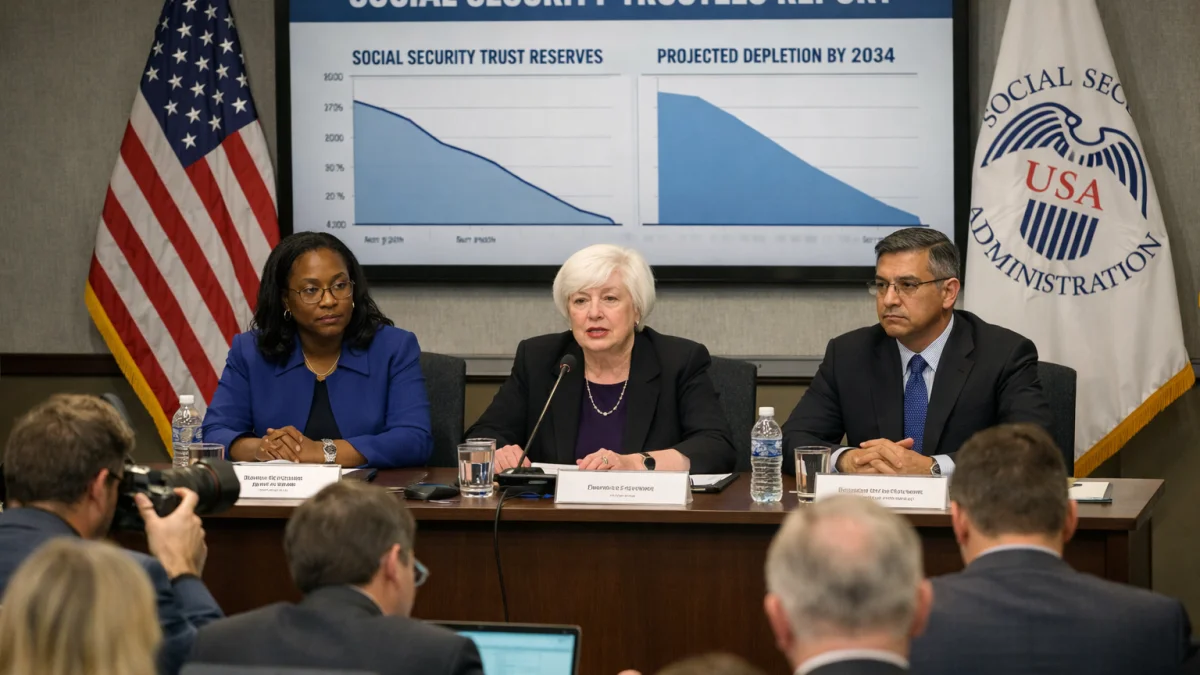
The latest annual report from the Social Security Board of Trustees reinforces a central warning that has shaped U.S. fiscal policy debates for years: under current law, the combined Social Security trust funds remain on track to deplete their reserves in 2034. While the projected depletion date for the combined Old-Age and Survivors Insurance (OASI) and Disability Insurance (DI) trust funds is unchanged from last year's report, the retirement-only OASI trust fund is now expected to exhaust its reserves slightly earlier, in late 2032, highlighting continuing financial pressures on the nation's largest retirement program.
The report matters because it underscores that the financial challenge facing Social Security is no longer a distant issue. More than 70 million Americans receive retirement, disability, or survivors' benefits from the program, making it one of the federal government's largest expenditures and a primary source of income for many retirees. The trustees' projections indicate that, absent legislative action, Social Security would continue paying benefits after reserve depletion, but only at levels supported by incoming payroll tax revenue. Under the trustees' intermediate assumptions, that would amount to roughly 83% of scheduled benefits for the combined trust funds after 2034, while the retirement trust fund alone would be able to pay about 78% once its reserves are exhausted.
The distinction between trust fund depletion and program insolvency remains important. Depletion does not mean Social Security would stop operating or beneficiaries would receive nothing. Instead, current law prohibits the program from paying benefits beyond available resources. Without congressional intervention, payments would automatically be reduced to match continuing revenue. The trustees have emphasized this distinction in successive reports to clarify that the projected shortfall represents a financing gap rather than the collapse of the system itself.
The worsening outlook for the retirement trust fund reflects several long-term demographic and economic trends. The United States continues to experience population aging as the large baby boom generation retires, while lower birth rates reduce the growth of the future workforce that finances benefits through payroll taxes. The trustees also cited updated demographic assumptions and legislative changes affecting program revenues as factors contributing to the weaker long-term actuarial balance. The combined program's estimated 75-year actuarial deficit widened compared with the previous report, indicating that the long-term financing gap has increased under current assumptions.
The financial imbalance has developed gradually over decades. Social Security's annual costs have exceeded its non-interest income since 2010, and total annual costs have surpassed total income since 2021. The program has continued paying full benefits by drawing on accumulated trust fund reserves built during earlier decades when payroll tax collections exceeded benefit payments. As those reserves decline, policymakers face increasing pressure to address the gap before automatic benefit reductions become necessary.
Successive administrations and Congresses have acknowledged the need for reform, but agreement on specific measures has remained elusive. Policy proposals generally fall into two broad categories: increasing revenues, such as through higher payroll taxes or expanding the taxable wage base, and reducing long-term costs through changes to benefits, retirement ages, or eligibility rules. Some proposals combine elements of both approaches to distribute the burden across workers and beneficiaries. Economists and fiscal policy specialists generally agree that earlier legislative action allows changes to be phased in more gradually, while delays typically require larger adjustments.
The trustees' report also illustrates the importance of distinguishing between Social Security's two legally separate trust funds. Although the Disability Insurance trust fund remains financially secure throughout the report's 75-year projection period, the retirement trust fund faces substantially greater pressure because of the growing number of retirees relative to workers. Combined projections are widely cited because they provide a broad measure of the program's overall finances, but transfers between the funds would require congressional action.
The report arrives amid broader debates over federal fiscal policy, aging populations, and long-term budget sustainability. Social Security remains politically sensitive because beneficiaries span nearly every congressional district, and the program enjoys broad public support. Officials have reiterated commitments to preserving benefits while acknowledging that lawmakers ultimately must determine how to restore long-term solvency. Social Security Commissioner Frank Bisignano said the administration remains committed to protecting the program while emphasizing the need for cooperation between Congress and the Social Security Administration to strengthen the trust funds.
For now, the trustees' findings do not change immediate benefit payments, nor do they alter the legal obligations of the program. Instead, they provide Congress with updated actuarial projections showing that, under current law, the combined trust funds remain projected to deplete their reserves in 2034 while the retirement trust fund is expected to reach depletion in late 2032. Whether those projections ultimately become reality will depend on future demographic and economic developments as well as whether lawmakers enact reforms before the projected reserve depletion dates.