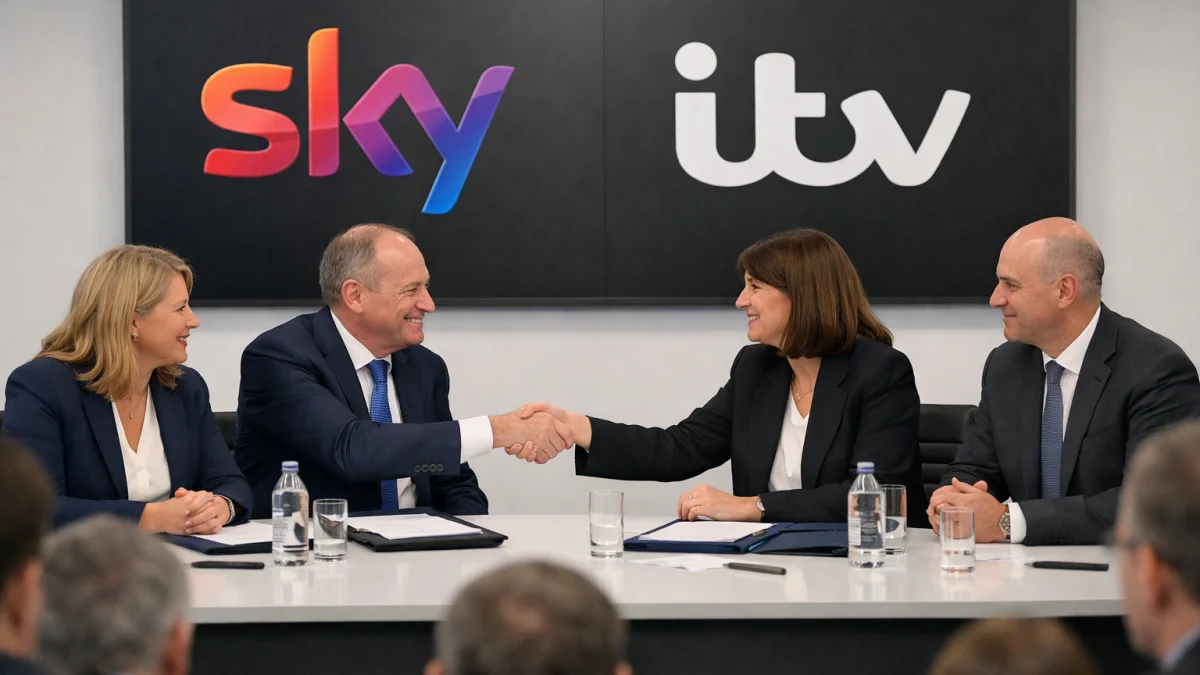
Sky’s agreement to acquire ITV’s Media and Entertainment business marks one of the most significant restructurings of the British television industry in years, underscoring how traditional European broadcasters are increasingly pursuing consolidation to compete with global streaming platforms that have transformed viewing habits, advertising markets and content economics. The proposed transaction, valued at up to £1.6 billion ($2.1 billion), combines two of the United Kingdom’s best-known television brands while leaving ITV Studios as a separate publicly listed production company. The deal remains subject to shareholder and regulatory approval and is expected to complete in the second half of 2027.
The transaction is significant because it represents more than a change in ownership. It reflects an industry-wide shift in which scale has become increasingly important as broadcasters seek to spread the rising costs of premium programming, streaming technology and sports rights across larger subscriber and advertising bases. European television groups have faced years of pressure from international competitors including Netflix, YouTube, Amazon Prime Video and Disney+, whose global reach and financial resources have reshaped audience expectations and fragmented advertising revenues.
Under the agreement, Sky will acquire ITV’s free-to-air television channels and ITVX streaming platform while ITV retains ITV Studios, whose productions include internationally successful entertainment formats and scripted programming. The companies also announced a long-term content agreement under which Sky will commit at least £2.1 billion to ITV Studios between 2028 and 2032, aiming to preserve investment in British programming while separating production from broadcasting.
The structure of the deal reflects broader trends in global media. Production businesses with international licensing revenues have generally proved more resilient than domestic broadcasters, whose advertising income has come under sustained pressure from digital platforms. By retaining ITV Studios as an independent company, ITV seeks to create a more focused global content producer while monetizing its broadcasting assets. ITV has also said it intends to return around £950 million to shareholders from the transaction proceeds.
For Sky, the acquisition strengthens a business model that already combines subscription television, broadband and streaming services. Integrating ITV’s advertising-supported television operations with Sky’s subscription platform could provide broader distribution, deeper audience data and greater flexibility in offering advertising across both free-to-air and paid services. Company executives have described the combination as creating a stronger domestic competitor capable of investing in British content while improving streaming capabilities.
The proposed merger also arrives during a period of wider corporate restructuring at Comcast, Sky’s parent company. Comcast recently announced plans to separate its media assets, including NBCUniversal and Sky, from its connectivity business. That restructuring means the enlarged Sky operation would ultimately become part of a newly focused media company rather than remain integrated within Comcast’s broader telecommunications operations. Analysts have noted that the corporate reorganization could provide greater strategic flexibility for future acquisitions or partnerships, although no further transactions have been announced.
Regulatory review is likely to become one of the transaction’s defining tests. Combining two major commercial broadcasters raises questions about competition in television advertising, audience reach and distribution. Some analysts estimate the merged company would command a substantial share of Britain's television advertising market. Others argue that regulators are increasingly evaluating competition across a broader digital ecosystem that includes online video platforms and social media companies, potentially reducing concerns based solely on traditional television market share. The review is therefore expected to examine both conventional broadcasting markets and the rapidly evolving digital advertising landscape.
The companies have sought to address some public-interest concerns in advance. Sky said ITV's public service broadcasting commitments would remain intact, ITV's flagship programming would continue to be available free-to-air, and ITV News and Sky News would remain separate editorial operations. Such commitments may become relevant during regulatory assessments that consider media plurality alongside competition issues.
Beyond the United Kingdom, the agreement could influence merger activity across Europe's media sector. Broadcasters in several European markets face similar pressures from declining linear television audiences, slower advertising growth and rising investment requirements for streaming technology. Investment analysts have suggested that the Sky-ITV transaction could encourage additional consolidation as companies seek greater scale to remain competitive against global technology and entertainment groups. Whether similar deals emerge will depend on national competition rules, ownership structures and regulatory attitudes toward media concentration.
The agreement also illustrates how the competitive landscape has shifted from domestic rivalry toward international competition. Historically, British broadcasters primarily competed against one another for viewers and advertising. Today, they increasingly compete with multinational streaming services for consumer attention, subscription spending and advertising budgets. That shift has altered strategic priorities, making investment capacity, streaming technology and content libraries as important as traditional broadcast reach.
For now, the transaction remains at an early stage. Regulatory authorities, shareholders and other stakeholders must still evaluate the proposal before completion. Officials will monitor competition, public service broadcasting obligations and media plurality during the approval process, while investors and industry observers will assess whether the combination delivers the scale and efficiencies the companies argue are necessary in an increasingly global and digitally driven media market.