Record-breaking mergers and acquisitions in the first half of 2026 underscore a sharp revival in corporate dealmaking, with a relatively small number of multibillion-dollar transactions propelling global activity to its strongest opening six months on record despite persistent geopolitical tensions, higher financing costs and uneven economic conditions. According to LSEG data, the value of announced transactions reached about $2.8 trillion during the period, nearly half again as much as a year earlier, marking the highest first-half total since the data series began in 1980.
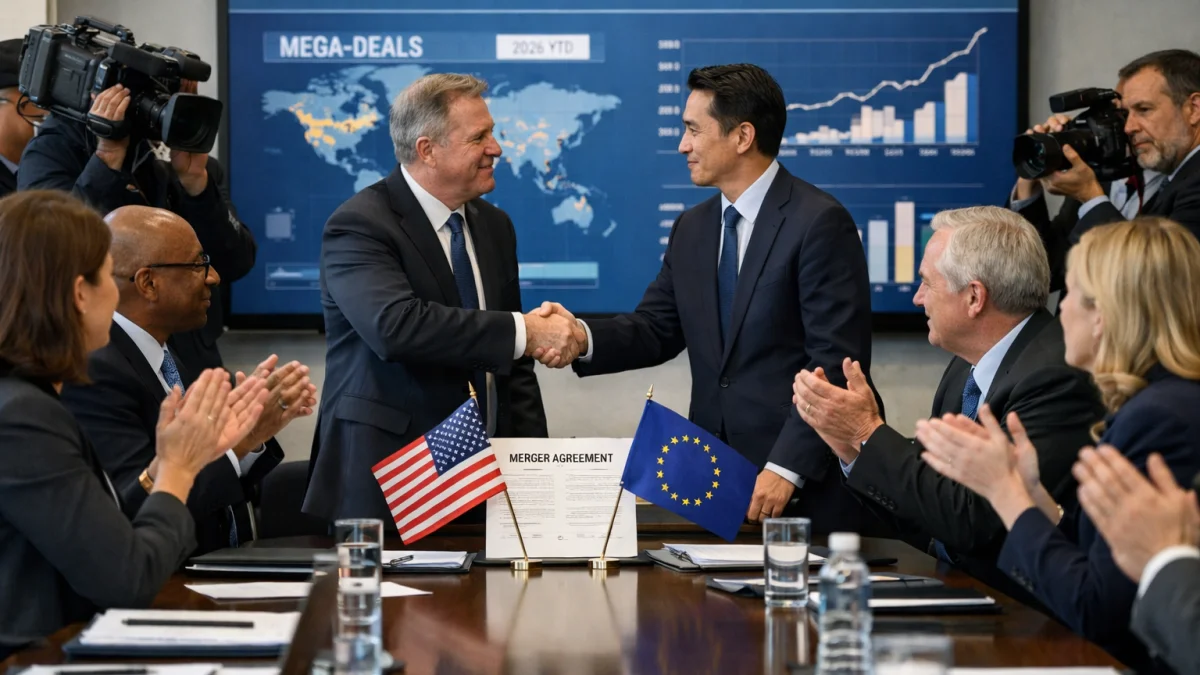
The headline figures are significant not simply because of their size, but because they reveal a shift in how companies are approaching strategic growth. Rather than pursuing a broad expansion in acquisitions across the market, large corporations have increasingly concentrated on transformative transactions valued at more than $10 billion. Those deals accounted for nearly half of global M&A value, while the overall number of announced transactions fell to its lowest first-half level in six years.
That divergence suggests confidence has returned primarily among the world's largest companies rather than across the corporate sector. Businesses with strong balance sheets and access to financing have demonstrated a greater willingness to pursue acquisitions aimed at reshaping industries, expanding technological capabilities or securing long-term growth opportunities. Smaller companies and the middle market, by contrast, have remained more cautious amid elevated borrowing costs and economic uncertainty. Industry analyses similarly describe a market characterized by exceptionally high transaction values but comparatively subdued deal volumes outside the largest acquisitions.
Several structural factors have contributed to the resurgence. Investment bankers and advisers point to a regulatory environment that has become more receptive to large corporate combinations in some jurisdictions, reducing uncertainty surrounding major transactions. At the same time, many executives appear increasingly willing to pursue acquisitions despite geopolitical risks, inflation concerns and market volatility, reflecting a view that waiting for complete economic stability could mean missing strategic opportunities.
Artificial intelligence has emerged as one of the most influential drivers of the current deal cycle. Companies are racing to secure computing infrastructure, software capabilities, semiconductor technologies and energy assets needed to support expanding AI investment. Those competitive pressures have encouraged acquisitions across technology, utilities and related industries, while also generating significant demand for financing, advisory services and capital markets activity. Senior executives at major Wall Street banks have described AI investment as a long-term catalyst extending well beyond the technology sector into industries including energy, construction and industrial manufacturing.
The rebound in dealmaking has already translated into stronger financial performance for investment banks. Goldman Sachs, Bank of America and other large institutions reported substantial increases in advisory fees during the second quarter as mergers, acquisitions and equity issuance accelerated. Goldman Sachs said it advised on roughly $1.2 trillion of announced M&A during the first half, while Bank of America also reported sharply higher investment banking revenue supported by robust global deal activity.
The concentration of activity among very large transactions, however, highlights continuing fragilities beneath the headline numbers. Although aggregate deal value has reached unprecedented levels, declining transaction counts indicate that many companies remain reluctant to undertake acquisitions. Analysts note that higher interest rates continue to weigh on financing conditions for smaller buyers, while ongoing geopolitical conflicts, volatile commodity prices and uncertain economic growth continue to complicate boardroom decision-making.
The composition of the deal flow also reflects broader changes in corporate strategy. Many of the year's largest acquisitions have been motivated less by short-term cost cutting than by efforts to secure strategic assets, achieve greater scale or position businesses for technological change. Such transactions can reshape competitive landscapes, prompting regulatory scrutiny even where antitrust enforcement has become comparatively more predictable. Whether these acquisitions ultimately generate expected efficiencies or create integration challenges will become clearer only after transactions close and businesses begin combining operations.
Historical comparisons suggest the current environment differs from previous merger booms. Earlier periods of elevated M&A activity often coincided with abundant liquidity, exceptionally low borrowing costs or rapid economic expansion. The first half of 2026 instead combined record deal values with relatively restrictive monetary conditions and continuing geopolitical uncertainty. That combination indicates that strategic necessity, particularly surrounding AI investment and infrastructure, has become a more prominent driver than purely favorable financing conditions.
For investors, regulators and policymakers, the surge provides mixed signals. Rising M&A activity may indicate renewed corporate confidence and expectations of long-term growth, while also increasing attention on market concentration, competition policy and execution risks associated with large-scale integrations. Financial institutions, meanwhile, have benefited from stronger advisory and underwriting activity, contributing to improved earnings across much of the banking sector.
The record first half therefore reflects both renewed confidence among the world's largest corporations and a more selective acquisition environment overall. Confirmed data show that mega-deals have driven global M&A to unprecedented levels even as overall transaction numbers declined. Market participants are now monitoring whether the momentum broadens to mid-market transactions, how regulators respond to the largest proposed combinations, and whether economic and geopolitical conditions allow the current pace of strategic dealmaking to continue through the remainder of 2026.