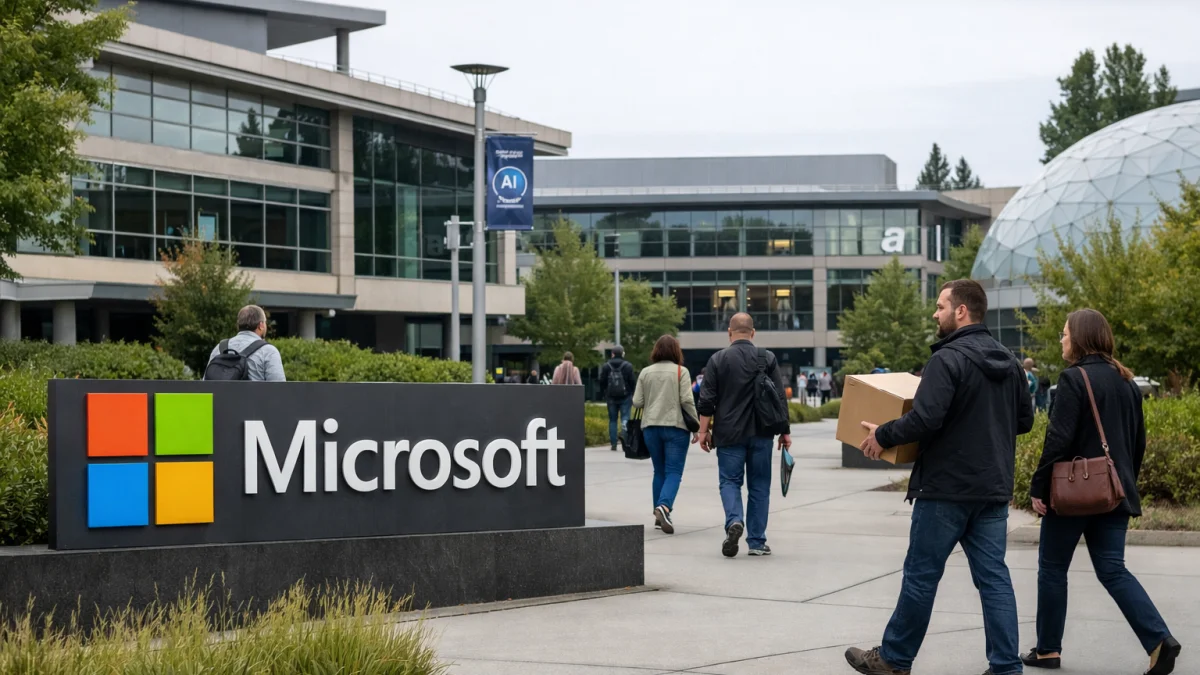
Microsoft’s decision to eliminate about 4,800 jobs marks the latest stage in a broader restructuring taking place across the global technology industry, where companies are simultaneously increasing investment in artificial intelligence while reshaping their workforces to support that transition. The reductions, representing roughly 2.1% of Microsoft’s workforce, affect parts of its commercial operations and Xbox gaming business and come at the beginning of the company’s new fiscal year.
The significance of the announcement extends beyond the number of positions being eliminated. It reflects how major technology companies are increasingly reallocating capital, management attention, and talent toward AI infrastructure and products rather than maintaining organizational structures built around earlier growth priorities. Although Microsoft has emphasized that the layoffs are not the direct result of AI replacing individual workers, the restructuring illustrates how AI investment is reshaping corporate strategy across the sector.
Microsoft remains one of the largest investors in generative AI, having committed substantial resources to expanding cloud infrastructure, advanced computing capacity, and AI-enabled software. Industry-wide spending on AI infrastructure is expected to exceed hundreds of billions of dollars in 2026, creating pressure on companies to demonstrate financial returns while managing rising capital expenditures. Analysts have increasingly viewed workforce reductions, organizational simplification, and tighter operating discipline as one method companies are using to offset those costs.
The restructuring also highlights a distinction that technology executives have sought to make between automation and corporate reallocation. Microsoft’s leadership has stated that the eliminated positions are not being replaced directly by AI systems. Instead, the company says it is reorganizing operations to better align with changing customer demand and evolving business priorities. Company officials have pointed to previous voluntary retirement programs and internal redeployment efforts as evidence that workforce reductions were preceded by attempts to limit involuntary layoffs.
That distinction nevertheless reflects a wider transformation in how AI influences employment. Rather than producing immediate one-for-one replacement of workers, AI is increasingly affecting hiring priorities, organizational design, and investment decisions. Companies are directing more resources toward AI engineering, cloud computing, semiconductor infrastructure, and data-center expansion while reducing spending in business units facing slower growth or lower margins.
Microsoft’s gaming division illustrates those broader dynamics. Xbox has faced weaker profitability amid higher hardware costs, shifting consumer demand, and increased competition across the gaming industry. The company has announced significant restructuring within the division, including reductions in staffing and changes to studio operations, as executives seek to improve margins while integrating gaming more closely with Microsoft's broader technology strategy.
The announcement also fits into a wider industry pattern. Amazon, Meta Platforms, and other large technology companies have announced substantial workforce reductions while continuing to increase AI-related spending. Although each company cites different operational reasons, investors have generally viewed these measures as part of an effort to redirect resources toward technologies expected to generate future growth rather than maintaining staffing levels established during earlier periods of expansion.
Economic research has suggested that AI's effects on labor markets are likely to emerge gradually through changing job composition rather than immediate displacement across entire occupations. Studies examining large language models have found that many professional roles may experience partial automation of specific tasks instead of outright replacement, potentially increasing productivity while altering demand for certain skills. Those findings have reinforced expectations that companies will increasingly reorganize work around AI-assisted processes rather than eliminating entire categories of employment.
For Microsoft, the restructuring also follows a more difficult period in financial markets. The company experienced a sharp decline in its share price during the first half of 2026 despite continued strength in cloud services, reflecting investor concerns over the pace of AI monetization, rising infrastructure costs, and pressure on profitability. Those conditions have heightened expectations that management will continue seeking operational efficiencies while maintaining substantial AI investment.
The broader corporate challenge is balancing long-term investment with near-term financial performance. AI infrastructure requires exceptionally large capital commitments for advanced semiconductors, networking equipment, and data centers before corresponding revenue gains are fully realized. As a result, companies have faced increasing scrutiny from investors regarding operating margins, workforce efficiency, and capital allocation. Restructuring has therefore become one component of a broader financial strategy rather than an isolated employment decision.
Microsoft’s latest workforce reductions underscore how the technology industry's AI transition is increasingly becoming an organizational transformation as well as a technological one. The confirmed developments indicate that the company is continuing to prioritize investment in AI capabilities while simplifying parts of its existing business structure. What remains under close observation is whether these reorganizations improve productivity and financial performance without disrupting innovation, customer demand, or the industry's longer-term employment trajectory.