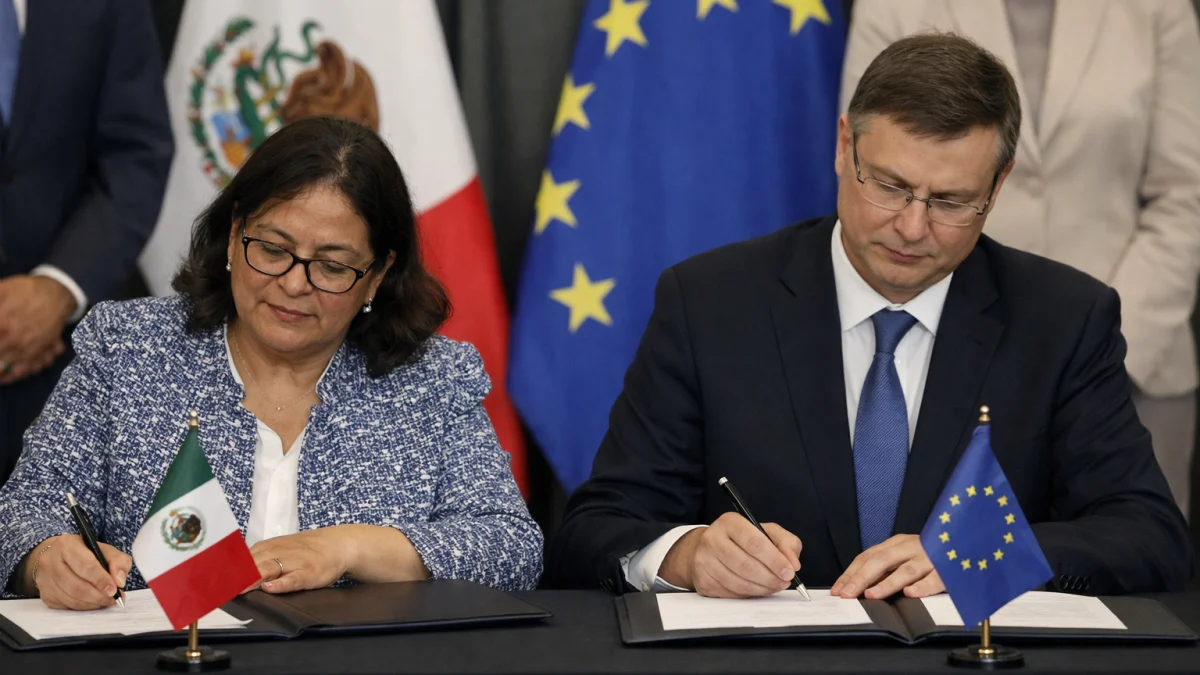
Mexico and the European Union have moved to finalize a long-delayed modernization of their trade relationship, marking one of the most significant efforts by major U.S. trading partners to diversify commercial ties amid heightened tariff pressures from Washington. The agreement, which has now cleared the European Parliament after being signed at an EU-Mexico summit in May, updates a framework that has governed bilateral trade since 2000 and expands cooperation well beyond traditional goods trade.
The development is significant because it reflects a broader shift in global trade policy. Rather than relying predominantly on access to the U.S. market, governments facing higher American tariffs are accelerating agreements with other major economies to reduce vulnerability to policy changes in Washington. For both Mexico and the European Union, the updated accord represents an attempt to strengthen supply chains, widen export opportunities and reinforce support for a rules-based trading system at a time of heightened geopolitical and commercial uncertainty.
The modernized agreement substantially expands the scope of the original EU-Mexico trade framework. In addition to reducing tariffs on most goods, it introduces updated provisions covering services, digital trade, investment, intellectual property protection, public procurement, sustainable development and anti-corruption measures. European institutions have also highlighted improved protection for geographical indications and broader access for European companies to Mexican government procurement markets.
The timing is closely linked to changes in U.S. trade policy. Since President Donald Trump returned to office, Washington has pursued higher tariffs and a more assertive approach toward several major trading partners while simultaneously reopening negotiations over the United States-Mexico-Canada Agreement (USMCA). U.S. officials have emphasized reducing bilateral trade deficits, strengthening domestic manufacturing and tightening rules governing strategic industries such as automobiles, steel and aluminum.
Against that backdrop, Mexico has sought to preserve its critical economic relationship with the United States while expanding commercial links elsewhere. More than three-quarters of Mexican exports still go to the U.S. market, leaving the country highly exposed to changes in American trade policy. Broadening access to European markets provides Mexico with additional export destinations and could reduce dependence on a single trading partner over the longer term.
The European Union faces similar incentives. While the United States remains one of its largest trading partners, Brussels has increasingly pursued agreements with countries across Latin America and the Indo-Pacific as part of a wider strategy to diversify supply chains and strengthen economic resilience. EU officials have repeatedly argued that expanding partnerships with reliable trading partners reduces exposure to unilateral trade measures and supports predictable international commerce.
Business groups are likely to view the updated agreement as particularly valuable because it extends beyond tariff reductions. Easier access to procurement contracts, clearer regulatory frameworks and stronger protections for investment and intellectual property may encourage additional cross-border investment. Industries including automotive components, machinery, chemicals, pharmaceuticals, agriculture and digital services stand to benefit from lower trade barriers and greater regulatory certainty.
European institutions estimate that more than 45,000 EU companies export to Mexico, the majority of them small and medium-sized enterprises. Officials argue that simplifying market access could encourage more businesses to participate in bilateral trade while strengthening supply chains across sectors increasingly affected by geopolitical fragmentation.
Some analysts also view the agreement as carrying broader strategic implications. Rather than directly challenging the United States, the accord demonstrates how countries affected by tariff uncertainty are pursuing parallel commercial relationships that reduce concentration risk. That approach has become more common as governments seek greater resilience following disruptions caused by the COVID-19 pandemic, geopolitical tensions and repeated trade disputes.
At the same time, the agreement does not diminish the importance of North American economic integration. Mexico's manufacturing sector remains deeply intertwined with U.S. supply chains, particularly in automotive production and electronics. Ongoing USMCA review negotiations indicate that maintaining stable commercial relations with Washington remains Mexico's highest economic priority, even as it expands ties with Europe.
Implementation will also take time. While the European Parliament has approved both the broader Modernised Global Agreement and the interim trade agreement covering areas under exclusive EU competence, the full partnership still requires completion of remaining ratification procedures, including approval by EU member states for the broader agreement. The interim trade agreement is designed to allow many commercial provisions to take effect sooner while broader ratification continues.
For now, the confirmed outcome is that Mexico and the European Union have completed another major step toward implementing their modernized trade partnership at a moment when global trading relationships are being reshaped by U.S. tariff policy. Officials on both sides continue to monitor ratification procedures, implementation timelines and parallel negotiations with Washington, while businesses will be watching how quickly the new rules translate into expanded trade and investment opportunities.