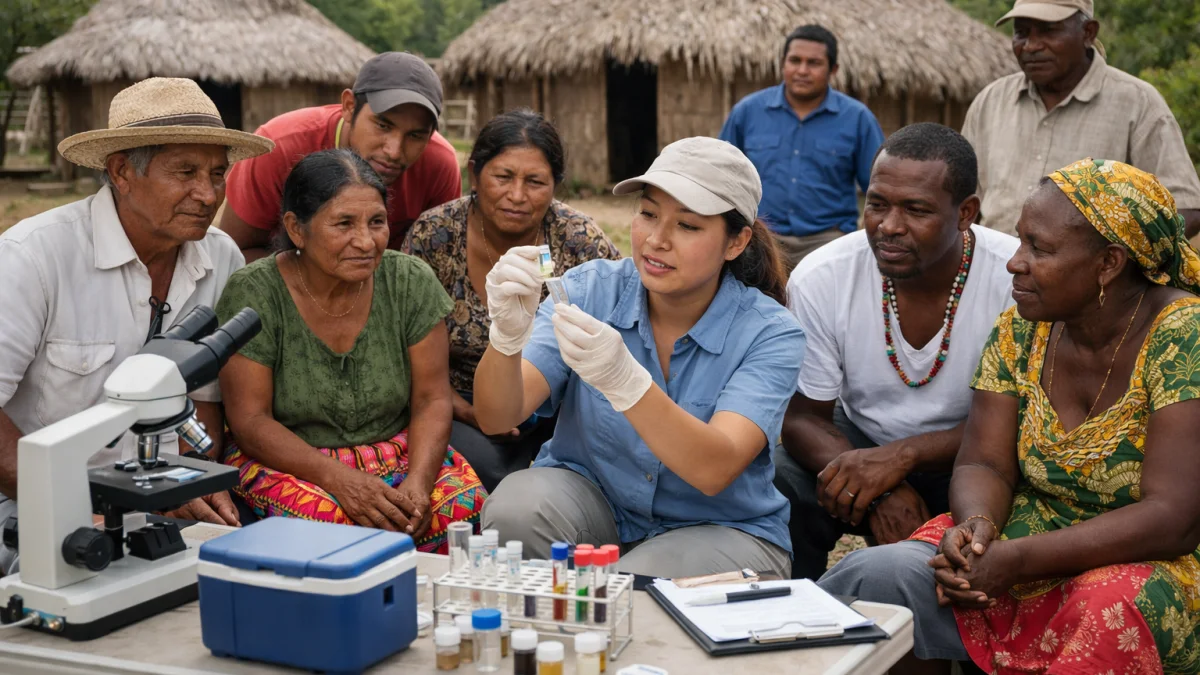
Morning meetings at the MRC/Wits Agincourt Research Unit in rural northeastern South Africa no longer begin only with discussions of sampling methods or laboratory schedules. Community representatives now sit alongside researchers to help decide how benefits generated by scientific projects should return to the people whose participation makes the work possible.
The conversations reflect a broader shift taking place across international research, where communities increasingly influence not only how studies are conducted but also how their outcomes are shared. Rather than treating local residents solely as research participants, universities, public health institutions and scientific organizations are experimenting with partnerships that give communities a formal role in setting priorities, governing projects and determining how research benefits are distributed.
The change is reshaping relationships that have often been marked by unequal power, particularly in low- and middle-income countries where international researchers have long collected data while local communities saw few lasting gains.
Researchers say the new approach is driven by practical as well as ethical considerations. Communities that trust researchers are more likely to participate in long-term studies, while research designed with local knowledge often addresses problems more relevant to people's daily lives.
One of the most closely watched examples comes from genomic research in South Africa. A study published in Nature Communications documented a benefit-sharing model in which participating communities themselves identify organizations and projects that should receive support generated through research partnerships. Instead of researchers deciding where resources should go, community-led governance structures make those decisions after local consultation. The supported initiatives have included schools, youth organizations, water infrastructure and services for older residents.
Ngonidzashe Ngwarai, lead author of the study and assistant director of systems and operations at the MRC/Wits Agincourt Research Unit, said the value created by genomic data often extends well beyond individual studies. The question, he said, is how communities contributing that knowledge can also share in its long-term benefits.
The model represents a departure from traditional research arrangements, where compensation has often been limited to reimbursing participants for travel or time. Under the newer framework, benefits are directed toward priorities identified collectively by communities rather than distributed solely to individuals.
Similar ideas are emerging elsewhere.
In England, the University of Reading and the British Science Association recently completed an evaluation of a three-year Community Led Research Pilot that allowed community organizations to design research questions alongside academic partners. The evaluation concluded that projects became more relevant to local needs when residents helped shape them from the outset rather than joining after research agendas had already been established.
In the United States, Rutgers University's Community Scientist Program trains community members in research ethics and methodology before pairing them with academic investigators. One project developed through the initiative examined ways to improve public understanding of clinical trials, with community participants involved throughout the research process rather than serving only as advisors.
Public health researchers say such partnerships require significant investments of time. Building relationships, maintaining transparency and sharing decision-making can slow projects compared with conventional research models.
Yet many scientists argue that the additional effort improves both the quality and durability of research.
A qualitative analysis published in Public Health in Practice this year examined partnerships developed through the U.S. National Institutes of Health's RADx-UP initiative. Researchers identified long-term commitment, transparent communication, co-designed research tools and sustained funding as essential ingredients for successful community-based participatory research.
Another study published in Geoforum found that community engagement exists along a spectrum and that different projects require different levels of participation. While intensive community-based participatory research remains valuable, the authors concluded that effective engagement depends on matching collaboration to local context rather than applying a single model to every project.
The evolution is also changing how universities measure success.
For decades, scientific achievement has largely been evaluated through publications, grants and citations. Increasingly, research institutions are also examining whether projects produce outcomes valued by host communities, whether partnerships continue after individual grants end and whether local organizations develop lasting research capacity.
A report released this month by the University of Sheffield's Urban Institute argues that successful university-community collaborations progress "at the speed of trust," describing long-term relationships as more valuable than one-off consultation exercises. Drawing on several case studies, the report concludes that sustainable partnerships require communities to be treated as equal contributors rather than recipients of academic expertise.
The shift is especially visible in fields where research depends heavily on local knowledge, including environmental science, biodiversity conservation and public health.
Indigenous researchers and community leaders have increasingly argued that traditional ecological knowledge should be incorporated alongside scientific methods, with communities retaining authority over how their knowledge is used. Collaborative environmental projects in several countries now combine scientific monitoring with Indigenous stewardship practices, reflecting growing recognition that local expertise can strengthen conservation outcomes.
Challenges remain. Shared governance can complicate funding arrangements, intellectual property rights and publication timelines. Researchers must balance scientific independence with community expectations, while communities often seek assurances that partnerships will continue after individual studies conclude.
Even so, advocates say the direction of travel is becoming clearer.
Rather than asking communities merely to participate in research, many institutions are beginning to ask how research itself can participate in community priorities.
Back in rural South Africa, where local advisory groups continue to deliberate over projects supported through genomic research partnerships, the discussions extend beyond laboratories or scientific journals. They concern schools, water supplies, youth organizations and other investments chosen by the communities themselves—an indication that, for many researchers and residents alike, the success of science is increasingly measured not only by discoveries made, but also by the relationships that make those discoveries possible.