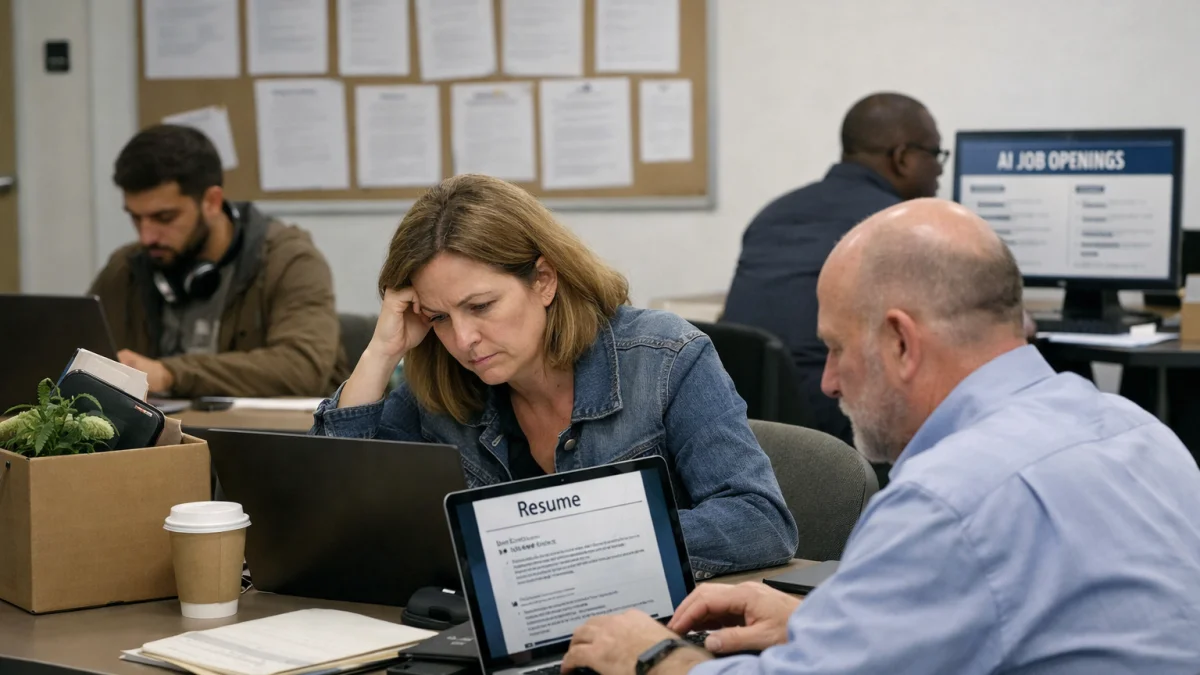
When software engineer Sarah Chen learned that her position had been eliminated earlier this year, the news came alongside a message familiar to thousands of technology workers in 2026: the company was reorganizing around artificial intelligence.
Her experience reflects a wider shift unfolding across the labor market, where layoffs are coinciding with unprecedented corporate investment in AI systems and a growing demand for workers who can build, manage or work alongside those tools. Rather than a simple story of jobs disappearing, many displaced employees are finding themselves navigating a market that increasingly values different skills than it did only a few years ago.
The transition has become one of the defining workplace stories of 2026. Technology companies, banks, media firms and professional services businesses have announced job cuts while simultaneously increasing spending on AI infrastructure, automation and new technical capabilities. In many cases, employers have said the reductions are part of broader restructuring rather than direct replacement of workers by AI. Yet for employees searching for new work, the distinction often offers little immediate comfort.
Microsoft announced plans this month to eliminate roughly 4,800 jobs as it continued investing heavily in AI infrastructure. Amazon, Meta and other large technology companies have also reduced headcount while emphasizing AI-related priorities. Reuters has documented similar restructuring across multiple industries as executives seek to balance rising investment costs with pressure to improve efficiency.
For many workers, the challenge begins after the layoff notice arrives.
Recruiters and labor economists say employers continue to hire, but the profile of sought-after candidates is changing. Job postings increasingly ask applicants to demonstrate experience with AI-assisted workflows, prompt engineering, machine learning tools or the ability to supervise automated systems. Even positions that are not directly involved in AI development frequently list familiarity with generative AI platforms as a preferred qualification.
Research examining millions of U.S. job postings has found that companies are not simply eliminating occupations. Instead, they are redesigning jobs by changing the tasks employees perform while shifting hiring toward roles that complement AI systems. The research suggests organizations are adjusting through both changes in who they hire and changes in what existing jobs require.
That evolution has left many experienced workers in a difficult position.
Those whose careers were built around routine programming, documentation, customer support or administrative work often discover that employers now expect candidates to perform higher-level analytical or supervisory tasks while using AI tools to automate repetitive work. The result is a labor market where entry-level opportunities have become more limited while expectations for technical proficiency have risen.
The changing landscape has been particularly visible among recent graduates. According to reporting citing analysis from the Federal Reserve Bank of St. Louis, the U.S. labor market has entered what researchers describe as a "low-hire" phase, with new graduates facing rising unemployment while employers increasingly seek applicants with AI-related skills.
Companies maintain that AI adoption also creates new opportunities.
Thomson Reuters, for example, said this week it would eliminate up to 500 engineering positions while planning to add more than 250 engineering roles over the next two years, primarily focused on senior and AI-native talent. A company spokesperson said the changes reflected evolving customer expectations across legal, tax and regulatory services rather than a simple reduction in staffing.
That pattern—cutting some roles while hiring for others—has become increasingly common. Economists note that previous waves of technological change also reshaped labor markets by reducing demand for certain tasks while increasing demand for new skills. The pace of generative AI adoption, however, has compressed those adjustments into a relatively short period.
Not every dispute over AI's role has focused solely on economics.
Former Meta employees recently filed a lawsuit alleging the company used AI-driven productivity tools in ways that unfairly influenced layoff decisions affecting workers on medical or family leave. Meta has denied the allegations, saying employment decisions were made by human managers rather than AI systems. The case highlights growing scrutiny over how AI is used not only to perform work but also to evaluate workers.
Meanwhile, employee concerns have become more visible inside some of the world's largest technology companies.
More than 4,500 Google employees signed a petition this week calling for stronger layoff protections amid the company's expanding AI investments. Organized through the Alphabet Workers Union, the petition asked management to provide guaranteed severance, voluntary buyouts before mandatory layoffs and greater transparency around workforce reductions.
Labor specialists caution against viewing AI as the sole explanation for every layoff. Corporate restructuring, slower hiring, changing consumer demand and broader economic conditions also influence employment decisions. Nevertheless, AI has become an increasingly important factor in how companies allocate investment and organize work, making it difficult for displaced employees to separate technological change from broader business strategy.
For workers entering the job market after a layoff, the immediate priority often becomes adaptation rather than debate. Training providers, universities and employers have expanded programs focused on AI literacy, while professional organizations encourage workers to treat AI proficiency as a complement to existing expertise rather than a replacement for it.
Whether those efforts will keep pace with the changing labor market remains uncertain. What is already evident is that the next chapter for many laid-off employees is being written in a hiring environment where experience alone is no longer enough, and where learning to work alongside AI has become an increasingly important part of finding the next opportunity.