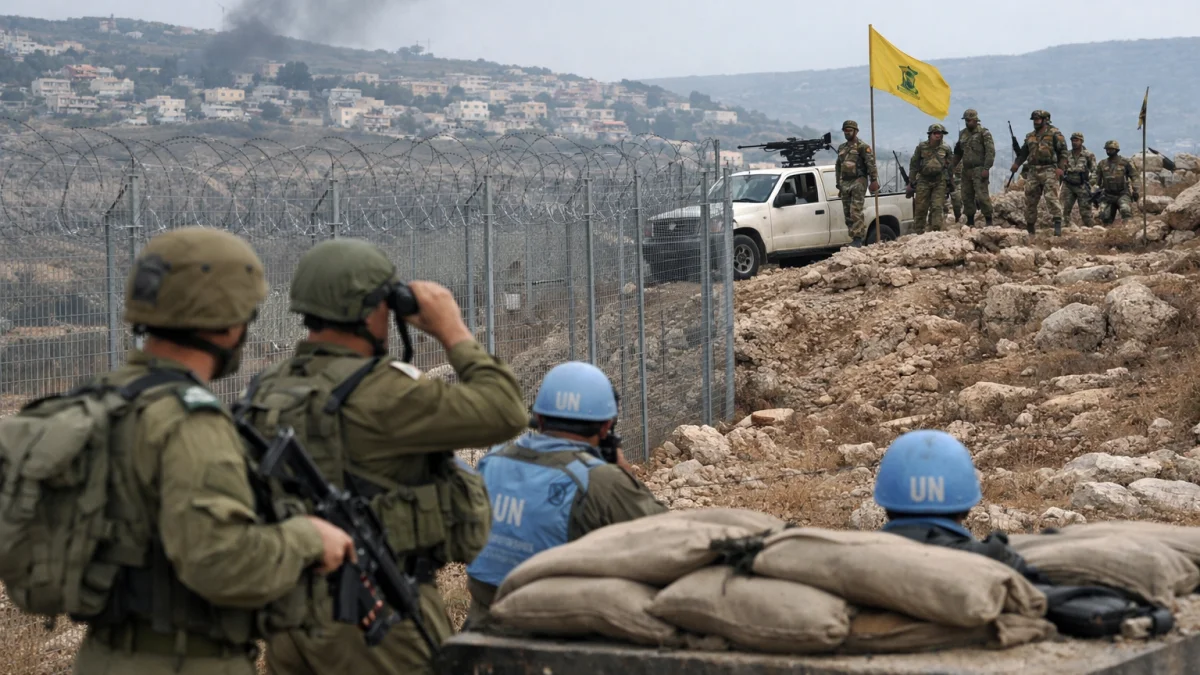
Israel’s declaration that it intends to maintain an open-ended military presence in parts of southern Lebanon has become the most significant test yet of the U.S.-brokered framework intended to halt months of cross-border fighting. Israeli leaders have stated that any withdrawal will depend on the elimination of Hezbollah as a military threat, while Lebanon’s government argues that continued Israeli military control cannot become a permanent feature of the agreement. The competing interpretations have exposed the central tension within the ceasefire framework only days after it was concluded.
The dispute matters because the agreement was presented not merely as a ceasefire but as the beginning of a broader security and political process between two states that have technically remained at war for decades. Unlike previous arrangements focused primarily on halting hostilities, the latest framework links Israeli withdrawal from southern Lebanon to the disarmament of Hezbollah, the Iran-backed armed movement that remains Lebanon’s most powerful non-state military force. That condition has transformed what might otherwise have been a military de-escalation into a politically contentious effort to reshape Lebanon’s internal security order.
Israeli Prime Minister Benjamin Netanyahu reinforced that linkage during a visit to southern Lebanon, stating that Israeli forces would remain until Hezbollah no longer posed a threat. Israeli officials argue that previous ceasefires failed because Hezbollah retained its military infrastructure and resumed attacks after periods of relative calm. From Israel’s perspective, maintaining a buffer zone is presented as a security requirement rather than an occupation without end.
That position was strengthened further when Israeli Defense Minister Israel Katz declared that Israeli forces would remain indefinitely in self-declared security zones not only in Lebanon but also in Syria and Gaza. The statement suggested that Israel increasingly views long-term military control in strategic border areas as part of its broader security doctrine following successive regional conflicts.
For Lebanon, however, those statements have raised concerns that the framework risks institutionalizing an indefinite Israeli military presence. President Joseph Aoun has argued that the agreement should not be interpreted as legitimizing continued occupation but instead as expanding the authority of the Lebanese Armed Forces throughout Lebanese territory. His administration has attempted to portray the agreement as strengthening state sovereignty rather than conceding territory in exchange for uncertain security guarantees.
Domestic politics further complicate implementation. Hezbollah rejected the framework because it was negotiated without its participation and because it requires the group's disarmament. Parliamentary Speaker Nabih Berri, a key Hezbollah ally, has also criticized the agreement, warning that efforts to enforce it could deepen political divisions and potentially provoke internal instability. Those objections highlight the practical difficulty facing the Lebanese state, whose military has historically lacked the political authority and operational capacity to compel Hezbollah to surrender its weapons.
Security analysts have therefore questioned whether the framework establishes conditions that are politically achievable. Several observers argue that conditioning Israeli withdrawal on Hezbollah's complete disarmament creates a circular process: Israel says it cannot withdraw before Hezbollah is neutralized, while Hezbollah insists it will not disarm while Israeli forces remain inside Lebanese territory. Unless that sequence changes, implementation could remain stalled despite the formal agreement.
The framework nevertheless represents an important diplomatic departure. It includes mutual recognition of sovereignty, U.S.-led monitoring arrangements, plans for expanded deployment of the Lebanese Armed Forces in designated pilot zones, reconstruction assistance, and mechanisms intended to reduce future military escalation. If implemented, those provisions could gradually replace direct military confrontation with state-based security institutions. Yet nearly every major provision depends upon mutual confidence that neither side currently appears to possess.
The regional context also shapes the agreement's prospects. The latest Israel-Hezbollah conflict unfolded alongside wider tensions involving Iran, making Lebanon part of a broader strategic contest extending beyond the bilateral relationship. Although international mediation helped reduce active fighting, sporadic military strikes and continuing accusations of ceasefire violations demonstrate how rapidly localized incidents could undermine broader diplomatic efforts.
International law and diplomacy are also likely to remain central to the debate. Lebanese officials continue to emphasize sovereignty and eventual Israeli withdrawal, while Israel maintains that military deployment is justified by continuing security threats. Those competing legal and political interpretations are likely to influence future discussions involving the United States and other international partners seeking to preserve the ceasefire framework.
For now, the ceasefire remains in effect but under significant strain. Israeli leaders continue to insist that withdrawal depends on Hezbollah's disarmament, Lebanese authorities maintain that the agreement should restore full state authority rather than legitimize occupation, and Hezbollah continues to reject the framework. Officials and international mediators are closely monitoring implementation of the pilot security zones, deployment of the Lebanese Armed Forces, Israeli military activity in southern Lebanon, and whether negotiations can prevent renewed escalation despite the unresolved disagreements at the center of the agreement.