LONDON — British American Tobacco announced sweeping workforce reductions on June 29, 2026, as part of a major restructuring effort. The company, one of the world's largest tobacco groups and maker of brands including Lucky Strike and Dunhill, plans to eliminate about 5,500 roles and outsource another 3,500 positions by the end of the year.
The changes affect nearly one-fifth of BAT's roughly 47,000 global employees outside its largest market, the United States. They form a core element of the company's Fit2Win transformation programme, launched in 2025, which aims to deliver around £600 million ($810 million) in annual cost savings by 2028 through greater agility, cost discipline, and technology enablement.
The restructuring arrives as the traditional cigarette business confronts declining volumes. BAT has reported a roughly 2.5% drop in cigarette volumes this year while accelerating its shift toward smoke-free nicotine products such as vaping devices and pouches. Chief Executive Tadeu Marroco described the moves as positioning the company for the future.
"These changes affect many of our colleagues, and we are focused on supporting them through this transition with care and respect, as we position the business for the future," Marroco said in a statement.
The job cuts and outsourcing, which have already begun, exclude the U.S. operations run through subsidiary Reynolds American. BAT is partnering with firms including Accenture to handle some transferred roles, with activity already underway in locations such as the UK, Poland, Romania, Costa Rica, Mexico, Singapore, and Malaysia.
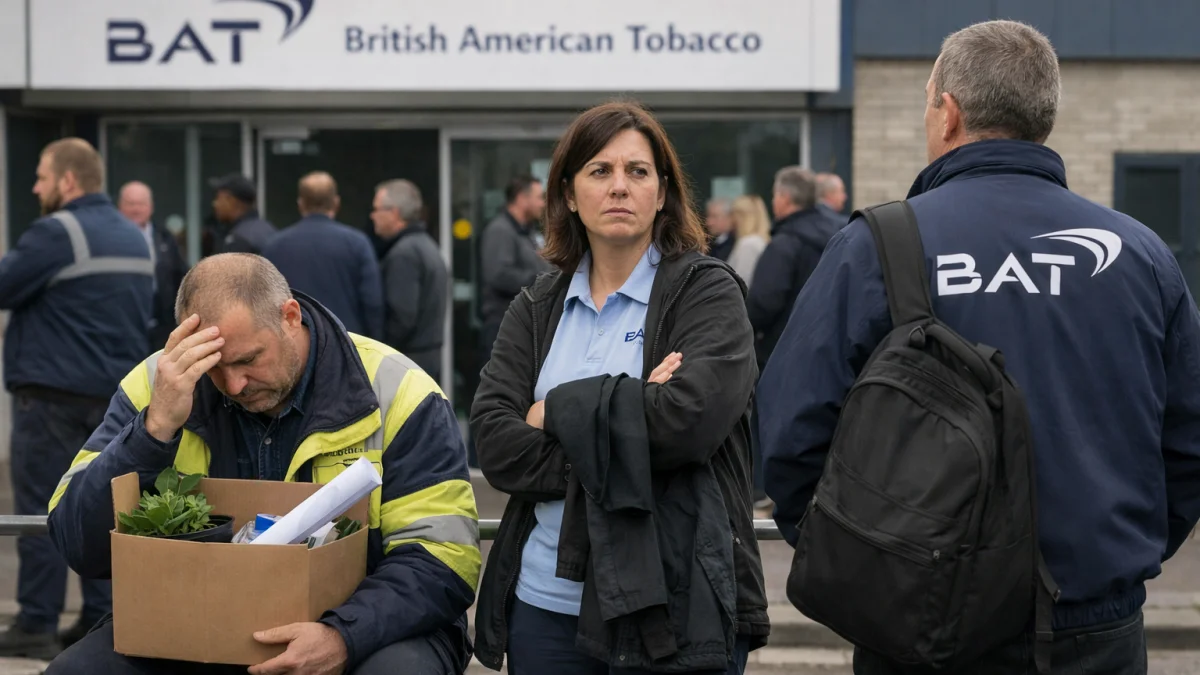
For employees, the announcement signals a period of profound uncertainty. Many long-serving staff in manufacturing, administrative, and support functions now face the prospect of redundancy or reassignment to third-party providers, often with different terms and conditions. The company has not detailed the geographic distribution of the cuts beyond the global scope and U.S. exclusion, leaving workers across multiple markets to await individual notifications.
BAT's broader industry context underscores the pressure. Global cigarette demand continues to face headwinds from regulation, health awareness, and shifting consumer preferences toward alternatives. The company is investing heavily in "new categories" — smoke-free products — while streamlining operations through automation, artificial intelligence, and process simplification under Fit2Win.
Interim Chief Financial Officer Javed Iqbal had earlier signaled that embracing AI and digital tools would impact staffing levels as part of productivity initiatives. The programme seeks to reduce complexity, build technology partnerships, and enable faster decision-making across the organization.
The human toll of such large-scale corporate restructurings is well documented in the tobacco sector and beyond. Previous rounds of cost-cutting at BAT and peers have involved factory consolidations and management layer reductions. In this instance, the scale — affecting support functions, operations, and back-office roles targeted for outsourcing — suggests impacts on a wide range of skill levels and tenures.
Workers in affected areas must navigate severance arrangements, potential redeployment, or transitions to new employers. For those nearing retirement or with specialized experience tied to traditional tobacco manufacturing, options may feel limited amid an industry in transition. Families and local communities dependent on BAT facilities could also experience ripple effects, though specific local impacts remain unclear pending further implementation details.
BAT has emphasized support measures. The company states it is prioritizing care and respect in the transition process, consistent with its public commitments during previous restructurings. However, the pace — with most changes completed by year-end 2026 — compresses the window for adjustment.
The restructuring reflects wider trends in global business. Companies across sectors are turning to AI, automation, and outsourcing to manage costs and adapt to technological change. For BAT, the savings are intended to fund growth in higher-margin smoke-free products while defending profitability in a challenging regulatory environment.
As the cuts unfold, the affected employees represent the human face of an industry navigating its next chapter. BAT's leadership frames Fit2Win as essential for long-term strength and competitiveness. For thousands of workers, it marks the end of familiar roles and the beginning of an uncertain search for stability in a rapidly evolving corporate and industry landscape.
The full effects will become clearer in the coming months as notifications proceed and support programmes take shape. In the meantime, the announcement underscores the tension between corporate adaptation and the immediate livelihoods of those who have powered the business.