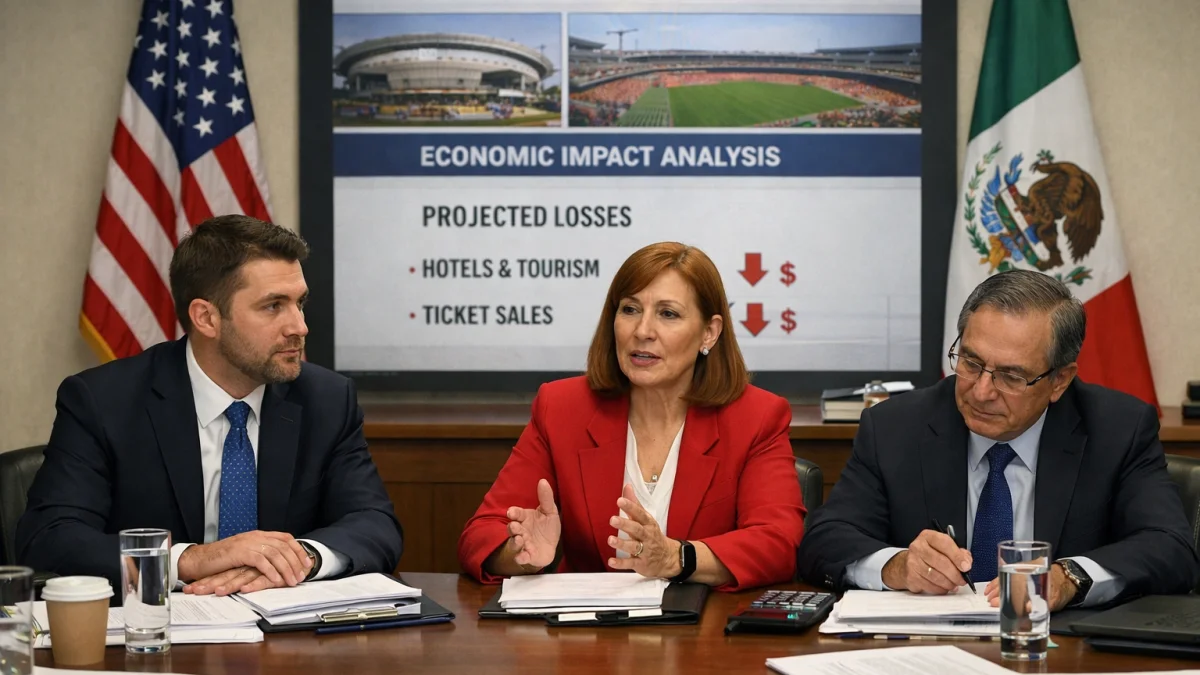
MEXICO CITY — Officials, economists and business groups in the United States and Mexico are assessing the economic effects of hosting the 2026 FIFA World Cup as the tournament enters its final stages, with early indications pointing to uneven local gains and higher-than-expected costs in some host cities rather than broad national economic benefits.
Governments and host-city authorities have begun reviewing tourism, consumer spending and infrastructure data following weeks of matches across North America, while analysts cautioned that a full accounting will take months after the tournament concludes.
Economists at S&P Global Market Intelligence said before and during the tournament that the World Cup was expected to generate a temporary boost in activity for hotels, restaurants and transportation but was unlikely to produce a measurable effect on overall economic growth in either the United States or Mexico. The firm cited historical evidence showing that substitution of spending, crowding out of regular economic activity and other factors often reduce the net impact of major sporting events.
The assessment contrasts with earlier projections commissioned by FIFA that forecast substantial economic output, employment and visitor spending associated with the expanded 48-team tournament hosted jointly by the United States, Mexico and Canada. Those studies estimated billions of dollars in economic activity across the host nations through tourism, operations and event-related investment.
In Mexico, the World Cup has drawn large crowds and boosted business activity in host cities, but public attention has also remained focused on broader economic and social concerns, including inflation and domestic policy issues, according to Reuters reporting. Some residents and advocacy groups have questioned whether the tournament's benefits are being distributed evenly across the economy.
U.S. host cities have likewise reported strong visitor numbers during match days, although economists have warned that much of the additional spending may represent a shift in consumption rather than entirely new economic activity. They said existing stadium infrastructure helped limit construction costs but also reduced the scale of long-term investment effects compared with previous mega-events.
Officials in both countries said comprehensive economic assessments will continue after the tournament ends, incorporating tax receipts, tourism statistics, employment data and public expenditures before final conclusions are reached.
The 2026 World Cup, co-hosted by the United States, Mexico and Canada, is the largest in FIFA history, featuring 48 national teams and matches staged across 16 host cities in North America.