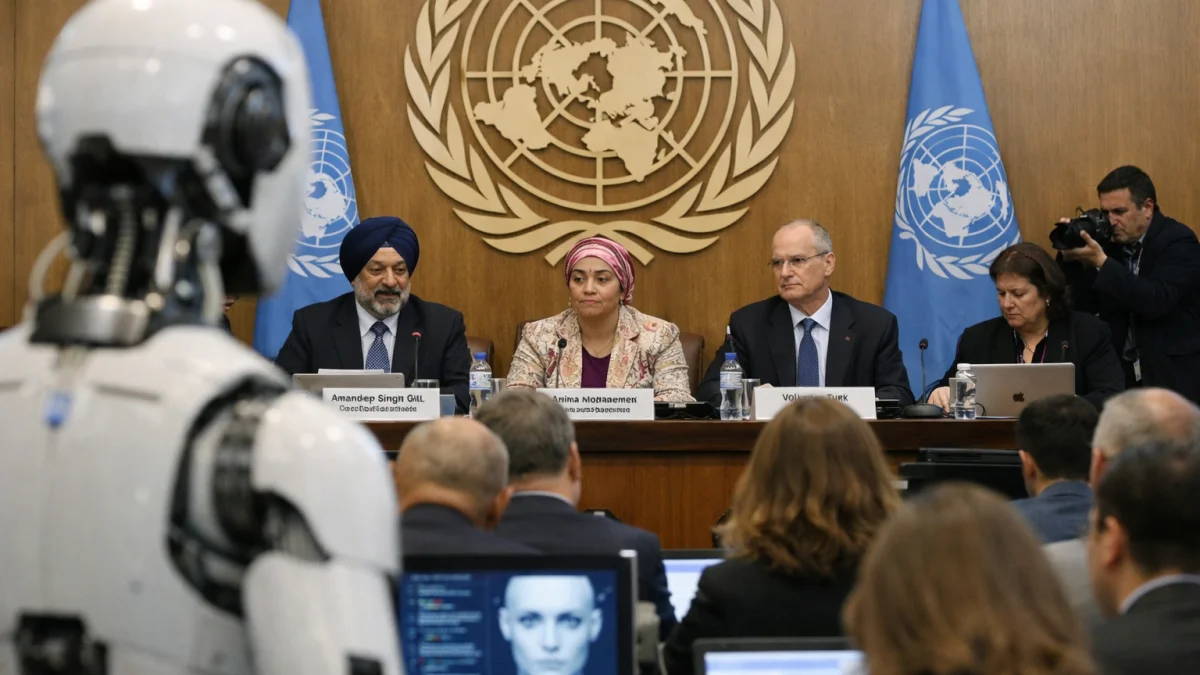
The United Nations has warned that the development of artificial intelligence is outpacing the ability of governments and international institutions to govern it, marking one of its strongest calls yet for coordinated global oversight as AI systems become more capable and more widely deployed. Speaking at the inaugural Global Dialogue on AI Governance in Geneva on July 6, Secretary-General António Guterres said AI is advancing faster than regulatory frameworks can keep pace and urged governments to establish common safeguards that preserve innovation while addressing growing societal risks.
The warning reflects a broader shift in the international debate over AI. Rather than focusing solely on the technology's economic potential, policymakers are increasingly grappling with whether existing legal, technical and institutional mechanisms are sufficient to manage systems that are evolving rapidly and are already being integrated into public services, scientific research, financial markets and critical infrastructure. The UN's intervention is significant because it seeks to establish a shared scientific foundation for international discussions before governments attempt to negotiate more formal governance arrangements.
The immediate backdrop is the release of the preliminary report by the UN's Independent International Scientific Panel on Artificial Intelligence, a group of 40 experts appointed to provide an evidence-based assessment of AI's opportunities, risks and impacts. Unlike regulatory proposals advanced by individual governments, the report does not prescribe specific legal rules. Instead, it identifies areas where scientific evidence suggests governance is failing to keep pace with technological development, while acknowledging that AI continues to offer significant benefits in areas including medicine, education, scientific discovery and productivity.
One of the report's central conclusions is that policymakers face what it describes as an "evidence dilemma." Governments often seek strong empirical evidence before regulating emerging technologies, yet AI capabilities can advance so quickly that waiting for complete evidence may leave regulators responding only after new risks have become widespread. According to the panel, this dynamic challenges traditional regulatory approaches that rely on lengthy legislative and administrative processes.
The UN also argues that AI governance is becoming an international development issue rather than simply a technology policy question. Guterres warned that advanced computing power, AI models and technical expertise remain concentrated among a relatively small number of countries and companies. Reuters reported that the United States accounts for roughly three-quarters of the world's leading AI supercomputing capacity, with China holding much of the remainder, highlighting concerns that many developing economies could become increasingly dependent on technologies they cannot independently build, evaluate or adapt.
This concern extends beyond infrastructure. The scientific panel argues that many lower-income countries lack sufficient computing resources, technical expertise, local-language data and regulatory capacity to participate fully in AI development. Without greater investment, the report concludes, AI could reinforce existing global inequalities instead of narrowing them. That assessment broadens the governance discussion beyond questions of safety and ethics to include economic competitiveness, digital sovereignty and equitable access to emerging technologies.
The governance debate has also expanded to encompass a wider range of risks than earlier discussions, which often centered on misinformation or algorithmic bias. The UN panel examines implications for cybersecurity, democratic institutions, human rights, environmental sustainability, child safety and economic disruption. During the Geneva dialogue, Guterres placed particular emphasis on protecting children, proposing an AI Child Safety Pledge that would require companies to ensure their AI systems are safe for children before deployment.
At the same time, the UN has avoided portraying AI primarily as a threat. Its assessment emphasizes that governance should enable societies to benefit from AI while reducing avoidable harms. The panel highlights applications that could improve healthcare, scientific research, agriculture and education, provided governance mechanisms encourage transparency, accountability and broad access rather than concentrating benefits among a limited group of actors.
The challenge, however, is that AI governance remains fragmented. Different jurisdictions have adopted varying regulatory approaches, ranging from comprehensive legislation to voluntary industry commitments and sector-specific guidance. According to the UN assessment, dozens of governance instruments already exist, but they are unevenly implemented, difficult to compare and rarely evaluated for real-world effectiveness. This fragmentation complicates efforts to establish internationally compatible standards as AI systems increasingly operate across borders.
The Geneva dialogue is therefore intended less as a negotiating forum than as the beginning of a longer institutional process. The UN's scientific panel is expected to continue updating its evidence base through consultations and thematic reports before publishing a more comprehensive assessment in 2027. Officials have described the current report as a common factual starting point for future international discussions rather than a final policy blueprint.
For now, the confirmed development is not the creation of new international AI rules but a growing consensus among UN officials and independent experts that governance structures are struggling to match the pace of technological change. Governments participating in the Global Dialogue are examining how scientific evidence can inform future policy coordination, while the UN continues developing its assessment of AI's opportunities and risks. Whether those discussions ultimately produce broadly accepted international governance mechanisms remains an open question that future meetings and the panel's subsequent reports are expected to address.