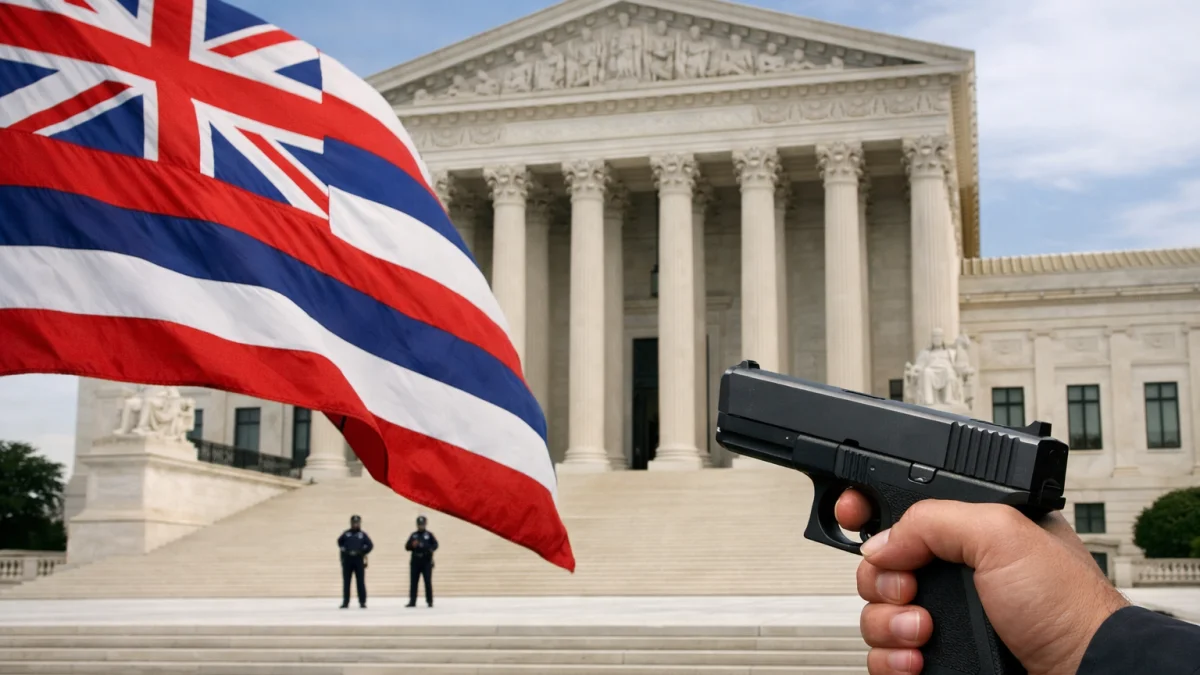
WASHINGTON — The U.S. Supreme Court struck down a Hawaii law requiring concealed-carry permit holders to obtain express permission from property owners before bringing firearms onto private property open to the public, ruling 6-3 that the restriction violates the Second Amendment.
The decision in Wolford v. Lopez, released on Thursday, reverses a ruling by the 9th U.S. Circuit Court of Appeals that had largely upheld the state law enacted in 2023. The case was brought by three Maui residents with concealed-carry permits and the Hawaii Firearms Coalition.
Writing for the majority, Justice Samuel Alito said the Hawaii provision “hobbles what the Second Amendment protects: the right of Americans to carry arms for self-defense as they go about their daily lives.” The law, often referred to as a “vampire rule,” made it a crime to carry on private property open to the public — such as stores, restaurants and malls — without specific owner consent.
Hawaii Attorney General Anne Lopez had defended the law, citing the state’s history of firearm regulation. The law was passed following the Supreme Court’s 2022 decision in New York State Rifle & Pistol Association v. Bruen, which expanded Second Amendment protections for public carry. Similar laws exist in California, Maryland, New York and New Jersey.
In dissent, the court’s three liberal justices argued that the ruling unduly limits states’ ability to balance gun rights with property owners’ interests and public safety. Details of the dissenting opinions were not immediately available in early reports.
The challengers welcomed the outcome. “This decision affirms that the Second Amendment applies when law-abiding citizens go about their daily business,” one plaintiff’s attorney said in a statement.
Hawaii officials said they were reviewing the ruling’s implications for state law enforcement. The decision does not prevent private property owners from posting signs banning firearms or otherwise prohibiting them on their premises.
The Supreme Court heard arguments in the case on Jan. 20. It limited review to the private property consent requirement, declining to address other provisions on sensitive places.
As of Thursday, the full impact on other states with similar laws remained under assessment by legal experts. The ruling is the latest in a series of Supreme Court decisions interpreting the Second Amendment since Bruen.