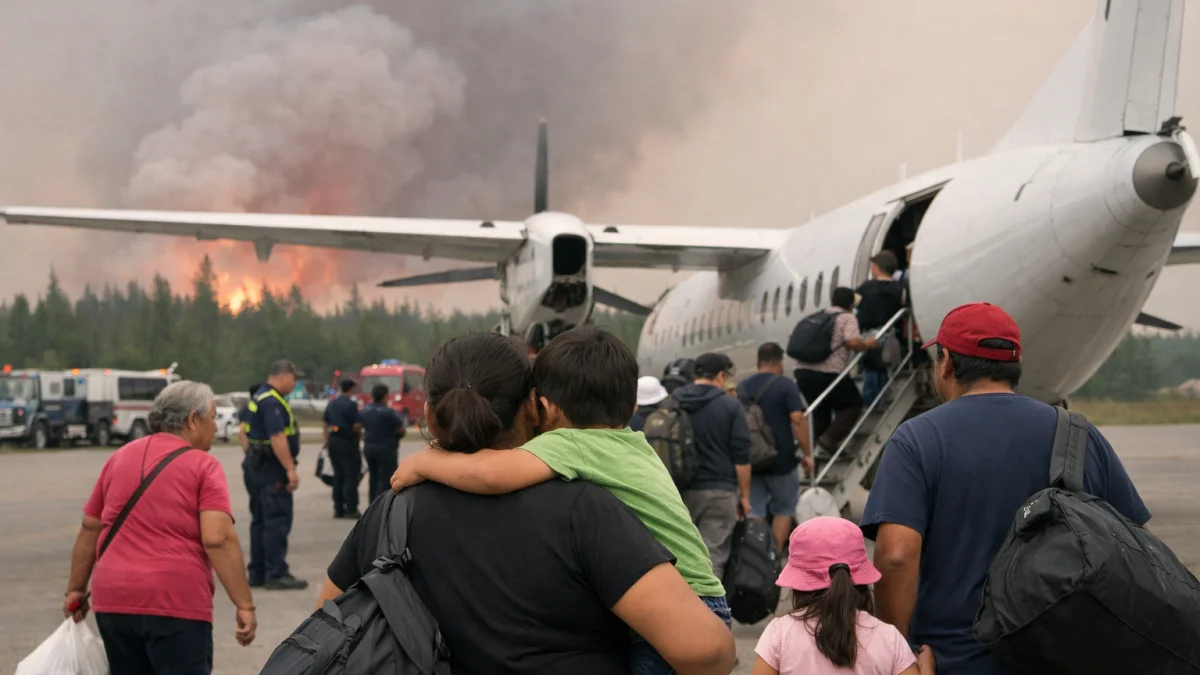
The first departures came by boat.
As wildfire closed roads and advanced toward remote First Nations in northwestern Ontario, residents carried what they could across the water, leaving homes that had stood for generations. Provincial officials later said the fire consumed the community of Namaygoosisagagun (Collins) First Nation in less than an hour, turning one of the most severe wildfire outbreaks of the Canadian summer into a defining loss for families already accustomed to living with the risks of isolation.
For many evacuees arriving in Thunder Bay and other reception centres this week, the journey marked more than an escape from flames. It was another displacement from communities where language, culture and family ties are rooted in the land, even as soaring temperatures and prolonged dry conditions have made northern fire seasons increasingly unpredictable.
The evacuation of multiple First Nations across northwestern Ontario illustrates how climate-driven extremes are reshaping life in Canada's remote north. Wildfires and an intense heat wave converged in mid-July, forcing emergency officials to move entire communities while smoke spread hundreds of kilometres south, degrading air quality across Ontario and into the northeastern United States. Provincial authorities requested federal military assistance as the scale of the emergency grew.
Ontario said more than 1,600 First Nations residents had been displaced by the fires. Across Ontario, Manitoba and Saskatchewan, officials reported hundreds of active wildfires, with more than two million hectares burned during the season. Prime Minister Mark Carney said the federal government would coordinate support for affected provinces as evacuations expanded.
The destruction of Collins First Nation became one of the most striking symbols of the crisis. Ontario's Minister of Emergency Preparedness and Response said the community was destroyed in under an hour after fire intensified rapidly. Residents evacuated before the flames arrived, many leaving by boat because road access was threatened.
Mandatory evacuation orders also affected communities including Whitesand First Nation, Lac La Croix First Nation and Lac des Mille Lacs First Nation, while officials monitored additional settlements facing changing fire conditions. Police closed sections of highways, and a major Canadian National Railway corridor through the region was disrupted after fire surrounded rail infrastructure.
For residents of these remote communities, evacuation brings challenges that extend well beyond immediate safety. Many families travel hundreds of kilometres to temporary accommodations, separated from familiar support networks while waiting for news about homes, community buildings and the condition of traditional territories.
The fires have unfolded alongside unusually intense heat. Environment Canada issued heat warnings across large parts of northern Ontario, with humidex values approaching 40 degrees Celsius in some areas. Dry vegetation and persistent warmth created conditions favourable for rapid fire growth, complicating firefighting efforts already stretched across multiple provinces.
Smoke became another shared experience, reaching communities far from the fire line. Toronto briefly recorded the world's worst air quality among major cities, according to monitoring company IQAir, as thick haze prompted health advisories urging people to reduce outdoor activity. Similar warnings extended into parts of the northeastern United States, where officials cautioned residents about elevated pollution levels.
The contrast between distant urban smoke and the immediate danger facing northern communities underscored the broad reach of the wildfire season. While city residents coped with reduced visibility and unhealthy air, evacuees from the north confronted uncertainty about whether they would have homes to return to.
Provincial officials acknowledged that supporting remote Indigenous communities presents logistical challenges. Many First Nations depend on limited transportation links, making large-scale evacuations complex and weather-dependent. Emergency responders coordinated aircraft, boats and ground transport as conditions shifted.
The fires have also disrupted economic activity across the region. Mining operations assessed risks from advancing flames, while railway interruptions affected freight movement through northwestern Ontario. Yet officials repeatedly emphasized that protecting lives remained the immediate priority.
Scientists have long warned that a warming climate is increasing the likelihood of longer and more severe wildfire seasons across Canada. Although wildfire has always been part of the country's boreal forest ecosystem, higher temperatures, prolonged dry spells and more frequent extreme weather have increased the potential for fast-moving fires that threaten communities.
For Indigenous leaders, the consequences extend beyond physical infrastructure. Repeated evacuations interrupt education, healthcare, cultural practices and community life, placing additional strain on populations that have often faced historical disadvantages in emergency preparedness and recovery.
As firefighters continued battling dozens of uncontrolled fires, authorities cautioned that changing winds and persistent heat could alter conditions with little warning. Restricted fire zones remained in place across much of northwestern Ontario, and emergency officials urged residents to follow evacuation orders immediately if instructed.
For the families waiting in evacuation centres, the days ahead are measured not only by weather forecasts and fire maps but by news from home. Whether their communities remain standing or require rebuilding, the wildfire season has already reshaped lives across northwestern Ontario, leaving Indigenous communities once again at the forefront of Canada's increasingly severe climate emergencies.