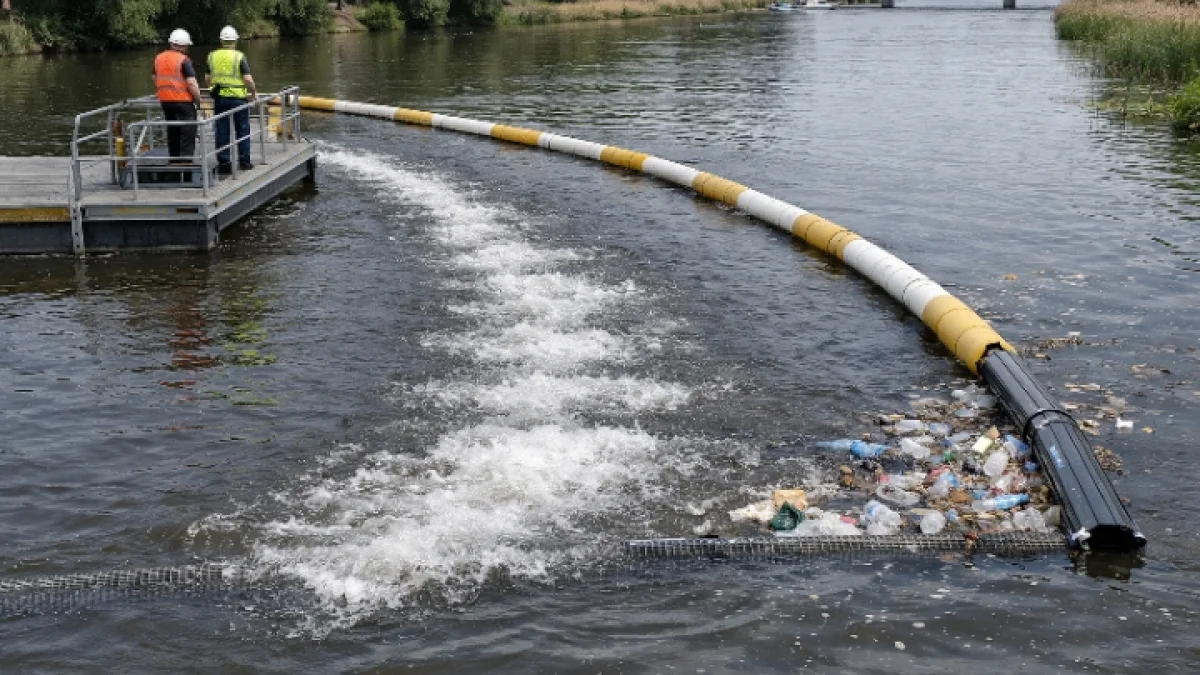
AMSTERDAM — Dutch environmental technology company The Great Bubble Barrier is expanding efforts to intercept plastic waste in rivers before it reaches the ocean, promoting a system that uses a curtain of air bubbles to guide floating debris toward collection points while allowing ships and fish to pass unhindered.
The technology consists of a perforated tube installed diagonally along the bottom of a river or canal. Compressed air pumped through the tube creates a rising curtain of bubbles that lifts plastic debris toward the surface, where the natural current directs it to a catchment system on the riverbank for removal and processing.
According to the Amsterdam-based company, the system can capture about 86% of floating plastic pollution in waterways and is designed to operate continuously without obstructing navigation or fish migration. The company says the technology has been evaluated with universities and independent research institutes, although performance varies depending on local river conditions.
Anne Marieke Eveleens, chief business development officer at The Great Bubble Barrier, told Euronews that rivers are the primary pathway by which plastic reaches the world's oceans and argued that preventing waste from entering marine environments is more effective than relying solely on ocean clean-up efforts. She said plastic production continues to rise while global recycling rates remain low, increasing pressure on waterways.
The company currently operates Bubble Barrier installations in Amsterdam, Katwijk and Harlingen in the Netherlands, as well as near Vila do Conde in Portugal. It said discussions are under way for additional projects in Europe and the United States and identified Southeast Asia as a priority region because several of the world's most polluted rivers are located there.
The Great Bubble Barrier says each installation is tailored to the characteristics of an individual waterway and, where possible, powered by renewable electricity. The collected waste is transferred to local authorities or waste management partners for sorting, monitoring and, where feasible, recycling. Data gathered from the debris are also used to support research and inform policy on plastic pollution, according to the company.
Environmental experts broadly agree that intercepting plastic in rivers can reduce the volume reaching oceans, though they note that river-cleaning technologies complement rather than replace measures aimed at reducing plastic production, improving waste management and increasing recycling.
The company said it is continuing to seek partnerships with governments, water authorities and local communities to deploy additional Bubble Barrier systems in waterways where plastic pollution remains a significant environmental concern.