BEIJING — China has successfully recovered the first-stage booster of an orbital-class rocket for the first time, marking a milestone in its effort to develop reusable launch technology and lower the cost of future space missions.
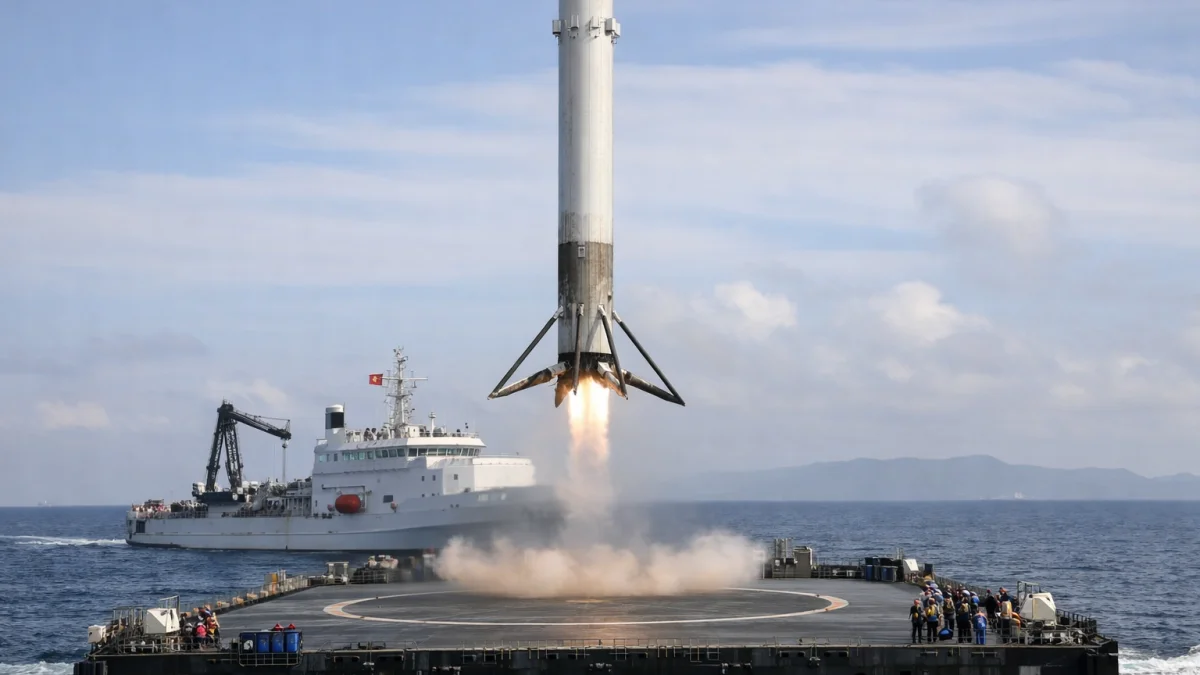
The test was carried out on July 10 when a Long March 10B rocket lifted off from the Hainan commercial space launch site in southern China, according to state broadcaster CCTV and the China Academy of Launch Vehicle Technology (CALT). After completing its role in the launch, the booster separated from the upper stage, performed a controlled powered descent and was recovered on an offshore platform using a sea-based cable-and-net capture system.
The mission marked China's first successful recovery of an orbital-class rocket booster, placing the country among the few nations to demonstrate the capability. Unlike the landing method used by SpaceX, which relies on deployable landing legs and autonomous touchdowns on droneships or land-based pads, the Chinese system captures the descending booster with a specially designed net mounted on a floating recovery platform. Officials say the approach could reduce the weight of the launch vehicle by eliminating landing legs while maintaining recovery capability.
The Long March 10B, developed by CALT, is designed to carry at least 16 metric tons into low-Earth orbit. The rocket forms part of China's broader reusable launch vehicle program and is expected to support commercial satellite deployments as well as future crewed lunar missions planned before 2030.
State media reported that the maiden flight also successfully placed its payload into the intended orbit before the booster executed its return sequence. CCTV said engineers intend to inspect and refurbish the recovered stage, with plans to attempt another flight using the same booster before the end of the year if testing proceeds as scheduled.
China has pursued reusable launch technology for nearly a decade through a series of increasingly complex flight demonstrations. Previous recovery attempts by both state-owned and private launch providers did not complete the final recovery phase, making the latest mission the country's first fully successful orbital-class booster retrieval.
The demonstration comes as governments and commercial launch providers seek reusable rockets to reduce launch costs and increase flight frequency. Recovered first-stage boosters are widely regarded as the most valuable components of orbital launch vehicles, and successful reuse has become a key technology in the global space launch industry. Chinese authorities said further analysis of the recovered booster is underway ahead of the next planned Long March 10B mission.